
The Nocturnists
Season
9
Episode
6
|
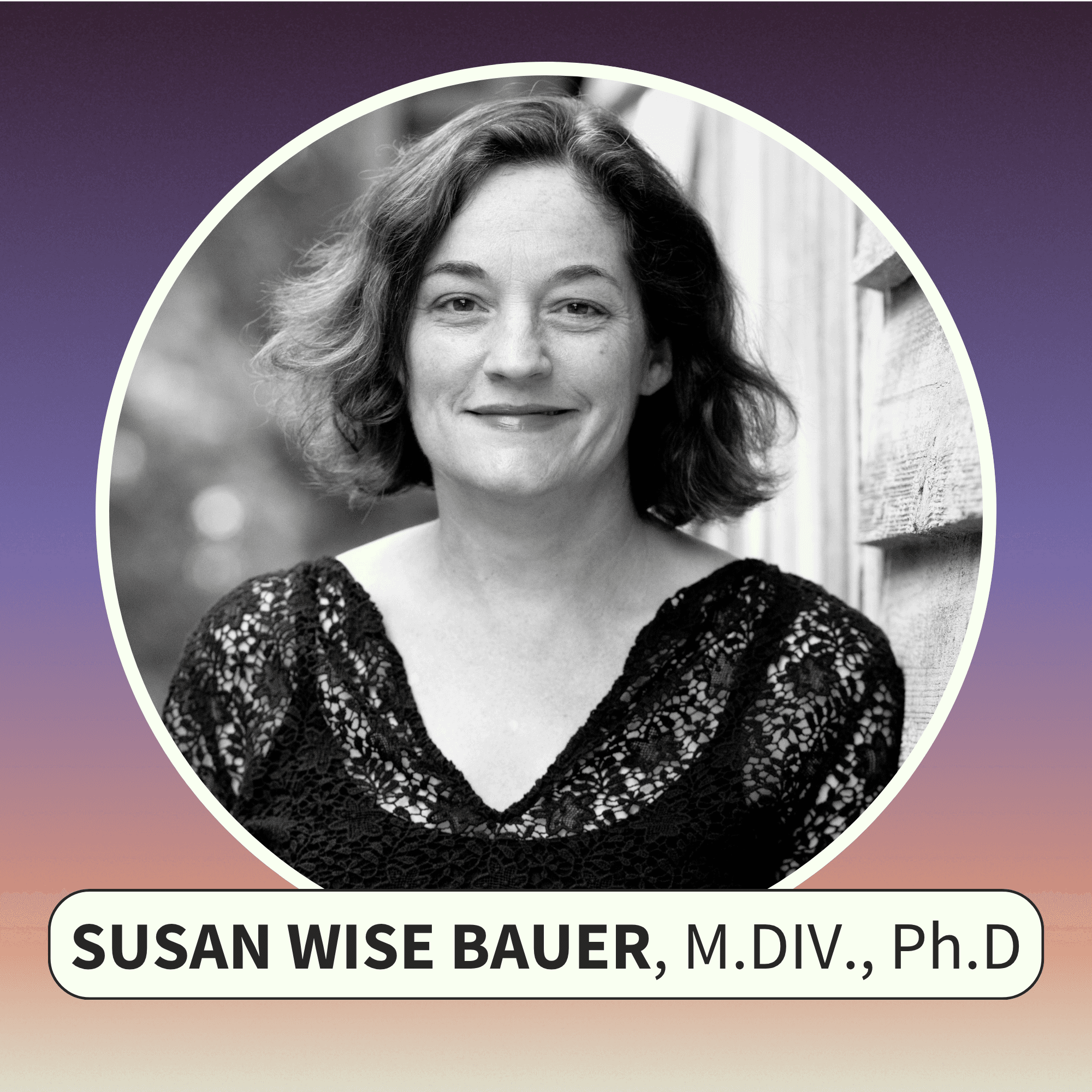
The History of Being Sick with Susan Wise Bauer, M.DIV, PhD
Historian Susan Wise Bauer tells the story of how, across centuries—from ancient civilizations to modern medicine—humans have tried to make sense of illness through evolving frameworks, from divine punishment to bodily imbalance to germs. Drawing on historical accounts and cultural analysis, she explores how fear, suffering, and uncertainty shape not only medical knowledge but also trust in authority and social behaviors—and ultimately shows that our present-day struggles with medicine and trust are not new, but part of a long, repeating human story.
0:00/1:34
The Nocturnists
Season
9
Episode
6
|
The History of Being Sick with Susan Wise Bauer, M.DIV, PhD
Historian Susan Wise Bauer tells the story of how, across centuries—from ancient civilizations to modern medicine—humans have tried to make sense of illness through evolving frameworks, from divine punishment to bodily imbalance to germs. Drawing on historical accounts and cultural analysis, she explores how fear, suffering, and uncertainty shape not only medical knowledge but also trust in authority and social behaviors—and ultimately shows that our present-day struggles with medicine and trust are not new, but part of a long, repeating human story.
0:00/1:34
About Our Guest
Susan Wise Bauer is a historian, writer, and educator. She taught for fifteen years at the College of William & Mary in Virginia and is the author of numerous books, including The Great Shadow (St. Martin’s Press), The Art of the Public Grovel (Princeton University Press); The Well-Trained Mind, The Well-Educated Mind, The Story of Western Science, and the History of the World series (all from W. W. Norton); and the Story of the World Series from Well-Trained Mind Press.
About The Show
The Nocturnists is an award-winning medical storytelling podcast, hosted by physician Emily Silverman. We feature personal stories from frontline clinicians, conversations with healthcare-related authors, and art-makers. Our mission is to humanize healthcare and foster joy, wonder, and curiosity among clinicians and patients alike.
resources
Credits
About Our Guest
Susan Wise Bauer is a historian, writer, and educator. She taught for fifteen years at the College of William & Mary in Virginia and is the author of numerous books, including The Great Shadow (St. Martin’s Press), The Art of the Public Grovel (Princeton University Press); The Well-Trained Mind, The Well-Educated Mind, The Story of Western Science, and the History of the World series (all from W. W. Norton); and the Story of the World Series from Well-Trained Mind Press.
About The Show
The Nocturnists is an award-winning medical storytelling podcast, hosted by physician Emily Silverman. We feature personal stories from frontline clinicians, conversations with healthcare-related authors, and art-makers. Our mission is to humanize healthcare and foster joy, wonder, and curiosity among clinicians and patients alike.
resources
Credits
This episode of The Nocturnists is sponsored by Claimable.
Transcript
Note: The Nocturnists is an audio-first experience with emotion and sound design that can be difficult to fully capture in text. Transcripts are provided to support accessibility and reference, but may contain minor inaccuracies. If quoting in print, please consult the audio when possible.
Emily: This is The Nocturnists, and I'm Emily Silverman. When we get sick, we don't just experience symptoms, we reach for stories, we search for causes, meaning, someone to trust, and someone to blame. Today's guest is Susan Wise Bauer, a historian, writer, and educator, whose work spans world history, science, literature, and culture. Her latest book, The Great Shadow, traces the history of illness across human civilization, asking not only how disease shaped societies, but what it actually felt like to be sick in different eras of history.
In our conversation, Susan and I talk about plague and pandemics, ancient theories of balance, the rise of germ theory, wellness culture, and the long repeating dance between suffering and authority. We also talk about why today's crisis of trust in medicine may be less unprecedented than it seems. I hope you enjoy this conversation as much as I did, but first take a listen to Susan reading an excerpt from one of her books.
Susan Wise Bauer: It's easy to wax lyrical over the beginning of civilization. Civilization, after all, is what divides us from chaos. Civilized cities have walls that separate the orderly streets within from the wild waste outside. Civilization, as archaeologist Stuart Piggott explains in his introduction to Max Mallowan's classic study of ancient Sumer, is the result of a courageous discontent with the status quo. Sporadically, Pigott writes, there have appeared peoples to whom innovation and change, rather than adherence to tradition, gave satisfaction and release. These innovating societies are those which we can class as the founders of civilization. Actually, civilization appears to be the result of a more elemental urge: making sure that no one seizes too much food or water.
Civilization began in the Fertile Crescent, not because it was an edenic place overflowing with natural resources, but because it was so hostile to settlement that a village of any size needed careful management to survive. Farmers had to cooperate in order to construct the canals and reservoirs needed to capture flood waters. Someone needed to enforce that cooperation and oversee the fair division of the limited water. Someone had to make sure that farmers who grew more grain than their families needed would sell food to the non-farmers, the basket makers, leather workers, and carpenters who grew no grain themselves.
Only in an hidden, hospitable, and wild place is this sort of bureaucracy the true earmark of civilization needed. In genuinely fertile places overflowing with water and food and to game and minerals and timber people generally don't bother. In the Fertile Crescent, as villages grew into cities, more people had to sustain themselves on the same amount of dry land. Strong leadership became more necessary than ever. Human nature being what it is, city leaders needed some means of coercion, armed men who policed their decrees. The leaders had become kings.
[theme music]
Emily: I am sitting here with Susan Wise Bauer. Susan, thank you so much for coming on the show.
Susan: Thank you.
Emily: So, you have written many books. The one that we're focusing on today is a sweeping history of, I guess, illness and disease, and how that interfaces with society and culture and politics. I don't know. How would you describe it or summarize it?
Susan: I describe it as a history of being sick. There are a lot of histories of medicine out there, and there are a lot of histories of disease out there. I aimed to do something slightly different, which was delve into what it actually felt like to be sick from ancient times up to the present, and how that changes the way we interact with the world around us,
Emily: How did you get the idea for this?
Susan: Well, it really came from my work as a historian. I've written a three volume narrative world history that covers ancient times, medieval renaissance, and I'm continuing on to do modern times. The thing about a big picture history is that you tell a big story, and as you're telling the big story, I was just amazed how many deaths went by unremarked on.
Of course, lots of people die in the past, but what I really found striking was the things that they died from that nobody was really remarking on. People die of splinters, people die of
sore throats. So many women die either during pregnancy or during childbirth or just after childbirth. People die of things that you would not imagine could actually kill you. People die of anal fistulas, and these things are just noted, matter of fact.
As I was working through history, and I kept running across these descriptions of, well, they weren't descriptions, they were just statements of people dying, I just had to think, yes, but what did that feel like? How does it change the way you interact with the world, with your children, with what you do every day if you wake up with a sore throat and you know you could be dead by nightfall? That has to make a difference, and that was something that I didn't really see addressed in the histories of medicine, or in the histories of disease. I really wanted to tap into that experience,
Emily: You do in the book. It's written in a very lyrical way, and it's written sometimes even in the first person, like you're imagining your way into the mind of a person dying of, I guess, just any old virus, whatever it was. Did you read primary sources, and then based on that, put together what you imagined it felt like, or how did you get inside the
experience of these people living in the 500s or whatever year, what it was like for them?
Susan: Yes, so in order to do this kind of history, you do have to take a little bit of creative license. It's a little bit like what I did at the beginning of The History of the Ancient World, when I'm describing why civilization arose where and when it did, you have to think back a bit. Put yourself at the place, and say, okay, what are the motivations here? Not the story that we've always been told, the traditional story, but what are the actual motivations, and it turns out that a lot of history has its origins in our fears and in our pain and suffering.
Depending on the era that I was working with, for ancient times, I actually spent a lot of time looking at myths and legends, because the best accounts that we have of what it felt like to be sick and die are in things like The Epic of Gilgamesh, that describes the death of Gilgamesh's great companion, and how it felt, and what their fears were, and why they thought he was sick. As you get up into the Middle Ages and after that, I did have access to a lot more first person accounts, and then also physician accounts, so I had to sort of balance those two side by side, because very often what the physicians are describing and what the sick person is recording seem like very, very different things, but I was able to make significant use of those. Then as you move on into the 17th, 18th, and 19th century, and later, there are tremendous numbers of journals where people record the experience of being sick.
Emily: In addition to the first person experience, you talk a lot about how the particular illnesses that emerge, the belief systems, whether they're religious or scientific, or somewhere in between, that then emerge to try to address those illnesses, that the illness feeds into the culture, and the culture feeds back into the illness, and there's almost like this dialog between illness and society that shape each other, and you take us through chapter by chapter. What was it like to be looking at history through that lens? Because it's a very specific lens.
Susan: Yes. You have to continually push away the things that aren't really relevant. Of course, it's relevant what the doctor says when he shows up to treat you, but to be honest, what's less relevant is what the medical schools were teaching at the time. Of course, that affects the experience of sickness because it's filtered through the doctor, but the really important nexus is between the person who's sick and the person who's treating them, what they tell the person who's sick, and whether or not the sick person trusts that report.
From ancient times all the way up until the present, there is this ongoing relationship between the person saying, I am sick, and here's what I feel, and the physician or priest or whoever it is that shows up to treat them, saying, well, yes, but here's what's really going on, and whether or not the sick person decides to trust and accept that. There's this whole interplay of personal experience against authority that I think a lot of work has been done recently on the ways in which female self-reporting is often dismissed by physicians as not reliable or not meaningful, and that's a dynamic that we see going back to very ancient times. Just tracing that dynamic told me a lot about not only what it was like to be sick, but how we looked at authority and what weight we gave to it, and when.
Emily: Our team is working on a new podcast series on the theme of trust in medicine. We're still in the early stages of research and thinking about this topic, and reading your book actually gave me some comfort, strangely. Because we were just talking at one of our meetings about how sometimes it feels like trust is deteriorating in 2026 and everything we knew is dissolving in the wind, and we're polarized, and authority is suspect, and all of these things, and it feels like a crisis, and in some ways it is a crisis, but in some ways, it's actually nothing new.
I was wondering if you could reflect a bit on what you were saying about illness, the authorities that arise to make sense of illness, whether it's religious or scientific, and then the way that individual people, but also populations then react and respond to that authority. What are some of the most striking episodes of mistrust or distrust that have come up across time?
Susan: Yes. Oh, this is such a big question. Let me see if I can narrow it down just a tiny bit. I will say that, as someone who, I write world history, I love to look across
countries and across time frames to see what stays the same and what is different, and I will say that the ways in which we react to sickness and to authority that stay the same are so much vaster than the ways in which it's different.
When you look at, for example, how a sufferer in ancient Greece might have treated the person who was supposed to be easing their pain, they would go to a temple and they would pay an offering, and they would sit in an antechamber, and then the acolytes would lead them into the presence of the physician, and then they would pay over their offering,
and the physician would consult the oracle, and then give them an explanation and a diagnosis, and a prescription. What do you do next? I think you just think about how that has survived right up until today.
You go into the doctor's office, you hand over your insurance card, you are kept outside in an antechamber until the white-clad nurse or pink clad, or whatever they're wearing, comes to escort you back into the presence, and then you have to sit a little bit longer, and then the physician shows up and does exactly the same steps. While the body of knowledge
behind what the physician did then and what physicians do now is hugely different, it is startling to me how little the process has changed.
One of the reasons why I wanted to read that excerpt at the beginning from The History of the Ancient World, which is not even the book that we're talking about, is that, to me, it illustrates the sameness in our responses. We want to be protected, we are willing to give over power to someone who is going to protect us, we are willing to accept the presence of armed men. That that excerpt describes life in 6000 BC, and so little has changed. Like you, I do find that comforting in a way. Because I do history, I am often asked, are we at the worst time that we have ever been, and I'm always like no. [chuckles]
Emily: The Black Death in Europe was pretty bad. [chuckles]
Susan: That was pretty bad. I'd rather be living now than in London during the Blitz, you know. We don't even have to go back to the Black Death, but there
were times that are so much worse, and you know, history is a series of pendulum swings where we have less confidence in medical authority, and then more confidence in medical authority, and then less confidence in medical authority, and it will swing back, we can be sure of that. What we can't know is how long the pendulum swing is going to be.
I mean, I do agree with you that we are in a time when we are trusting medical science much less than we used to as a society, but you have to remember that this grows out of the triumphal '50s and '60s, when absolutely any medical problem could be solved with the brand new antibiotics or the brand new surgical techniques. Part of what we're seeing here is that natural pendulum swing that always happens in human history.
Emily: Let's go back in time a bit, because I think the older stuff is really fun.
Susan: Me too.
Emily: Talk about how the formation of cities, human beings evolving away from being scattered groups of agricultural communities into these centralized cities, where people are living in close quarters, and they're organizing themselves, and of course, in that context, we're getting more diseases, and people are then having to then to then explain what are these diseases and where are they coming from. Talk about that transition.
Susan: Yes. When we moved away from nomadic lifestyles into villages, there were actually three things that happened. The first was that we started to eat a lot more grain and less greens because we could now store grain, and one of the things that did is it pitted our teeth, which had not evolved to deal with hard abrasive substances that we were now chewing, and because our teeth got pitted, we lost them earlier, and then once you've lost your teeth, your nutrition goes down, and you become much more susceptible to all sorts of illnesses.
The second thing about actually, this is also related to grain, is once we started growing and storing grain and settling in one place with that grain, we invited animals into our domestic lives. I'm not just talking about cows and pigs, which actually are major vectors for germs moving from, I'm just going to use germs generically, moving from their animal hosts into humans, but also rodents. Because as long as you're moving, you don't really have rats and sparrows getting after your grain, but as soon as you start storing it, you've got all of these other small rodents moving in, and once again, those become vectors for new diseases, but then the biggest factor is simply density of population.
Ancient people got sick and ancient people died, but before we settled in villages, we didn't really spread disease from one person to the next, because we didn't really have the density that is necessary for an epidemic to occur. The bigger the cities get, the more of a threat epidemic illness is, and the more puzzled we are because we don't know why someone is getting sick. Depending on how the illness spreads, it could spread to someone in the same household, or it could spread to somebody on the other side of the village, just depending on how that disease is transmitted.
There is so little understanding, of course, of why that happens that we really see this huge explosion in religious devotion of people saying, I must have made something mad. I don't know if it was a god or if it was a demon, but something is clearly taking revenge on me. Then you get this whole next dimension, which is I've got to atone for that. I've got to be better. I have to be holier, otherwise I wouldn't be sick.
Emily: So this idea comes forward that sickness or illness is punishment for sin.
Susan: Also still with us. [chuckles]
Emily: Right, which is still with us in some ways. How did people respond to that? When they got sick, did they did they go pray? How did they try to fix
themselves?
Susan: Well, the earliest reports we have of what people did to recover from illness is that they call a medicine man, a priest, someone who has a connection with the divine that they don't have. As we move up towards what I guess I would call more recent ancient times, like the Greece, you would actually go to a special edifice that was made for sick people to go to in order to consult with the priest and follow their recommendations. We do see this centering of many religious rituals around the need to get better, around the need. To free ourselves from sickness,
Emily: Then we come up to ancient Greece, and our thinking changes, or I guess you could say develops, or matures somewhat, where it's no longer punishment from the divine, but there's this alternative system, which is the four humors system at the time, you say in the book that Greek society was very preoccupied with things like balance and harmony and symmetry and things like that, and so it makes sense that this four humors explanation system would emerge from that society. Tell us a bit about that time.
Susan: Yes, I mean, it's quite a complicated evolution of how we think about our bodies, but I think it's important to identify that time, so we're talking about Hippocrates, 4th, 5th century BC, as a time when we go through one of what is really three major shifts in how we think about illness, and the shift is from this is obviously caused by the divine, to this is caused by something natural, not something supernatural.
This is where we see the first really big chasm between what we now think of very easily as natural and supernatural being two different realms that didn't really exist so much until the Hippocratic era. Hippocrates' first really influential study was on epilepsy, which had always been called the sacred disease, because it was assumed that people who suffered from it had been touched by a god and actually had special powers of foresight. Really his most famous and most widely read teaching was called On the Sacred Disease, and its whole point was to say there is no such thing.
Hippocrates says, "I think people who call this disease sacred are just too lazy to go out and look for the actual physical reasons why this happens." The Hippocratic philosophy said that there are four humors or fluids in the body, and each one of them has to stay in correct balance, and they are affected by what he called airs and waters, which is essentially your surroundings, everything around you, and then what you eat and drink. His theory was that you could fix any illness by figuring out what was out of balance, either in your surroundings or in your food and your drink, and adjusting that.
If you had an illness that could be identified as an excess of color or an excess of red blood, then you needed to stop eating meat, and you needed to start eating cucumbers, and boiled puppies was a big recommendation for those.
Emily: [chuckles] I know, right?
Susan: A lot of the recommendations are heartbreaking. If, on the other hand, your illness was something that was caused by an excess of what they called phlegm, then you needed to reduce the cold elements around you. If you were in a place that was very windy, you needed to go somewhere still. If you were near the water, you needed to get away from the water. You needed to eat fewer cucumbers and lettuces, and you needed to have more red wine and more meat. This was a way of looking at disease that lasted for 2000 years. We are still the heirs of it.
We still call a cold a cold, as opposed to a virus, because the Hippocratic theory was that that was caused by an excess of cold ingredients. The reason for the hoary advice of feed a cold and starve a fever is because in response to a cold imbalance, you were supposed to eat more red meat and more red wine, and if you had a fever, then that was a hot disease, and you needed to do the opposite. These things made their way into our language, and anyone who has read 19th century novels, has absorbed this. People are always going away to the country in order to recover because they needed to change their winds, they needed to change their surroundings, and they're being fed calf's foot jelly, which I have had, by the way, and it's not good, because that was a way of rebalancing the fluids, and we still carry that with us.
Emily: Then, what happened with Galen? So, Galen, he wasn't ancient Greece, right? He was ancient Rome. How was he different?
Susan: Well, not very different at all. You have to think of Hippocrates a little bit-- Okay, I don't mean this to be blasphemous, but Hippocrates is a little bit like Jesus, and Galen is a little bit like Paul, in that Hippocrates himself did not write, his disciples gathered his sayings and put them together, and then what Galen did was he took all of those collections of Hippocratic sayings, and he sort of rationalized them, he assembled them, he put them together into volumes. Most of what we think of now as Hippocratic medicine actually came by way of Galen, because he was the one who set it down in writing, and gave it immortality, essentially.
Emily: In this new non-supernatural, more natural belief system, did people stop blaming themselves or stop worrying as much about angering the gods in sin, or was that belief system also still alive and well, and they were more layered on top of each other?
Susan: The really fascinating thing about the history of sickness is that we never abandon any of the old ways of thinking about sickness, we just add other ways of thinking to them. All you have to do is look at responses to the COVID phenomenon, and you will see how many people and how many organized groups went straight back to this is either God's judgment or this is something that God controls. It was as though the intervening 2000 plus years had never even happened. We don't let go of these ideas. We hold them side by side, even if they are contradictory.
In terms of blaming yourself from getting sick, it's a pretty straight line from the ancient demons did it because I am bad, to, well, I'm sick because my diet is out of balance, and it's out of balance because I'm undisciplined. In Hippocratic and Galenic medicine, there's a huge emphasis on responsible living, on making sure that you don't overindulge, on getting the right exercise at the right times, on surrounding yourself with the best possible surroundings so that you don't get sick.
There's still blame attached to getting sick, it's just it's a blame that has, I think of it as having more to do with sort of contemporary wellness culture, which again is really just a return of Hippocratic medicine storming back into the present. If your nutrition is good, and if you don't smoke, and you don't drink too much, and I'm not saying that those aren't good things, but the entire responsibility for illness still lands on the person.
I don't want to jump ahead too much, but one of the really fascinating parts of medicine to me is the extent to which really thoughtful and dedicated medical people like Florence Nightingale thought that germ theory was the worst thing that had ever happened. Because if germs made you sick, then you don't bear any personal responsibility for it. If germs make you sick, and Nightingale actually says this in her writings, if germs make you sick, where is the motivation to have a clean lifestyle? Where is the motivation to eat well? Where is the motivation to exercise, and to clean up your house, and to not leave trash all around? If you say that germs cause sickness, you're removing one of the biggest motivations for people to be good.
That's in the 19th century, so it's just amazing to me the strength that that philosophy still has, even in the face of evidence that, you know, nutrition is important, clean living is a good thing, but that isn't necessarily what makes people sick.
[theme music]
Emily: You said the four humors idea lasted hundreds if not thousands of years, and then we were joking about the Black Death or the plague, but it really wasn't a joke. It killed, I think, a third of Europe, is the statistics. Tell us about that, and how that changed the way that people think about sickness.
Susan: The problem with the Black-- well, I mean, obviously the problem with the Black Death was that so many people died, but in terms of an interpretive framework, the problem with the Black Death is, it didn't make any sense. It didn't make sense in Hippocratic terms, it didn't make sense in terms of ancient religion. People were mounting these huge penitential parades to show God how sorry they were, and to beg for mercy, during which people would just drop dead during the penitential parade, so that wasn't helping. People were moving away, adjusting their diets, doing everything that a Hippocratic physician would have recommended, and they still died, and it just, it made a mockery of every single explanation.
Emily: There was the initial wave, but then it kept coming back. I don't know, every few years, every few decades?
Susan: Every few decades, yes.
Emily: You have these images of people with the beaked mask. It's so eerie. What was the beaked mask? Was that the person coming to collect the dead body?
Susan: No, that was the physician.
Emily: Okay.
Susan: That was an exercise of Hippocratic theory that there were bad airs surrounding this person, and so the beak was actually stuffed with herbs and flowers, so that that would filter out the bad airs. There was definitely a growing understanding that coming into contact with somebody who was sick could make you sick. The problem, again, with the Black Death is that in most cases, it isn't actually a person to person transmission. In the case of pneumonic bubonic plague, it is, but that was definitely the minority of cases. It's carried by fleas, which we now know. Whether or not you got sick after seeing a sick person had less to do with whether you were breathing in their breath than whether a flea jumped on you from their environment, and that, of course, was just something that was invisible to people at the time.
There's this really interesting, there's kind of a long evolution towards the idea of contagion, that you can actually catch an illness from someone else, and the Black Death kind of begins it, because if you lived in the household with somebody who got sick, you were more likely to get sick, and so a theory arose, which was still a Hippocratic theory, but a little bit of a wrinkle, which was that miasma or unhealthy airs were the reason, and if you could get away from the unhealthy airs, or you could filter them out, you were less likely to get sick.
We do see, during the Black Death, the sort of the beginning of the progression towards accepting the idea that illnesses are person to person contagious, which is something that then in turn paves the way for germ theory, but it is very undeveloped at this point.
Emily: You said that it made a mockery of their existing interpretive frameworks, so they were doing everything they could to please the gods, that wasn't working. They were doing all the Hippocratic dietary things, that wasn't working, and so they were grasping for other explanations, and this idea of poison came up as an explanation, which then led to the scapegoating of the Jewish population in Europe, which is an impulse, a human impulse that has repeated, as you said, these behaviors, and they repeat across time, different minorities being scapegoated for diseases. Tell us a little bit of that piece of this history, that way of humans interpreting where disease comes from.
Susan: Yes, so the idea of miasma was probably that they were unhealthy airs, was probably the most believable for people of the time, because it lined up with most of the cases of what we would now call contagion, that they saw. The problem with miasma is that nobody could figure out where these bad airs came from. There was actually sponsored by the Pope at the time. There was a scholarly theory that there had been a conjunction of the planets that beamed the evil miasmas down to earth, because the other
question there was, well, we've been living in this same place for centuries, and this is the first time this has ever happened, so, what changed?
There was that theory, there was a theory that there were underground earthquakes, and that had released some poison from the ground, but the most unfortunately powerful version of this theory was that the miasma was caused by Jews who had vials of poison, which they would either put in wells or else break into the air, and the reasoning behind this was that more Christians than Jews died, which is because there were more Christians than Jews in each one of these cities where the Black Death was so prevalent, but finding a scapegoat for something that we don't understand is, again, one of those human impulses.
We saw it during COVID. We still see-- I actually just had to remove a bunch of posts from my own Facebook page when I was writing about germs on this. There's still the theory that we can blame it on the Chinese. There is also, with COVID, a theory that the Jews were somehow responsible. Normally, George Serros comes up in reference to this, but finding someone to blame for a phenomenon that we don't understand, again, human impulse that has never gone away. Only the names are different, and not even the names sometimes.
Emily: You said Irish people have been blamed for cholera, and of course the HIV AIDS epidemic blamed on gay men, so we see this a lot repeating over time, and I think just speaks to, yes, our need to grasp for explanation when something's happening that we don't understand.
Susan: Well, and HIV also attributed to Africans. Its African origin pointed out as threatening.
Emily: Right. Well, let's skip ahead to the Renaissance, just skipping from era to era here, because we don't have much time, but I do want to talk about this time of Copernicus and Galileo, and how we're rethinking the cosmos. For a long time, we thought the earth was the center of the universe. Now we're having this competing theory that the sun is the center of the universe. This is also a time of great scientific advancement. People are starting to dissect bodies and map out anatomy in a way that had never been done before.
Tell us about this era, and in the same way that ancient Greece was about balance and harmony in the humors, This era was more about structures and mechanisms and complex machines and things like that, and how that influenced the way we think about the body and illness.
Susan: Yes. I mean, the history of dissection is a whole other topic, and some great books have been written on that. This one treats the rise of dissection more to say, for the first time, we can look at the body as a machine in the same way that we look at the solar system as a machine, something that works under certain rules, in the same way, the same way that we begin to look at the universe as a machine. What this time really does is it lays the groundwork for what is going to become the second great revolution in the way we think about getting sick, which is that we are going to begin, eventually, to think of sickness as something that exists apart from us, something with its own independent existence.
During the Hippocratic era, if you got sick, whatever your symptoms were, physicians treated them in the same way. That is, you could have what we would now think of as Scarlet fever, you could have measles, you could have chicken pox, whatever it was. If you had a fever and you had a rash, the doctors would treat those symptoms in the same way. There was no sense that there was an external thing, what we now think of as a disease, that was outside of us and then came in and entered us, and that's what caused us to be sick.
Doctors had no sense during the Hippocratic era of diseases as such. All they had was the individual body in front of them, so you could have any number of symptoms and be diagnosed with an excess of red wine and meat. You could have any number of symptoms and be diagnosed with you need to go to the water side and breathe in country airs, or whatever. It was all about you, your body, and how your body interacted with the environment. What this time during the Renaissance did was give us a sense that the
body works in a particular way, and if something disarranges it, that could be something from the outside.
For the first time, we start to get a sense of what we would now say, you throw a spanner in the works. This worked fine until something from the outside came in and disarranged it. What this time did was give us the sense of the body as something mechanical, something that works properly until it meets a challenge, and that allowed us eventually to begin to think of disease as something that exists outside of us, interacts with us, but exists outside of us, has an independent existence.
Until that understanding was in place, we weren't ready to talk about germs, we weren't ready to accept the reality of germs, and in fact, when germs were first identified and given names, there was a lot of resistance to these little beasties, as one Scottish physician called them, the idea that those would make us sick, but what Copernicus and Galileo and Newton did for us was give us at least the framework where we could accept that a disease could exist apart from us and that it could then enter our mechanism and disarrange it.
Emily: It's funny that you say little beasties, because I have a four year old daughter and she got sick. She got a cold, and we were trying to explain to her, what does it mean to get sick? What's actually happening in your body? My husband started explaining it to her first, and he opens by saying, well, you're sick because there's these little bugs and the bugs, and I was like, no, no, stop.
[laughter]
Susan: That's too creepy. She's never going to sleep again. [chuckles]
Emily: Exactly. I was like, we can talk about viruses and bacteria, but if you say that there's like little bugs that are getting inside of you and making you sick, it just-- it gave me anxiety, and I didn't want to give her anxiety, and you write in the book about how, when germ theory first came to be, it did produce this feeling of anxiety and dread among people who didn't want to imagine that there was this secret microscopic world where bugs were living on them and, you know, making them sick. Talk a little bit about germ theory, less, you know, less the discoveries, but more the response to those discoveries.
Susan: Yes, and that is really the second great innovation in how we think about being sick. We move from the gods and demons did it, to imbalance, and then we move from imbalance to germs. I actually find this one of the most fascinating parts of human history, and one of the eras that most closely sticks to us as we respond to sickness is that there's this period between the like the 1860s and about 1940, because antibiotics start to go into more common use just after World War II, where we slowly begin to accept the reality of germs and their role in making us sick.
We knew germs were out there, we knew they made us sick, we knew that sometimes they killed us. What we didn't know was, first of all, really how they were spread. There was some knowledge, and you can trace the history of this if you want to do a history of germ theory. There was some recognition that, for example, cholera was spread through
bad water. There was some really groundbreaking work done on that, but for the most part, nobody really knew where germs came from. One of the most prevalent theories was that they lived in dust.
Here we see the beginning of domestic science, which was it was the responsibility of the mother of the household to keep her children safe by dusting, eliminating dust, getting rid of those heavy Victorian carpets and curtains that just held dust, having the nursery be as clean and sparkling as possible. They're these wonderful public service like cartoons, and
eventually little animations of people walking happily along the streets of New York, and then suddenly just being surrounded by a cloud that was filled with germs, and coming out the other side sick.
We developed this immense fear towards our environment, and it's not the same fear as the Hippocratic fear, which is the miasma is bad, or that particular wind is bad for my
particular kind of body. It's this fear that we are surrounded at all times by an enemy that we cannot see and cannot fight against, and so we have this about this 80 year period where we are totally on the defensive. We are surrounding ourselves with every weapon that we can think of to fight the germs off, because once they get us, then there's nothing we can do about it.
We have this massive
development in what is first cellophane and then plastic wrap to put around anything that we touch, food most definitely, but also just shirts and and household items. We have this massive uptick in buying household products, bleaches, detergents, room fresheners, because it was thought that good smells, this was a carryover from Hippocrates, good smells could keep the germs away. We have this immense fear of other people, That we can't touch other people because they might have germs and in some way they would spread to us, and certainly a fear of people whose bodies are unlike our own.
It's a time of great xenophobia when we are terrified of people of other races, and in the United States, the horrible custom of having separate bathrooms for Blacks and whites and separate water fountains for Blacks and whites was, of course, an expression of hatred for the other, but it was also largely based in this idea that African bodies had germs that white bodies couldn't necessarily fight off, and so we had to avoid sharing spaces with them. Totally inconsistent, as most white families had people of color as nannies and servants, but just so many things that we now look at and say, oh well, that was just old fashioned, actually grew out of this time when we knew there were germs, we knew they made us sick, and there wasn't anything we could do about it once we got sick, so we had to protect ourselves.
Emily: You mentioned earlier that there was a period of time, I think you said it was the '80s and '90s, maybe, where there was almost like a euphoric, we won the war, we developed antibiotics, there was military metaphors started to emerge, and there was a time of great cultural optimism, which now is giving way to a more complicated feeling. Obviously, there's antibiotic resistance now that we're worrying about, and things like that. I was wondering, if, as we come to a close, you could talk about, having written this book, and seeing everything that we're dealing with today, of course, we had COVID, but now, having this, I guess, new crisis of trust in medicine, and just different relationships to science and scientific information. Having written this book, and having this grand sweeping historical perspective, how are you seeing this moment, and what are you thinking about these days with illness?
Susan: I mean, there are a couple of things that I would like to see happen, whether they will or not. I don't know. I would like to see the medical establishment, whatever you take that to be, we could talk about that, but let me just say, doctors. I would like to see doctors and people who are responsible for speaking for doctors be a little less arrogantly sure of themselves. Because I think a lot of what we see with the current pushback against medical expertise, and in that I would include RFK Jr, he's pushing back against medical expertise in a way that I find intellectually dishonest, but also in a way that many, many people find sympathetic, and feeds into their own suspicion that they're not getting the whole story.
I think that COVID lent itself to this suspicion of medical authority, because, and look, we were all doing the best we could, we were all grappling with an unknown, but there were a lot of very dogmatic pronouncements from the CDC here in the US, for example, that then had to be walked back. Well, actually, that wasn't true, even though we said it with such assurance. One of the ways physicians could begin to help reverse this is to be a little bit more honest.
Instead of just saying, for example, this vaccine is 100% safe, perhaps they should say a little more clearly, there are some risks, they are very small, and here's what we're comparing it to, the risk of actually getting this illness Instead. That parents in, if we just stick with vaccines for a minute, parents' fears have really been dismissed by the academic and medical establishment, in the same way, to be honest, that women's, as we return to something we said earlier, women's self-reports of their experience have been dismissed.
Because a woman self-reports, the doctor says, "Well, I don't see that on your lab reports, so obviously it's not true," so some humility, some listening, and some acknowledging that physicians don't know everything I think would go a long way towards beginning to right that, which has definitely gotten very out of balance.
I think that the other thing I would like to see happen is, and I think it will happen, is I'd like to see a wider recognition of the fact that people who are pushing alternative therapies, and I'm going to just like finger the entire wellness culture right now, are selling something. They are saying, here is a way in which you can be better. Much wellness culture is a return to Hippocratic theory. It is get your vitamins in balance, get your nutrition in balance, get your exercise in balance, and you won't need any of these medicines. It's very seductive, because we've seen the ways in which drugs have failed us.
The emergence of drug-resistant viruses has done a lot to dent our faith in drugs, but I think over time, the grift in wellness culture is going to become clearer to people, and we're going to see that pendulum swing go back in the other direction.
Emily: That's very interesting. Yes, I did watch a debate where they were talking about big pharma and big wellness, and how people have a lot of suspicion toward big pharma, and yet there's this big multi million dollar big wellness industry, and there just isn't as much suspicion of it, in part yet, in part because it's oriented against the so-called institutions, but I think you're right, this is always changing, always evolving, and things are going to catch up and change, and we'll have to see what happens.
Susan: Yes. I think one of the things I really appreciated about doing this book was seeing the pendulum go back and forth and back and forth and back and forth, which just gives you a little bit of perspective on what the next thing is going to be, and it's going to be a swing back in the other direction.
Emily: What are you working on next? Do you have a new book project?
Susan: I always have a new book project. [chuckles]
Emily: Sounds fun.
Susan: Yes. Yes, I've got a couple of different things that I'm working on right now. I actually would like to do some more work on wellness culture, but I don't feel like it's quite time for that yet. We're still so in the middle of the explosion post COVID that I think a few more years of seeing what happens is going to bring a lot more clarity, but that's definitely something I'm interested in doing. I mentioned, my Narrative World History series, which I've done ancient, medieval, and Renaissance times. I'm working on what
will probably be a two-volume conclusion. I would love to bring that up to the present and finish that. Then I've got a novel with my agent that is, I hope, going to find a home soon.
Emily: Oh my goodness, well, you're busy wearing all the different hats, and it sounds like a lot of fun to be reading and studying and making work, so I will definitely be keeping an eye on those forthcoming projects. Just wanted to say, thank you so much for coming on The Nocturnists podcast and talking to us about your book. I learned a lot, and I think there will be a lot of overlap with trust, so we may have to speak again at some point.
Susan: I really hope that we do. This has been lovely. Thank you.
[theme music]
Emily: This episode of The Nocturnists was produced by me and producer and head of story development Molly Rose-Williams. Our executive producer is Ali Block, and Ashley Pettit is our program director. Original theme music was composed by Yosef Munro, with additional music from Blue Dot Sessions. The Nocturnists is made possible by listeners like you. If you enjoy what you hear and you want to support our work, consider subscribing to The Nocturnists Plus. You'll get access to The Nocturnists after hours, our monthly bonus series featuring original conversations from our team, along with merch discounts and a full archive of episodes all in one place. Subscriptions start at just $10 a month. Learn more at The Nocturnists.org/plus or through the link in the description. Thank you for listening and being part of this community. Until next time, I'm your host Emily Silverman.
Transcript
Note: The Nocturnists is an audio-first experience with emotion and sound design that can be difficult to fully capture in text. Transcripts are provided to support accessibility and reference, but may contain minor inaccuracies. If quoting in print, please consult the audio when possible.
Emily: This is The Nocturnists, and I'm Emily Silverman. When we get sick, we don't just experience symptoms, we reach for stories, we search for causes, meaning, someone to trust, and someone to blame. Today's guest is Susan Wise Bauer, a historian, writer, and educator, whose work spans world history, science, literature, and culture. Her latest book, The Great Shadow, traces the history of illness across human civilization, asking not only how disease shaped societies, but what it actually felt like to be sick in different eras of history.
In our conversation, Susan and I talk about plague and pandemics, ancient theories of balance, the rise of germ theory, wellness culture, and the long repeating dance between suffering and authority. We also talk about why today's crisis of trust in medicine may be less unprecedented than it seems. I hope you enjoy this conversation as much as I did, but first take a listen to Susan reading an excerpt from one of her books.
Susan Wise Bauer: It's easy to wax lyrical over the beginning of civilization. Civilization, after all, is what divides us from chaos. Civilized cities have walls that separate the orderly streets within from the wild waste outside. Civilization, as archaeologist Stuart Piggott explains in his introduction to Max Mallowan's classic study of ancient Sumer, is the result of a courageous discontent with the status quo. Sporadically, Pigott writes, there have appeared peoples to whom innovation and change, rather than adherence to tradition, gave satisfaction and release. These innovating societies are those which we can class as the founders of civilization. Actually, civilization appears to be the result of a more elemental urge: making sure that no one seizes too much food or water.
Civilization began in the Fertile Crescent, not because it was an edenic place overflowing with natural resources, but because it was so hostile to settlement that a village of any size needed careful management to survive. Farmers had to cooperate in order to construct the canals and reservoirs needed to capture flood waters. Someone needed to enforce that cooperation and oversee the fair division of the limited water. Someone had to make sure that farmers who grew more grain than their families needed would sell food to the non-farmers, the basket makers, leather workers, and carpenters who grew no grain themselves.
Only in an hidden, hospitable, and wild place is this sort of bureaucracy the true earmark of civilization needed. In genuinely fertile places overflowing with water and food and to game and minerals and timber people generally don't bother. In the Fertile Crescent, as villages grew into cities, more people had to sustain themselves on the same amount of dry land. Strong leadership became more necessary than ever. Human nature being what it is, city leaders needed some means of coercion, armed men who policed their decrees. The leaders had become kings.
[theme music]
Emily: I am sitting here with Susan Wise Bauer. Susan, thank you so much for coming on the show.
Susan: Thank you.
Emily: So, you have written many books. The one that we're focusing on today is a sweeping history of, I guess, illness and disease, and how that interfaces with society and culture and politics. I don't know. How would you describe it or summarize it?
Susan: I describe it as a history of being sick. There are a lot of histories of medicine out there, and there are a lot of histories of disease out there. I aimed to do something slightly different, which was delve into what it actually felt like to be sick from ancient times up to the present, and how that changes the way we interact with the world around us,
Emily: How did you get the idea for this?
Susan: Well, it really came from my work as a historian. I've written a three volume narrative world history that covers ancient times, medieval renaissance, and I'm continuing on to do modern times. The thing about a big picture history is that you tell a big story, and as you're telling the big story, I was just amazed how many deaths went by unremarked on.
Of course, lots of people die in the past, but what I really found striking was the things that they died from that nobody was really remarking on. People die of splinters, people die of
sore throats. So many women die either during pregnancy or during childbirth or just after childbirth. People die of things that you would not imagine could actually kill you. People die of anal fistulas, and these things are just noted, matter of fact.
As I was working through history, and I kept running across these descriptions of, well, they weren't descriptions, they were just statements of people dying, I just had to think, yes, but what did that feel like? How does it change the way you interact with the world, with your children, with what you do every day if you wake up with a sore throat and you know you could be dead by nightfall? That has to make a difference, and that was something that I didn't really see addressed in the histories of medicine, or in the histories of disease. I really wanted to tap into that experience,
Emily: You do in the book. It's written in a very lyrical way, and it's written sometimes even in the first person, like you're imagining your way into the mind of a person dying of, I guess, just any old virus, whatever it was. Did you read primary sources, and then based on that, put together what you imagined it felt like, or how did you get inside the
experience of these people living in the 500s or whatever year, what it was like for them?
Susan: Yes, so in order to do this kind of history, you do have to take a little bit of creative license. It's a little bit like what I did at the beginning of The History of the Ancient World, when I'm describing why civilization arose where and when it did, you have to think back a bit. Put yourself at the place, and say, okay, what are the motivations here? Not the story that we've always been told, the traditional story, but what are the actual motivations, and it turns out that a lot of history has its origins in our fears and in our pain and suffering.
Depending on the era that I was working with, for ancient times, I actually spent a lot of time looking at myths and legends, because the best accounts that we have of what it felt like to be sick and die are in things like The Epic of Gilgamesh, that describes the death of Gilgamesh's great companion, and how it felt, and what their fears were, and why they thought he was sick. As you get up into the Middle Ages and after that, I did have access to a lot more first person accounts, and then also physician accounts, so I had to sort of balance those two side by side, because very often what the physicians are describing and what the sick person is recording seem like very, very different things, but I was able to make significant use of those. Then as you move on into the 17th, 18th, and 19th century, and later, there are tremendous numbers of journals where people record the experience of being sick.
Emily: In addition to the first person experience, you talk a lot about how the particular illnesses that emerge, the belief systems, whether they're religious or scientific, or somewhere in between, that then emerge to try to address those illnesses, that the illness feeds into the culture, and the culture feeds back into the illness, and there's almost like this dialog between illness and society that shape each other, and you take us through chapter by chapter. What was it like to be looking at history through that lens? Because it's a very specific lens.
Susan: Yes. You have to continually push away the things that aren't really relevant. Of course, it's relevant what the doctor says when he shows up to treat you, but to be honest, what's less relevant is what the medical schools were teaching at the time. Of course, that affects the experience of sickness because it's filtered through the doctor, but the really important nexus is between the person who's sick and the person who's treating them, what they tell the person who's sick, and whether or not the sick person trusts that report.
From ancient times all the way up until the present, there is this ongoing relationship between the person saying, I am sick, and here's what I feel, and the physician or priest or whoever it is that shows up to treat them, saying, well, yes, but here's what's really going on, and whether or not the sick person decides to trust and accept that. There's this whole interplay of personal experience against authority that I think a lot of work has been done recently on the ways in which female self-reporting is often dismissed by physicians as not reliable or not meaningful, and that's a dynamic that we see going back to very ancient times. Just tracing that dynamic told me a lot about not only what it was like to be sick, but how we looked at authority and what weight we gave to it, and when.
Emily: Our team is working on a new podcast series on the theme of trust in medicine. We're still in the early stages of research and thinking about this topic, and reading your book actually gave me some comfort, strangely. Because we were just talking at one of our meetings about how sometimes it feels like trust is deteriorating in 2026 and everything we knew is dissolving in the wind, and we're polarized, and authority is suspect, and all of these things, and it feels like a crisis, and in some ways it is a crisis, but in some ways, it's actually nothing new.
I was wondering if you could reflect a bit on what you were saying about illness, the authorities that arise to make sense of illness, whether it's religious or scientific, and then the way that individual people, but also populations then react and respond to that authority. What are some of the most striking episodes of mistrust or distrust that have come up across time?
Susan: Yes. Oh, this is such a big question. Let me see if I can narrow it down just a tiny bit. I will say that, as someone who, I write world history, I love to look across
countries and across time frames to see what stays the same and what is different, and I will say that the ways in which we react to sickness and to authority that stay the same are so much vaster than the ways in which it's different.
When you look at, for example, how a sufferer in ancient Greece might have treated the person who was supposed to be easing their pain, they would go to a temple and they would pay an offering, and they would sit in an antechamber, and then the acolytes would lead them into the presence of the physician, and then they would pay over their offering,
and the physician would consult the oracle, and then give them an explanation and a diagnosis, and a prescription. What do you do next? I think you just think about how that has survived right up until today.
You go into the doctor's office, you hand over your insurance card, you are kept outside in an antechamber until the white-clad nurse or pink clad, or whatever they're wearing, comes to escort you back into the presence, and then you have to sit a little bit longer, and then the physician shows up and does exactly the same steps. While the body of knowledge
behind what the physician did then and what physicians do now is hugely different, it is startling to me how little the process has changed.
One of the reasons why I wanted to read that excerpt at the beginning from The History of the Ancient World, which is not even the book that we're talking about, is that, to me, it illustrates the sameness in our responses. We want to be protected, we are willing to give over power to someone who is going to protect us, we are willing to accept the presence of armed men. That that excerpt describes life in 6000 BC, and so little has changed. Like you, I do find that comforting in a way. Because I do history, I am often asked, are we at the worst time that we have ever been, and I'm always like no. [chuckles]
Emily: The Black Death in Europe was pretty bad. [chuckles]
Susan: That was pretty bad. I'd rather be living now than in London during the Blitz, you know. We don't even have to go back to the Black Death, but there
were times that are so much worse, and you know, history is a series of pendulum swings where we have less confidence in medical authority, and then more confidence in medical authority, and then less confidence in medical authority, and it will swing back, we can be sure of that. What we can't know is how long the pendulum swing is going to be.
I mean, I do agree with you that we are in a time when we are trusting medical science much less than we used to as a society, but you have to remember that this grows out of the triumphal '50s and '60s, when absolutely any medical problem could be solved with the brand new antibiotics or the brand new surgical techniques. Part of what we're seeing here is that natural pendulum swing that always happens in human history.
Emily: Let's go back in time a bit, because I think the older stuff is really fun.
Susan: Me too.
Emily: Talk about how the formation of cities, human beings evolving away from being scattered groups of agricultural communities into these centralized cities, where people are living in close quarters, and they're organizing themselves, and of course, in that context, we're getting more diseases, and people are then having to then to then explain what are these diseases and where are they coming from. Talk about that transition.
Susan: Yes. When we moved away from nomadic lifestyles into villages, there were actually three things that happened. The first was that we started to eat a lot more grain and less greens because we could now store grain, and one of the things that did is it pitted our teeth, which had not evolved to deal with hard abrasive substances that we were now chewing, and because our teeth got pitted, we lost them earlier, and then once you've lost your teeth, your nutrition goes down, and you become much more susceptible to all sorts of illnesses.
The second thing about actually, this is also related to grain, is once we started growing and storing grain and settling in one place with that grain, we invited animals into our domestic lives. I'm not just talking about cows and pigs, which actually are major vectors for germs moving from, I'm just going to use germs generically, moving from their animal hosts into humans, but also rodents. Because as long as you're moving, you don't really have rats and sparrows getting after your grain, but as soon as you start storing it, you've got all of these other small rodents moving in, and once again, those become vectors for new diseases, but then the biggest factor is simply density of population.
Ancient people got sick and ancient people died, but before we settled in villages, we didn't really spread disease from one person to the next, because we didn't really have the density that is necessary for an epidemic to occur. The bigger the cities get, the more of a threat epidemic illness is, and the more puzzled we are because we don't know why someone is getting sick. Depending on how the illness spreads, it could spread to someone in the same household, or it could spread to somebody on the other side of the village, just depending on how that disease is transmitted.
There is so little understanding, of course, of why that happens that we really see this huge explosion in religious devotion of people saying, I must have made something mad. I don't know if it was a god or if it was a demon, but something is clearly taking revenge on me. Then you get this whole next dimension, which is I've got to atone for that. I've got to be better. I have to be holier, otherwise I wouldn't be sick.
Emily: So this idea comes forward that sickness or illness is punishment for sin.
Susan: Also still with us. [chuckles]
Emily: Right, which is still with us in some ways. How did people respond to that? When they got sick, did they did they go pray? How did they try to fix
themselves?
Susan: Well, the earliest reports we have of what people did to recover from illness is that they call a medicine man, a priest, someone who has a connection with the divine that they don't have. As we move up towards what I guess I would call more recent ancient times, like the Greece, you would actually go to a special edifice that was made for sick people to go to in order to consult with the priest and follow their recommendations. We do see this centering of many religious rituals around the need to get better, around the need. To free ourselves from sickness,
Emily: Then we come up to ancient Greece, and our thinking changes, or I guess you could say develops, or matures somewhat, where it's no longer punishment from the divine, but there's this alternative system, which is the four humors system at the time, you say in the book that Greek society was very preoccupied with things like balance and harmony and symmetry and things like that, and so it makes sense that this four humors explanation system would emerge from that society. Tell us a bit about that time.
Susan: Yes, I mean, it's quite a complicated evolution of how we think about our bodies, but I think it's important to identify that time, so we're talking about Hippocrates, 4th, 5th century BC, as a time when we go through one of what is really three major shifts in how we think about illness, and the shift is from this is obviously caused by the divine, to this is caused by something natural, not something supernatural.
This is where we see the first really big chasm between what we now think of very easily as natural and supernatural being two different realms that didn't really exist so much until the Hippocratic era. Hippocrates' first really influential study was on epilepsy, which had always been called the sacred disease, because it was assumed that people who suffered from it had been touched by a god and actually had special powers of foresight. Really his most famous and most widely read teaching was called On the Sacred Disease, and its whole point was to say there is no such thing.
Hippocrates says, "I think people who call this disease sacred are just too lazy to go out and look for the actual physical reasons why this happens." The Hippocratic philosophy said that there are four humors or fluids in the body, and each one of them has to stay in correct balance, and they are affected by what he called airs and waters, which is essentially your surroundings, everything around you, and then what you eat and drink. His theory was that you could fix any illness by figuring out what was out of balance, either in your surroundings or in your food and your drink, and adjusting that.
If you had an illness that could be identified as an excess of color or an excess of red blood, then you needed to stop eating meat, and you needed to start eating cucumbers, and boiled puppies was a big recommendation for those.
Emily: [chuckles] I know, right?
Susan: A lot of the recommendations are heartbreaking. If, on the other hand, your illness was something that was caused by an excess of what they called phlegm, then you needed to reduce the cold elements around you. If you were in a place that was very windy, you needed to go somewhere still. If you were near the water, you needed to get away from the water. You needed to eat fewer cucumbers and lettuces, and you needed to have more red wine and more meat. This was a way of looking at disease that lasted for 2000 years. We are still the heirs of it.
We still call a cold a cold, as opposed to a virus, because the Hippocratic theory was that that was caused by an excess of cold ingredients. The reason for the hoary advice of feed a cold and starve a fever is because in response to a cold imbalance, you were supposed to eat more red meat and more red wine, and if you had a fever, then that was a hot disease, and you needed to do the opposite. These things made their way into our language, and anyone who has read 19th century novels, has absorbed this. People are always going away to the country in order to recover because they needed to change their winds, they needed to change their surroundings, and they're being fed calf's foot jelly, which I have had, by the way, and it's not good, because that was a way of rebalancing the fluids, and we still carry that with us.
Emily: Then, what happened with Galen? So, Galen, he wasn't ancient Greece, right? He was ancient Rome. How was he different?
Susan: Well, not very different at all. You have to think of Hippocrates a little bit-- Okay, I don't mean this to be blasphemous, but Hippocrates is a little bit like Jesus, and Galen is a little bit like Paul, in that Hippocrates himself did not write, his disciples gathered his sayings and put them together, and then what Galen did was he took all of those collections of Hippocratic sayings, and he sort of rationalized them, he assembled them, he put them together into volumes. Most of what we think of now as Hippocratic medicine actually came by way of Galen, because he was the one who set it down in writing, and gave it immortality, essentially.
Emily: In this new non-supernatural, more natural belief system, did people stop blaming themselves or stop worrying as much about angering the gods in sin, or was that belief system also still alive and well, and they were more layered on top of each other?
Susan: The really fascinating thing about the history of sickness is that we never abandon any of the old ways of thinking about sickness, we just add other ways of thinking to them. All you have to do is look at responses to the COVID phenomenon, and you will see how many people and how many organized groups went straight back to this is either God's judgment or this is something that God controls. It was as though the intervening 2000 plus years had never even happened. We don't let go of these ideas. We hold them side by side, even if they are contradictory.
In terms of blaming yourself from getting sick, it's a pretty straight line from the ancient demons did it because I am bad, to, well, I'm sick because my diet is out of balance, and it's out of balance because I'm undisciplined. In Hippocratic and Galenic medicine, there's a huge emphasis on responsible living, on making sure that you don't overindulge, on getting the right exercise at the right times, on surrounding yourself with the best possible surroundings so that you don't get sick.
There's still blame attached to getting sick, it's just it's a blame that has, I think of it as having more to do with sort of contemporary wellness culture, which again is really just a return of Hippocratic medicine storming back into the present. If your nutrition is good, and if you don't smoke, and you don't drink too much, and I'm not saying that those aren't good things, but the entire responsibility for illness still lands on the person.
I don't want to jump ahead too much, but one of the really fascinating parts of medicine to me is the extent to which really thoughtful and dedicated medical people like Florence Nightingale thought that germ theory was the worst thing that had ever happened. Because if germs made you sick, then you don't bear any personal responsibility for it. If germs make you sick, and Nightingale actually says this in her writings, if germs make you sick, where is the motivation to have a clean lifestyle? Where is the motivation to eat well? Where is the motivation to exercise, and to clean up your house, and to not leave trash all around? If you say that germs cause sickness, you're removing one of the biggest motivations for people to be good.
That's in the 19th century, so it's just amazing to me the strength that that philosophy still has, even in the face of evidence that, you know, nutrition is important, clean living is a good thing, but that isn't necessarily what makes people sick.
[theme music]
Emily: You said the four humors idea lasted hundreds if not thousands of years, and then we were joking about the Black Death or the plague, but it really wasn't a joke. It killed, I think, a third of Europe, is the statistics. Tell us about that, and how that changed the way that people think about sickness.
Susan: The problem with the Black-- well, I mean, obviously the problem with the Black Death was that so many people died, but in terms of an interpretive framework, the problem with the Black Death is, it didn't make any sense. It didn't make sense in Hippocratic terms, it didn't make sense in terms of ancient religion. People were mounting these huge penitential parades to show God how sorry they were, and to beg for mercy, during which people would just drop dead during the penitential parade, so that wasn't helping. People were moving away, adjusting their diets, doing everything that a Hippocratic physician would have recommended, and they still died, and it just, it made a mockery of every single explanation.
Emily: There was the initial wave, but then it kept coming back. I don't know, every few years, every few decades?
Susan: Every few decades, yes.
Emily: You have these images of people with the beaked mask. It's so eerie. What was the beaked mask? Was that the person coming to collect the dead body?
Susan: No, that was the physician.
Emily: Okay.
Susan: That was an exercise of Hippocratic theory that there were bad airs surrounding this person, and so the beak was actually stuffed with herbs and flowers, so that that would filter out the bad airs. There was definitely a growing understanding that coming into contact with somebody who was sick could make you sick. The problem, again, with the Black Death is that in most cases, it isn't actually a person to person transmission. In the case of pneumonic bubonic plague, it is, but that was definitely the minority of cases. It's carried by fleas, which we now know. Whether or not you got sick after seeing a sick person had less to do with whether you were breathing in their breath than whether a flea jumped on you from their environment, and that, of course, was just something that was invisible to people at the time.
There's this really interesting, there's kind of a long evolution towards the idea of contagion, that you can actually catch an illness from someone else, and the Black Death kind of begins it, because if you lived in the household with somebody who got sick, you were more likely to get sick, and so a theory arose, which was still a Hippocratic theory, but a little bit of a wrinkle, which was that miasma or unhealthy airs were the reason, and if you could get away from the unhealthy airs, or you could filter them out, you were less likely to get sick.
We do see, during the Black Death, the sort of the beginning of the progression towards accepting the idea that illnesses are person to person contagious, which is something that then in turn paves the way for germ theory, but it is very undeveloped at this point.
Emily: You said that it made a mockery of their existing interpretive frameworks, so they were doing everything they could to please the gods, that wasn't working. They were doing all the Hippocratic dietary things, that wasn't working, and so they were grasping for other explanations, and this idea of poison came up as an explanation, which then led to the scapegoating of the Jewish population in Europe, which is an impulse, a human impulse that has repeated, as you said, these behaviors, and they repeat across time, different minorities being scapegoated for diseases. Tell us a little bit of that piece of this history, that way of humans interpreting where disease comes from.
Susan: Yes, so the idea of miasma was probably that they were unhealthy airs, was probably the most believable for people of the time, because it lined up with most of the cases of what we would now call contagion, that they saw. The problem with miasma is that nobody could figure out where these bad airs came from. There was actually sponsored by the Pope at the time. There was a scholarly theory that there had been a conjunction of the planets that beamed the evil miasmas down to earth, because the other
question there was, well, we've been living in this same place for centuries, and this is the first time this has ever happened, so, what changed?
There was that theory, there was a theory that there were underground earthquakes, and that had released some poison from the ground, but the most unfortunately powerful version of this theory was that the miasma was caused by Jews who had vials of poison, which they would either put in wells or else break into the air, and the reasoning behind this was that more Christians than Jews died, which is because there were more Christians than Jews in each one of these cities where the Black Death was so prevalent, but finding a scapegoat for something that we don't understand is, again, one of those human impulses.
We saw it during COVID. We still see-- I actually just had to remove a bunch of posts from my own Facebook page when I was writing about germs on this. There's still the theory that we can blame it on the Chinese. There is also, with COVID, a theory that the Jews were somehow responsible. Normally, George Serros comes up in reference to this, but finding someone to blame for a phenomenon that we don't understand, again, human impulse that has never gone away. Only the names are different, and not even the names sometimes.
Emily: You said Irish people have been blamed for cholera, and of course the HIV AIDS epidemic blamed on gay men, so we see this a lot repeating over time, and I think just speaks to, yes, our need to grasp for explanation when something's happening that we don't understand.
Susan: Well, and HIV also attributed to Africans. Its African origin pointed out as threatening.
Emily: Right. Well, let's skip ahead to the Renaissance, just skipping from era to era here, because we don't have much time, but I do want to talk about this time of Copernicus and Galileo, and how we're rethinking the cosmos. For a long time, we thought the earth was the center of the universe. Now we're having this competing theory that the sun is the center of the universe. This is also a time of great scientific advancement. People are starting to dissect bodies and map out anatomy in a way that had never been done before.
Tell us about this era, and in the same way that ancient Greece was about balance and harmony in the humors, This era was more about structures and mechanisms and complex machines and things like that, and how that influenced the way we think about the body and illness.
Susan: Yes. I mean, the history of dissection is a whole other topic, and some great books have been written on that. This one treats the rise of dissection more to say, for the first time, we can look at the body as a machine in the same way that we look at the solar system as a machine, something that works under certain rules, in the same way, the same way that we begin to look at the universe as a machine. What this time really does is it lays the groundwork for what is going to become the second great revolution in the way we think about getting sick, which is that we are going to begin, eventually, to think of sickness as something that exists apart from us, something with its own independent existence.
During the Hippocratic era, if you got sick, whatever your symptoms were, physicians treated them in the same way. That is, you could have what we would now think of as Scarlet fever, you could have measles, you could have chicken pox, whatever it was. If you had a fever and you had a rash, the doctors would treat those symptoms in the same way. There was no sense that there was an external thing, what we now think of as a disease, that was outside of us and then came in and entered us, and that's what caused us to be sick.
Doctors had no sense during the Hippocratic era of diseases as such. All they had was the individual body in front of them, so you could have any number of symptoms and be diagnosed with an excess of red wine and meat. You could have any number of symptoms and be diagnosed with you need to go to the water side and breathe in country airs, or whatever. It was all about you, your body, and how your body interacted with the environment. What this time during the Renaissance did was give us a sense that the
body works in a particular way, and if something disarranges it, that could be something from the outside.
For the first time, we start to get a sense of what we would now say, you throw a spanner in the works. This worked fine until something from the outside came in and disarranged it. What this time did was give us the sense of the body as something mechanical, something that works properly until it meets a challenge, and that allowed us eventually to begin to think of disease as something that exists outside of us, interacts with us, but exists outside of us, has an independent existence.
Until that understanding was in place, we weren't ready to talk about germs, we weren't ready to accept the reality of germs, and in fact, when germs were first identified and given names, there was a lot of resistance to these little beasties, as one Scottish physician called them, the idea that those would make us sick, but what Copernicus and Galileo and Newton did for us was give us at least the framework where we could accept that a disease could exist apart from us and that it could then enter our mechanism and disarrange it.
Emily: It's funny that you say little beasties, because I have a four year old daughter and she got sick. She got a cold, and we were trying to explain to her, what does it mean to get sick? What's actually happening in your body? My husband started explaining it to her first, and he opens by saying, well, you're sick because there's these little bugs and the bugs, and I was like, no, no, stop.
[laughter]
Susan: That's too creepy. She's never going to sleep again. [chuckles]
Emily: Exactly. I was like, we can talk about viruses and bacteria, but if you say that there's like little bugs that are getting inside of you and making you sick, it just-- it gave me anxiety, and I didn't want to give her anxiety, and you write in the book about how, when germ theory first came to be, it did produce this feeling of anxiety and dread among people who didn't want to imagine that there was this secret microscopic world where bugs were living on them and, you know, making them sick. Talk a little bit about germ theory, less, you know, less the discoveries, but more the response to those discoveries.
Susan: Yes, and that is really the second great innovation in how we think about being sick. We move from the gods and demons did it, to imbalance, and then we move from imbalance to germs. I actually find this one of the most fascinating parts of human history, and one of the eras that most closely sticks to us as we respond to sickness is that there's this period between the like the 1860s and about 1940, because antibiotics start to go into more common use just after World War II, where we slowly begin to accept the reality of germs and their role in making us sick.
We knew germs were out there, we knew they made us sick, we knew that sometimes they killed us. What we didn't know was, first of all, really how they were spread. There was some knowledge, and you can trace the history of this if you want to do a history of germ theory. There was some recognition that, for example, cholera was spread through
bad water. There was some really groundbreaking work done on that, but for the most part, nobody really knew where germs came from. One of the most prevalent theories was that they lived in dust.
Here we see the beginning of domestic science, which was it was the responsibility of the mother of the household to keep her children safe by dusting, eliminating dust, getting rid of those heavy Victorian carpets and curtains that just held dust, having the nursery be as clean and sparkling as possible. They're these wonderful public service like cartoons, and
eventually little animations of people walking happily along the streets of New York, and then suddenly just being surrounded by a cloud that was filled with germs, and coming out the other side sick.
We developed this immense fear towards our environment, and it's not the same fear as the Hippocratic fear, which is the miasma is bad, or that particular wind is bad for my
particular kind of body. It's this fear that we are surrounded at all times by an enemy that we cannot see and cannot fight against, and so we have this about this 80 year period where we are totally on the defensive. We are surrounding ourselves with every weapon that we can think of to fight the germs off, because once they get us, then there's nothing we can do about it.
We have this massive
development in what is first cellophane and then plastic wrap to put around anything that we touch, food most definitely, but also just shirts and and household items. We have this massive uptick in buying household products, bleaches, detergents, room fresheners, because it was thought that good smells, this was a carryover from Hippocrates, good smells could keep the germs away. We have this immense fear of other people, That we can't touch other people because they might have germs and in some way they would spread to us, and certainly a fear of people whose bodies are unlike our own.
It's a time of great xenophobia when we are terrified of people of other races, and in the United States, the horrible custom of having separate bathrooms for Blacks and whites and separate water fountains for Blacks and whites was, of course, an expression of hatred for the other, but it was also largely based in this idea that African bodies had germs that white bodies couldn't necessarily fight off, and so we had to avoid sharing spaces with them. Totally inconsistent, as most white families had people of color as nannies and servants, but just so many things that we now look at and say, oh well, that was just old fashioned, actually grew out of this time when we knew there were germs, we knew they made us sick, and there wasn't anything we could do about it once we got sick, so we had to protect ourselves.
Emily: You mentioned earlier that there was a period of time, I think you said it was the '80s and '90s, maybe, where there was almost like a euphoric, we won the war, we developed antibiotics, there was military metaphors started to emerge, and there was a time of great cultural optimism, which now is giving way to a more complicated feeling. Obviously, there's antibiotic resistance now that we're worrying about, and things like that. I was wondering, if, as we come to a close, you could talk about, having written this book, and seeing everything that we're dealing with today, of course, we had COVID, but now, having this, I guess, new crisis of trust in medicine, and just different relationships to science and scientific information. Having written this book, and having this grand sweeping historical perspective, how are you seeing this moment, and what are you thinking about these days with illness?
Susan: I mean, there are a couple of things that I would like to see happen, whether they will or not. I don't know. I would like to see the medical establishment, whatever you take that to be, we could talk about that, but let me just say, doctors. I would like to see doctors and people who are responsible for speaking for doctors be a little less arrogantly sure of themselves. Because I think a lot of what we see with the current pushback against medical expertise, and in that I would include RFK Jr, he's pushing back against medical expertise in a way that I find intellectually dishonest, but also in a way that many, many people find sympathetic, and feeds into their own suspicion that they're not getting the whole story.
I think that COVID lent itself to this suspicion of medical authority, because, and look, we were all doing the best we could, we were all grappling with an unknown, but there were a lot of very dogmatic pronouncements from the CDC here in the US, for example, that then had to be walked back. Well, actually, that wasn't true, even though we said it with such assurance. One of the ways physicians could begin to help reverse this is to be a little bit more honest.
Instead of just saying, for example, this vaccine is 100% safe, perhaps they should say a little more clearly, there are some risks, they are very small, and here's what we're comparing it to, the risk of actually getting this illness Instead. That parents in, if we just stick with vaccines for a minute, parents' fears have really been dismissed by the academic and medical establishment, in the same way, to be honest, that women's, as we return to something we said earlier, women's self-reports of their experience have been dismissed.
Because a woman self-reports, the doctor says, "Well, I don't see that on your lab reports, so obviously it's not true," so some humility, some listening, and some acknowledging that physicians don't know everything I think would go a long way towards beginning to right that, which has definitely gotten very out of balance.
I think that the other thing I would like to see happen is, and I think it will happen, is I'd like to see a wider recognition of the fact that people who are pushing alternative therapies, and I'm going to just like finger the entire wellness culture right now, are selling something. They are saying, here is a way in which you can be better. Much wellness culture is a return to Hippocratic theory. It is get your vitamins in balance, get your nutrition in balance, get your exercise in balance, and you won't need any of these medicines. It's very seductive, because we've seen the ways in which drugs have failed us.
The emergence of drug-resistant viruses has done a lot to dent our faith in drugs, but I think over time, the grift in wellness culture is going to become clearer to people, and we're going to see that pendulum swing go back in the other direction.
Emily: That's very interesting. Yes, I did watch a debate where they were talking about big pharma and big wellness, and how people have a lot of suspicion toward big pharma, and yet there's this big multi million dollar big wellness industry, and there just isn't as much suspicion of it, in part yet, in part because it's oriented against the so-called institutions, but I think you're right, this is always changing, always evolving, and things are going to catch up and change, and we'll have to see what happens.
Susan: Yes. I think one of the things I really appreciated about doing this book was seeing the pendulum go back and forth and back and forth and back and forth, which just gives you a little bit of perspective on what the next thing is going to be, and it's going to be a swing back in the other direction.
Emily: What are you working on next? Do you have a new book project?
Susan: I always have a new book project. [chuckles]
Emily: Sounds fun.
Susan: Yes. Yes, I've got a couple of different things that I'm working on right now. I actually would like to do some more work on wellness culture, but I don't feel like it's quite time for that yet. We're still so in the middle of the explosion post COVID that I think a few more years of seeing what happens is going to bring a lot more clarity, but that's definitely something I'm interested in doing. I mentioned, my Narrative World History series, which I've done ancient, medieval, and Renaissance times. I'm working on what
will probably be a two-volume conclusion. I would love to bring that up to the present and finish that. Then I've got a novel with my agent that is, I hope, going to find a home soon.
Emily: Oh my goodness, well, you're busy wearing all the different hats, and it sounds like a lot of fun to be reading and studying and making work, so I will definitely be keeping an eye on those forthcoming projects. Just wanted to say, thank you so much for coming on The Nocturnists podcast and talking to us about your book. I learned a lot, and I think there will be a lot of overlap with trust, so we may have to speak again at some point.
Susan: I really hope that we do. This has been lovely. Thank you.
[theme music]
Emily: This episode of The Nocturnists was produced by me and producer and head of story development Molly Rose-Williams. Our executive producer is Ali Block, and Ashley Pettit is our program director. Original theme music was composed by Yosef Munro, with additional music from Blue Dot Sessions. The Nocturnists is made possible by listeners like you. If you enjoy what you hear and you want to support our work, consider subscribing to The Nocturnists Plus. You'll get access to The Nocturnists after hours, our monthly bonus series featuring original conversations from our team, along with merch discounts and a full archive of episodes all in one place. Subscriptions start at just $10 a month. Learn more at The Nocturnists.org/plus or through the link in the description. Thank you for listening and being part of this community. Until next time, I'm your host Emily Silverman.
0:00/1:34

Humanizing healthcare through storytelling.
podcast
Humanizing healthcare through storytelling.
podcast