
The Nocturnists
Season
9
Episode
3
|
Practice and Reality with Solange Madriz, MA, MS
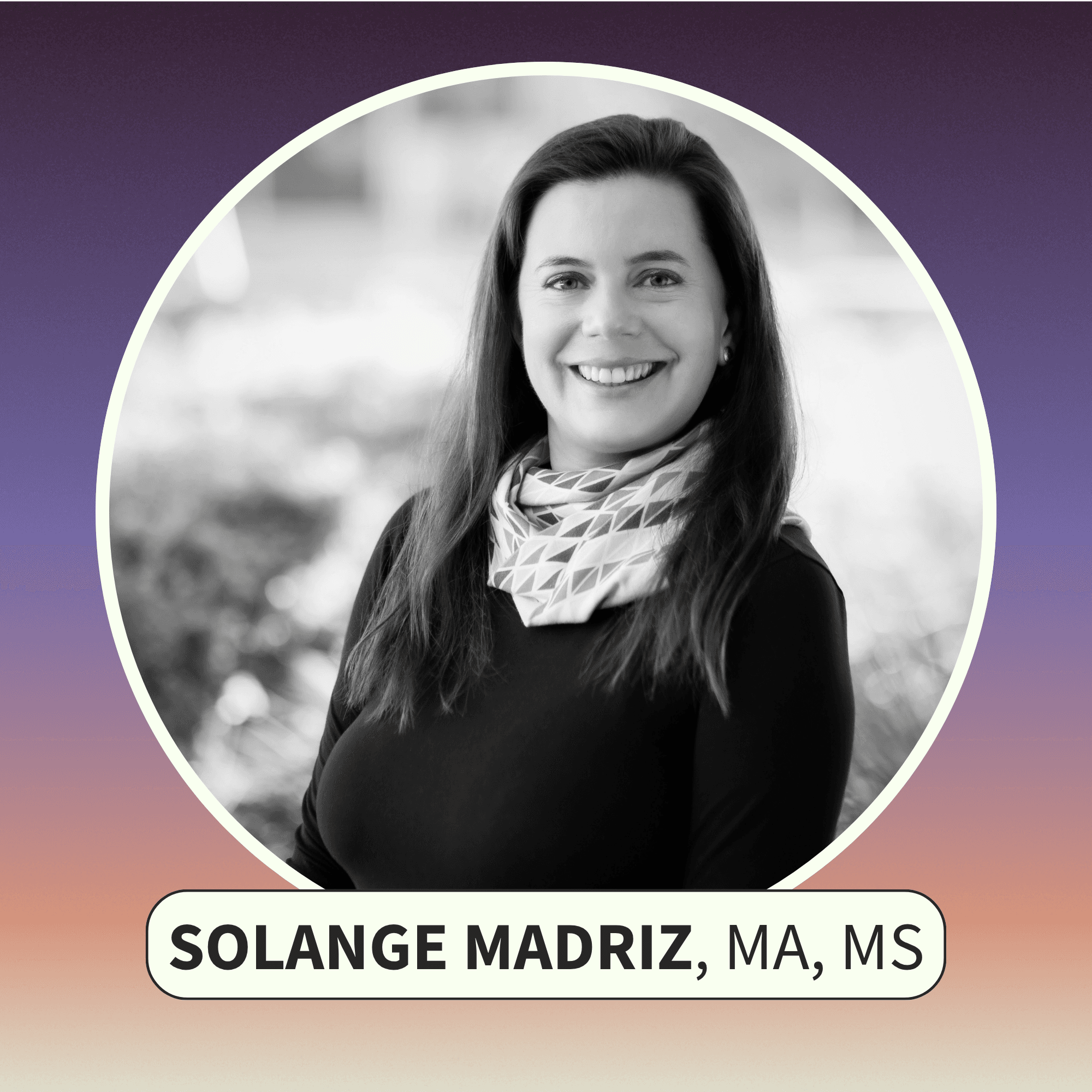
Solange Madriz, a public health professional at UCSF, reflects on her work training birth attendants and clinicians in rural Guatemala to respond to maternal emergencies through low-cost simulation. For years, she helped others prepare for postpartum hemorrhage, preeclampsia, and other life-threatening complications of childbirth. Then, after the birth of her own first child during the pandemic, she developed severe postpartum preeclampsia and found herself on the other side of the hospital bed. In our conversation, Solange talks about public health, maternal health, the limits of knowledge when your own body is in crisis, and how her own medical experience changed the way she thinks about her work
0:00/1:34
The Nocturnists
Season
9
Episode
3
|
Practice and Reality with Solange Madriz, MA, MS
Solange Madriz, a public health professional at UCSF, reflects on her work training birth attendants and clinicians in rural Guatemala to respond to maternal emergencies through low-cost simulation. For years, she helped others prepare for postpartum hemorrhage, preeclampsia, and other life-threatening complications of childbirth. Then, after the birth of her own first child during the pandemic, she developed severe postpartum preeclampsia and found herself on the other side of the hospital bed. In our conversation, Solange talks about public health, maternal health, the limits of knowledge when your own body is in crisis, and how her own medical experience changed the way she thinks about her work
0:00/1:34
About Our Guest
Solange Madriz is a global health professional with over 10 years of experience at the University of California, San Francisco. She is also a fourth-year doctoral student at the University of California, Berkeley School of Public Health, where her work reflects a deep commitment to health equity and impact. Over the years, she has designed, implemented, and monitored global health programs in Mexico, Guatemala, Ecuador, Paraguay, India, and across the United States. Originally from Caracas, Venezuela, she migrated to the U.S. in 2009 and brings a global perspective shaped by both personal and professional experience. Outside of work and school, she is a proud mom of two energetic toddlers (ages four and two) who keep life joyful and busy.
About The Show
The Nocturnists is an award-winning medical storytelling podcast, hosted by physician Emily Silverman. We feature personal stories from frontline clinicians, conversations with healthcare-related authors, and art-makers. Our mission is to humanize healthcare and foster joy, wonder, and curiosity among clinicians and patients alike.
resources
Credits
About Our Guest
Solange Madriz is a global health professional with over 10 years of experience at the University of California, San Francisco. She is also a fourth-year doctoral student at the University of California, Berkeley School of Public Health, where her work reflects a deep commitment to health equity and impact. Over the years, she has designed, implemented, and monitored global health programs in Mexico, Guatemala, Ecuador, Paraguay, India, and across the United States. Originally from Caracas, Venezuela, she migrated to the U.S. in 2009 and brings a global perspective shaped by both personal and professional experience. Outside of work and school, she is a proud mom of two energetic toddlers (ages four and two) who keep life joyful and busy.
About The Show
The Nocturnists is an award-winning medical storytelling podcast, hosted by physician Emily Silverman. We feature personal stories from frontline clinicians, conversations with healthcare-related authors, and art-makers. Our mission is to humanize healthcare and foster joy, wonder, and curiosity among clinicians and patients alike.
resources
Credits
Transcript
Note: The Nocturnists is an audio-first experience with emotion and sound design that can be difficult to fully capture in text. Transcripts are provided to support accessibility and reference, but may contain minor inaccuracies. If quoting in print, please consult the audio when possible.
Emily: This is The Nocturnists. I'm Emily Silverman. Today's episode features Solange Madriz, a public health professional whose work has focused on maternal health, global health, and childbirth emergencies. For years, Solange traveled to rural Guatemala to help lead a low-cost simulation training program for birth attendants and clinic staff. Instead of expensive mannequins and high-tech simulation labs, they used whatever they had: fake blood, fabric placentas, baby dolls, improvised props, and one another's bodies.
The goal was to help teams practice for obstetric emergencies like postpartum hemorrhage, preeclampsia, and newborn distress, and to think through not only the clinical response, but also the realities of working in under-resourced settings. Then, during the pandemic, after the birth of her first child, Solange developed severe postpartum preeclampsia and found herself in a situation no amount of training or simulation could fully prepare her for.
In our conversation, we talk about her path to public health, what she learned from working alongside birth providers in rural Guatemala, and what it was like to go from teaching emergency response to depending on it. First, here's a clip from Solange's live story.
Solange Madriz: [screaming] Contraction. It hurts. [screaming]
It's 2015, believe it or not. As part of my job description, I was asked to reenact giving birth. Essentially, I have to fake birth as part of my job, and not the pretty births that you
see in the movies. I had to reenact sepsis, preeclampsia, eclampsia, cardiomyositis, postpartum hemorrhage. Sometimes, not only I have to be the mom with problems, sometimes I have to pretend the baby was also having problems, such as being born and not being able to breathe, being born and being floppy, being born or being stuck on my pelvis. Again, this is 2015, and this job took me to the western highlands of Guatemala.
[music]
Emily: I am sitting here with Solange Madriz. Solange, thank you so much for coming on the show.
Solange: Thank you for inviting me. It's a pleasure to be here.
Emily: Solange, what was it like to stand on stage and tell your story at the event?
Solange: I was so excited to tell it, but of course, it was the first time that I was going to talk about not something that it was professional, but something more personal. I've done lots of sharing personal stuff. I'm usually a pretty open book, but the difference was, this time, it was with all the people in my office, higher-ups and new people that I haven't met, even though I've been working at UCSF for 15 years. It felt a little bit nerve-racking to share that aspect of my life with a wider audience.
Emily: How was the story received?
Solange: I think that people liked it. When you are talking, you usually get on the zone. You're not really thinking so much on how it's landing on them. Then afterwards, oh,
yes, they were laughing, and then this and that. It was reassuring that a lot of people approached me and said, "Solange, you made us laugh." "You made us cry." Just in one
talk, a lot of things. "You made us travel to Guatemala with you." I was happy at the end.
Emily: Amazing. This show often will have doctors, nurses, medical students, residents, and other types of clinicians. It's not every day that we get a public health worker on the show, so I would love to hear a bit about what brought you to public health work and just a little bit about your arc through your career in public health.
Solange: Thank you. I like that question. It's a story I like to tell to students, in particular students from other countries. I think public health in the United States it's been established. People know what it is. They can differentiate it from medicine. In my home country, Venezuela, if you want to do anything related to health, you have to be a doctor. When I was growing up and decided what I was going to do for college, what I was going to study, I knew that I liked health-related issues, but I also knew that I did not want to be a doctor. I did not want to be looking at patients.
My questions or the things that I was more interested were broader, like why Venezuela doesn't have access to the HPV vaccine that protects almost 90% of cervical cancers, so I decided to study international studies. Then I decided to apply for graduate programs in the United States, and I came to San Francisco with a scholarship. When I was here, I think it was part of me leaving my country, understanding, and exploring more my positionality, that I started writing about international problems, but they all were related to impacts to health.
I would write things such as the impact of oil extraction in the Amazon rainforest on Indigenous people. Then I got excited about understanding the impact of the North America Free Trade Agreement on the nutrition and on the lifestyle of Mexicans. That was actually my dissertation.
By doing this, I started really learning more about diseases, health problems. I started really talking to people like, "Oh, you know this about this," talking about the things that I was learning, until one day, actually, my sister said, "You not only like health, you're obsessed with it. In parties, you're like a nerd talking to people about these things. I think you're in the wrong path. You're not international studies. I think you're something more specific."
All the people listening to me would also say, "Oh, yes, you're interested in health, but why didn't you study public health?" I'm like, "Public health? What is that?" It was a very long journey. Then I found not only public health, but then global health, which is international studies nursing, like having a baby. It's health issues that transcend borders, not only that are unique to many countries, but also the way that you approach them require more disciplines. It's not only having access to health. You need to understand there are many other variables that affect health. I went on, I studied that, and it changed my life.
I did a master's degree in global health at UCSF in 2011, and I never left. I've been there ever since.
Emily: You started to get interested in pregnancy, OB-GYN, childbirth, specifically, how to deal with childbirth emergencies in low-resource settings. Tell us about that educational program that you were involved in. I think you said it was in Guatemala.
Solange: Yes.
Emily: Tell us about that program.
Solange: It was one of the situations in which you are at the right place at the right moment. It was shortly after I graduated from the master's degree. I'd been doing more office-related activities. I was doing public health, but more research, managing grants, overseeing deliverables of work that other researchers were doing. Then somebody approached and said, "Solange, I need to leave this project, and I think you will be the perfect candidate to replace me." I said, "Where is it?" She said Guatemala. It involves a lot of traveling.
Back then, I had all the flexibility, all the time in the world to travel. Then I didn't think twice. I said yes. It was really a beautiful program that not only changed the way that I approach education. It was the first time I was deployed into a country to oversee the implementation of a training program.
Emily: This wasn't in the city, right? This was in more rural areas. Bring us into the physical environment and the landscape. I know you mentioned that a lot of the people there did not speak Spanish. Of course, they spoke Indigenous language. I imagine it was a beautiful place. Tell us about where you were located and the patient population.
Solange: The places where I was they were very remote. To start with, I had to land in Guatemala City, but then travel for several hours. They were in two big states of the country. One was Huehuetenango, and the second one was Alta Verapaz. They are primarily Indigenous populations, rural, and lots of greenery everywhere. This part of the world they use a lot of wood to cook, so there's this scent of wood burning that, to this day, it reminds me to Guatemala. When I smell wood burning, it's like I'm traveling. [inhales] "That's Guatemala." Very clear skies.
I'm Venezuelan. In Venezuela they're not usually a lot of Indigenous population. That was one of the striking things for me, to understand, this is not a group of people. There's a lot of people. A lot of times, I felt that I was in a nation within another bigger nation. It also struck me that population was very young, very active, a lot of, in these villages, people moving around, but also at night or when the sun was going down, it stopped. Life was really around the sun.
I think a lot of things were traditional. Women still wear traditional outfits, very colorful, long hair, braided. I would see a lot of women holding their babies in their back. People were always hustling, doing multiple things at the same time. I remember seeing women with the babies in the back and then doing chores around the homes, or going with other kids holding hands with other kids, and then with grocery bags. There was a lot of things happening. There were small villages, but a lot of movement. Again, everything revolving around when there was sun.
Emily: Where did the women give birth? Was it a clinic? Was it a hospital? Was it a birthing center? What was that set up like?
Solange: I was part of this project, and one of the goals of the project was to incentivize women to give birth in the clinic. Traditionally, in these two states, the majority of the women, I don't have the current statistics, but they used to give birth at home with traditional birth attendants. Traditional birth attendants are women without a formal training to deliver babies, but they inherited their skills from their predecessors. The traditional birth attendants were not only women who attended women during birth, but they were also leaders in their community. They're very well respected, trusted.
I also learned that one of the main reasons why women don't like to deliver babies in clinics is because they're oftentimes mistreated, or the providers who would attend in clinics they didn't speak the language. They didn't speak Kʼicheʼ or any of the other languages that are spoken in this area. They felt that it was much better to be in the hands at home with somebody who you trust that allows you to give birth in the position that is better for you and that takes the time. It doesn't matter if it takes three hours, it takes two days; the traditional birth attendant is going to be with you.
One of the things that our project tried to do was to link traditional birth attendants with the clinic. We did a sensitization process in which we would approach the clinics and say, "Traditional birth attendants are your friends. They are not your enemies," because I think oftentimes what would happen in clinics is this conception that traditional birth attendants were either ignorant or they would complicate the deliveries, and they would make their job harder. We try to soften that and serve as the link.
We worked with birth attendants from Guatemala that had received formal training. They were the ones in charge of making all this sensitization, talking to the leads of the clinics and say, "Why don't we allow the women to accompany with the family, or whoever she wants to have in the delivery room?" Little by little, we started making some changes in that front.
Emily: Your goal was to reduce life-threatening complications like hemorrhage, eclampsia, newborn distress. One of the ways that you were teaching about this was through simulation. When I was a medical student, we had a simulation lab. I don't know if this is what it was like there, but we would all come into a room, there would be a mannequin, there would be a monitor, there would be a one-way mirror with somebody controlling behind the mirror, and then we would have to act out a scenario on the mannequin.
The mannequin could make noises, its pupils could dilate, and all those things. Then at the end, they would say, "End scene." We would debrief, and we would see if we got the diagnosis or whatever. It's a fun way to learn. Obviously, it's much more hands-on than reading a textbook, and of course, safer than practicing on a real person.
Tell us about your simulation education program. Did it involve traditional birth attendants? Did it involve doctors, nurses? I think in your story, you said that you helped train and educate a lot of clinicians on the ground. Tell us about that.
Solange: Absolutely. That is the gold standard, what you described, to have a mannequin and to have this. The issue is that is extremely expensive to replicate in developing countries, let alone in Indigenous villages, to scale a program like that. Only that mannequin that you were describing, it costs around $60,000 only one. You would need many of them, as many clinics. In this case, we visited around 50 clinics. Just the cost is a big barrier.
PRONTO, which is the program that I implemented and we led, what it uses is, instead of having that mannequin, we use an actual person. One of the trainees or myself would use all these artifacts and prompts to really immerse the participants into the scenario. Of course, at low stakes. It felt high stakes for them because, unlike what you're describing in medical school, that you were doing that, this was the first time.
Simulation is not common in many developing countries because of cost barriers. We had a fabric placenta, we have baby, and to reenact postpartum hemorrhage, which is one of the most common causes of mortality, we would make fake blood and then load it into an IV. When instructed, the woman would open the IV and then deliver all the blood. It was not so much to prevent these complications, because these complications are going to happen, but to have the providers experience them over and over again, so much that when they see them, they're not panicked. They don't have to refer a patient to a two-hour higher-level hospital, but they could feel comfortable to take care of them in their clinic.
The clinics that we were working were second-level, meaning that they couldn't perform C-sections, but with the necessary education and management, they could attend all of those complications right there. We would load a real patient with all these props, and then we will read a scenario. We have up to 30 scenarios to practice different emergencies. We had preeclampsia. We had postpartum hemorrhage, sepsis. We even have scenarios that are kind of taboo. We had domestic violence scenarios for providers to immerse them in that situation, to talk about them, and to discuss what you should do.
It was one of the most beautiful experiences that I've had, even to this day, in global health, because, first of all, it was the first time that they were immersed into simulation. Second of all, it was the first time also that they were learning in a way that they're not being told. It was more the themes emerge on their own after seeing the scenario, and you have a facilitator guiding that discussion. It's like, "What happened? How did you feel?" It's the very first time that those over 550 birth providers that we trained. Over and over again, the common sentiment is like, "Please, let's keep doing this. This was nothing as we ever learned before."
They know the communities, they know what's happening. Another great aspect of this training is not only the clinical aspect of how to identify a hemorrhage, or how to identify a preeclampsia, the symptoms, but also identifying barriers in their own system and how to address them. Sometimes, when we would hear things such as, "Well, the traditional birth attendant doesn't speak the language, so we don't want her to come here." We say, "Wait a second. What if that birth attendant is the hand that you need to do a massage while you are loading oxytocin to administer to a woman who is experiencing postpartum hemorrhage?"
Little by little, we were trying to instill this idea that traditional birth attendants could be their allies and trying to break these barriers to make them see how they could be their partners in doing deliveries of women.
Emily: It sounds like you trained over 500 of these clinicians. Do you have any particular memories or stories of a time that a simulation went especially well, or, I don't know, any funny mishaps, or anything like that?
Solange: Yes, I have a good one that is one of my favorite ones. It was two parts of the training. Module one, we will practice postpartum hemorrhage and then also complications related to baby, such as shoulder dystocia. Then in module two, the training also focus on team building and how to communicate during emergencies, so thinking out loud, these things that they were never taught or discussed during their medical training.
We would conduct the training. There was a two-day training, and then two or three months later, we would come back with part two of the training. In one of these rural clinics, it was a clinic in Raxruhá in Guatemala, when we came back for part two of the training, they told us that one of the issues that they had identified was that when they needed to refer a patient to another clinic, the people that were driving the ambulance, they couldn't hear them. What they did was to put a bell. When anybody rang that bell, it's like code blue, like you could hear in a hospital. Everybody knew there's a problem happening, and everybody stopped whatever they're doing; there's an emergency.
The situation was this. After I had demonstrated how to do the patient actress, it was actually a very popular activity to do. A lot of women wanted to do the character. It was great opportunity also for learning, because providers are typically providers. It was an opportunity for them to be a patient, and then they could see, did the provider ask your name? Did the provider during the simulation ever ask you how you're feeling? How did you feel? It was much better not for me to do it, but in this clinic, it was decided that I was going to do it. It was one of my favorite parts of my job, too, to have my fake baby, fake placenta.
In this one, we were practicing preeclampsia. I didn't have any blood because I arrived to the clinic with a headache, with all these other things, and for them to say, "Oh, that sounds like eclampsia." In this case, during the simulation, they actually surprised me, because they wanted to demonstrate us that they had now arranged a whole plan, an emergency plan, when they had to transfer a woman. That was when I learned that they had a bell.
During the simulation, they rang the bell, and then all the people in the clinic actually showed up, and then they actually transported me. They put me on the ambulance, and then they took off. They took off, and I'm like, "Oh my God, how far are they going? Are they really taking me to the next third-level clinic? Please, this is a simulation. You don't need to do the whole thing."
It was really one of my most proudest moments as a professional, when with so little, they accomplished so much. It didn't cost that much. That's another thing of global health, that the biggest problems you don't necessarily need a lot. You need people being able to talk to themselves and how to communicate. I was very proud to see this clinic, with a little bit of training and facilitation discussion, how they were able to identify so many barriers.
[music]
Emily: You were there in the middle of the jungle with a fake placenta and a fake pregnant belly, and they're loading you into the ambulance, they're ringing the alarm bells, and you're thinking, "How far is this going to go? It's just a simulation." Then fast-forward some time, and you're actually pregnant. Tell us what happened.
Solange: Oh, wow, you took me there. That was unexpected, too. I thought that we were going to keep talking about Guatemala. Fast forward, now we're in the middle of a pandemic and pregnant with my first child, and my delivery had nothing to do with any of the multiple scenarios that I had practiced. Nothing to do with them. My actual first birth ended up with a C-section. That's not what I wanted. It was an emergency C-section after two grueling days of waiting for something to happen, but nothing really happened.
What was also shocking is afterwards, when I asked the OB-GYN what happened, because everything was supposedly to be aligned, my water broke, and 99% of the labors just start spontaneously after your waters break. Mine didn't. It was that 1%. Then they try to initiate labor, and most women, with a little bit of Pitocin, they will start dilating. Mine didn't. A lot of things I was in these 1% or less of women that was not happening, but more concerning was that I was in this very small percentage of women who develop postpartum preeclampsia.
It's considered a rare outcome, although we're now seeing them more, because-- First of all, it's one of these things, why cannot we understand exactly what causes preeclampsia? This is one of the biggest unknowns. There are some theories, but one of the main killers of pregnant women, we don't have a concrete, solid response of why it happens. There are some theories that it's something mediated by the placenta. Then again, I had delivered that placenta. That placenta was not in my body. 48 hours later, my blood pressure was out of control.
Why is it that two days later, when supposedly the organ that mediates or produces preeclampsia is producing this high, uncontrollable instability in my blood pressure? Again, there's no answer to this. It was in a situation that I never expected. It was actually quite the opposite. I thought that with all the knowledge, all the experience that I've had practicing, I was going to be able to identify when something was not normal, that I was going to be able to advocate for myself, that I could tell and discuss with a provider, but I was in a complete unexpected situation in which I felt very vulnerable with a lot of intense fear of not knowing.
The other terrifying part of postpartum preeclampsia is that it's different from the high blood pressure that is experienced at a later age, because for those cases, you have your blood pressure medication and "Come back in three months. Goodbye." This one, I don't know if it's because they don't know exactly what causes it, but there's no one single thing that you have to do. First, you have to find out the right titration, the right concentration, and sometimes the right combo. In my case, was all of that. It took a while to find the right dosage.
I felt like I started motherhood with a lot of terror, because what was supposed to be an in-and-out situation, 48 hours, it ended up 2 weeks in a hospital. After that, I felt very unprepared on how to take care of an infant. I felt pretty traumatized by what happened in the hospital. Even though I have to say, nothing to do with the care. I actually received exceptional care. It's more the on these situations, nobody can tell you not fear death, "Don't fear this," because it's going to happen.
With this one, what was causing me a lot of anxiety was not knowing when they were going to get it right. It's also one of the situations in which I knew that was also one of the most common causes of maternal mortality. Again, I also had to tell myself, "This happens when women not necessarily measure." I was already hooked up with all the things in the hospital, but still my brain's like, "What if they miss something? What if they come too late? What if I have a stroke?" All of these things start spiraling in your head.
Emily: As a physician myself, I know that I've had experiences where I've gone to the doctor, and sometimes they'll be like, "Oh, well, you know this because you're a doctor." I just want to be treated like a normal person at the doctor. Sometimes I don't even tell them I'm a doctor. I remember one time I went to a party with my husband in Washington, DC, which is where he was living at the time. It was late, people were drunk, and they decided it would be a good idea to go up on the roof.
It was an unfinished roof. We got up on the roof, and I was already in a bad mood. I wanted to leave the party. I didn't really want to go on the roof. I actually just wanted to go home, and my husband said, "Let's just go on the roof. Let's have a drink, and then we'll go home." I begrudgingly crawl up this ladder. I get on the roof. People are hanging out. It's a dark black roof cover. It's unfinished. It was summertime, and I was wearing flip-flops. I started walking across the roof, and then I feel something go into my foot. It was a giant rusty nail. Went all the way through my flip-flop and into my foot.
Solange: Ouch. Oh.
Emily: I was already in a bad mood. My husband had to pull it out of my foot, and then I had to climb down the ladder and go into the bathroom and rinse it off. I remember this guy came into the bathroom, and he said, "Are you okay?" I said, "Yes, I think so. I'm fine." He was like, "I'm an Army medic. I'm going to take a look at your foot." I did not want to tell him I was a physician; I just wanted to surrender to this Army medic. He got on his hands and knees, he held my foot, and he said, "Move your toes like this, and move your foot like this." It just felt so good to be cared for.
It just really struck me when you were saying, even as somebody who is a global expert in preventing and educating around bad outcomes related to childbirth, somebody who's literally simulated it numerous times, that when it's you and when it's real, it just feels so different. In a way, the expertise, it just goes out the window on some level,
Solange: Absolutely. Absolutely. I felt so vulnerable, because it's one thing to be teaching and to reenact the scenarios when your life is in the hands of others. In the particular case of preeclampsia, they also inject you with magnesium sulfate. I remember in the training, during the debrief, asking, because this is something that my own boss told me, like, "Ask about if anybody in the audience, in your trainees, have felt what it feels magnesium sulfate," because it's this burning sensation.
Then, back then, I hadn't experienced it. I was making space to have that discussion, but almost somebody telling me that that's how it feels, and to making sure that participants understood that it's a very unpleasant feeling. Then, experiencing myself, magnesium sulfate is like burning inside out. It takes a while for magnesium because they had the drug on the body for a few days, because they were trying to prevent a stroke. It was almost like a dose of humility for me.
Emily: Totally.
Solange: For me, it was like, you're not only talking about issues that happen to other women. This happened to me in the best healthcare system in the world. I had exceptional care, the kindest nurses and physicians that would talk to me, to your point, what you were saying, almost tell me too much. I'm like, "I don't want to know that much," because it's like, "I know that usually knowledge is power, but in this case, knowledge is causing anxiety."
I still felt intense fear and powerless. I depend on these people knowing what to do, and ultimately, they did. That's something that stayed with me, that in many cases, I was lucky that I had all this access to all these resources, but in my privileged position, that was not the case for another women. I still felt that something that unites me and I can relate is to that fear that you feel.
Emily: Did it make you think differently about your work in Guatemala, after going through that experience?
Solange: Absolutely. Yes. Like I said, it was a humility check to think that this is not something that happens to other people. It can happen to anybody. From now on, I'm
going to give baby showers, I'm going to give blood pressure cuffs because I know that's number one cause of deaths in the US. I was lucky that I knew that if I felt a little bit off, I had to check my blood pressure.
Especially after your first pregnancy, you don't know how you're supposed to feel, especially after a long birth. I could have attributed all that to just the lack of sleep, or I just had major abdominal surgery. I had my blood pressure, I checked it, and it was a very scary reading. I immediately called, I was admitted, and I was taken care of, but that's not the case for many women.
Another reason why I changed the way that I think about my job is because this is not only in rural Guatemala. Actually, in some cases, they're more protected from these rare outcomes because the demographics and how things are, women are having children at a later age, and these outcomes are more common at a later age. I feel that these are topics that we need to talk more broadly, not only in Guatemala, but there's also disparities here. We have to talk about them here more than what's the first outfit that your baby is going to wear in the hospital.
Emily: It's been such a pleasure speaking with you and learning about your work in public health and about your personal story. Is there anything you want to share with our audience before we end, maybe somebody who's interested in getting involved in public health, global health, women's health, or anything like that? Any last thoughts?
Solange: These topics are more important to talk about than ever before, because right now, women, and I'm talking about no Guatemala, I'm talking about women in the US, shocking to say this, but instead of having more access to information or to resources that can prevent these complications, we actually have less. I would encourage all women, and that's why I was so excited to do this podcast, is to share their experiences, so it's not something that when it happens is when you learn about them.
Just know that if you want to be involved in health, you don't have to be a doctor. There are many, many things you can do that are not direct care with a patient. Global and public health, you take care of health of groups of people. That's another area where we need more support than ever before, as the field is hurting at the moment.
Emily: It's been wonderful to speak with you. This has been Solange Madriz. Solange, keep up the great work, and thanks so much for coming on the show.
Solange: Thank you, Emily. It was a pleasure. Thank you for making me feel so relaxed to share my experience.
[music]
Emily: This episode of The Nocturnists was produced by me and producer and head of story development, Molly Rose-Williams. Our executive producer is Ali Block, and Ashley Pettit is our program director. Original theme music was composed by Yosef Munro, with additional music from Blue Dot Sessions. The Nocturnists is made possible by listeners like you. If you enjoy what you hear and you want to support our work, consider subscribing to The Nocturnists+. You'll get access to The Nocturnists After Hours, our monthly bonus series featuring original conversations from our team, along with merch discounts and a full archive of episodes all in one place.
Subscriptions start at just $10 a month. Learn more at the nocturnists.org/plus or through the link in the description. Thank you for listening and being part of this community. Until next time, I'm your host, Emily Silverman.
Transcript
Note: The Nocturnists is an audio-first experience with emotion and sound design that can be difficult to fully capture in text. Transcripts are provided to support accessibility and reference, but may contain minor inaccuracies. If quoting in print, please consult the audio when possible.
Emily: This is The Nocturnists. I'm Emily Silverman. Today's episode features Solange Madriz, a public health professional whose work has focused on maternal health, global health, and childbirth emergencies. For years, Solange traveled to rural Guatemala to help lead a low-cost simulation training program for birth attendants and clinic staff. Instead of expensive mannequins and high-tech simulation labs, they used whatever they had: fake blood, fabric placentas, baby dolls, improvised props, and one another's bodies.
The goal was to help teams practice for obstetric emergencies like postpartum hemorrhage, preeclampsia, and newborn distress, and to think through not only the clinical response, but also the realities of working in under-resourced settings. Then, during the pandemic, after the birth of her first child, Solange developed severe postpartum preeclampsia and found herself in a situation no amount of training or simulation could fully prepare her for.
In our conversation, we talk about her path to public health, what she learned from working alongside birth providers in rural Guatemala, and what it was like to go from teaching emergency response to depending on it. First, here's a clip from Solange's live story.
Solange Madriz: [screaming] Contraction. It hurts. [screaming]
It's 2015, believe it or not. As part of my job description, I was asked to reenact giving birth. Essentially, I have to fake birth as part of my job, and not the pretty births that you
see in the movies. I had to reenact sepsis, preeclampsia, eclampsia, cardiomyositis, postpartum hemorrhage. Sometimes, not only I have to be the mom with problems, sometimes I have to pretend the baby was also having problems, such as being born and not being able to breathe, being born and being floppy, being born or being stuck on my pelvis. Again, this is 2015, and this job took me to the western highlands of Guatemala.
[music]
Emily: I am sitting here with Solange Madriz. Solange, thank you so much for coming on the show.
Solange: Thank you for inviting me. It's a pleasure to be here.
Emily: Solange, what was it like to stand on stage and tell your story at the event?
Solange: I was so excited to tell it, but of course, it was the first time that I was going to talk about not something that it was professional, but something more personal. I've done lots of sharing personal stuff. I'm usually a pretty open book, but the difference was, this time, it was with all the people in my office, higher-ups and new people that I haven't met, even though I've been working at UCSF for 15 years. It felt a little bit nerve-racking to share that aspect of my life with a wider audience.
Emily: How was the story received?
Solange: I think that people liked it. When you are talking, you usually get on the zone. You're not really thinking so much on how it's landing on them. Then afterwards, oh,
yes, they were laughing, and then this and that. It was reassuring that a lot of people approached me and said, "Solange, you made us laugh." "You made us cry." Just in one
talk, a lot of things. "You made us travel to Guatemala with you." I was happy at the end.
Emily: Amazing. This show often will have doctors, nurses, medical students, residents, and other types of clinicians. It's not every day that we get a public health worker on the show, so I would love to hear a bit about what brought you to public health work and just a little bit about your arc through your career in public health.
Solange: Thank you. I like that question. It's a story I like to tell to students, in particular students from other countries. I think public health in the United States it's been established. People know what it is. They can differentiate it from medicine. In my home country, Venezuela, if you want to do anything related to health, you have to be a doctor. When I was growing up and decided what I was going to do for college, what I was going to study, I knew that I liked health-related issues, but I also knew that I did not want to be a doctor. I did not want to be looking at patients.
My questions or the things that I was more interested were broader, like why Venezuela doesn't have access to the HPV vaccine that protects almost 90% of cervical cancers, so I decided to study international studies. Then I decided to apply for graduate programs in the United States, and I came to San Francisco with a scholarship. When I was here, I think it was part of me leaving my country, understanding, and exploring more my positionality, that I started writing about international problems, but they all were related to impacts to health.
I would write things such as the impact of oil extraction in the Amazon rainforest on Indigenous people. Then I got excited about understanding the impact of the North America Free Trade Agreement on the nutrition and on the lifestyle of Mexicans. That was actually my dissertation.
By doing this, I started really learning more about diseases, health problems. I started really talking to people like, "Oh, you know this about this," talking about the things that I was learning, until one day, actually, my sister said, "You not only like health, you're obsessed with it. In parties, you're like a nerd talking to people about these things. I think you're in the wrong path. You're not international studies. I think you're something more specific."
All the people listening to me would also say, "Oh, yes, you're interested in health, but why didn't you study public health?" I'm like, "Public health? What is that?" It was a very long journey. Then I found not only public health, but then global health, which is international studies nursing, like having a baby. It's health issues that transcend borders, not only that are unique to many countries, but also the way that you approach them require more disciplines. It's not only having access to health. You need to understand there are many other variables that affect health. I went on, I studied that, and it changed my life.
I did a master's degree in global health at UCSF in 2011, and I never left. I've been there ever since.
Emily: You started to get interested in pregnancy, OB-GYN, childbirth, specifically, how to deal with childbirth emergencies in low-resource settings. Tell us about that educational program that you were involved in. I think you said it was in Guatemala.
Solange: Yes.
Emily: Tell us about that program.
Solange: It was one of the situations in which you are at the right place at the right moment. It was shortly after I graduated from the master's degree. I'd been doing more office-related activities. I was doing public health, but more research, managing grants, overseeing deliverables of work that other researchers were doing. Then somebody approached and said, "Solange, I need to leave this project, and I think you will be the perfect candidate to replace me." I said, "Where is it?" She said Guatemala. It involves a lot of traveling.
Back then, I had all the flexibility, all the time in the world to travel. Then I didn't think twice. I said yes. It was really a beautiful program that not only changed the way that I approach education. It was the first time I was deployed into a country to oversee the implementation of a training program.
Emily: This wasn't in the city, right? This was in more rural areas. Bring us into the physical environment and the landscape. I know you mentioned that a lot of the people there did not speak Spanish. Of course, they spoke Indigenous language. I imagine it was a beautiful place. Tell us about where you were located and the patient population.
Solange: The places where I was they were very remote. To start with, I had to land in Guatemala City, but then travel for several hours. They were in two big states of the country. One was Huehuetenango, and the second one was Alta Verapaz. They are primarily Indigenous populations, rural, and lots of greenery everywhere. This part of the world they use a lot of wood to cook, so there's this scent of wood burning that, to this day, it reminds me to Guatemala. When I smell wood burning, it's like I'm traveling. [inhales] "That's Guatemala." Very clear skies.
I'm Venezuelan. In Venezuela they're not usually a lot of Indigenous population. That was one of the striking things for me, to understand, this is not a group of people. There's a lot of people. A lot of times, I felt that I was in a nation within another bigger nation. It also struck me that population was very young, very active, a lot of, in these villages, people moving around, but also at night or when the sun was going down, it stopped. Life was really around the sun.
I think a lot of things were traditional. Women still wear traditional outfits, very colorful, long hair, braided. I would see a lot of women holding their babies in their back. People were always hustling, doing multiple things at the same time. I remember seeing women with the babies in the back and then doing chores around the homes, or going with other kids holding hands with other kids, and then with grocery bags. There was a lot of things happening. There were small villages, but a lot of movement. Again, everything revolving around when there was sun.
Emily: Where did the women give birth? Was it a clinic? Was it a hospital? Was it a birthing center? What was that set up like?
Solange: I was part of this project, and one of the goals of the project was to incentivize women to give birth in the clinic. Traditionally, in these two states, the majority of the women, I don't have the current statistics, but they used to give birth at home with traditional birth attendants. Traditional birth attendants are women without a formal training to deliver babies, but they inherited their skills from their predecessors. The traditional birth attendants were not only women who attended women during birth, but they were also leaders in their community. They're very well respected, trusted.
I also learned that one of the main reasons why women don't like to deliver babies in clinics is because they're oftentimes mistreated, or the providers who would attend in clinics they didn't speak the language. They didn't speak Kʼicheʼ or any of the other languages that are spoken in this area. They felt that it was much better to be in the hands at home with somebody who you trust that allows you to give birth in the position that is better for you and that takes the time. It doesn't matter if it takes three hours, it takes two days; the traditional birth attendant is going to be with you.
One of the things that our project tried to do was to link traditional birth attendants with the clinic. We did a sensitization process in which we would approach the clinics and say, "Traditional birth attendants are your friends. They are not your enemies," because I think oftentimes what would happen in clinics is this conception that traditional birth attendants were either ignorant or they would complicate the deliveries, and they would make their job harder. We try to soften that and serve as the link.
We worked with birth attendants from Guatemala that had received formal training. They were the ones in charge of making all this sensitization, talking to the leads of the clinics and say, "Why don't we allow the women to accompany with the family, or whoever she wants to have in the delivery room?" Little by little, we started making some changes in that front.
Emily: Your goal was to reduce life-threatening complications like hemorrhage, eclampsia, newborn distress. One of the ways that you were teaching about this was through simulation. When I was a medical student, we had a simulation lab. I don't know if this is what it was like there, but we would all come into a room, there would be a mannequin, there would be a monitor, there would be a one-way mirror with somebody controlling behind the mirror, and then we would have to act out a scenario on the mannequin.
The mannequin could make noises, its pupils could dilate, and all those things. Then at the end, they would say, "End scene." We would debrief, and we would see if we got the diagnosis or whatever. It's a fun way to learn. Obviously, it's much more hands-on than reading a textbook, and of course, safer than practicing on a real person.
Tell us about your simulation education program. Did it involve traditional birth attendants? Did it involve doctors, nurses? I think in your story, you said that you helped train and educate a lot of clinicians on the ground. Tell us about that.
Solange: Absolutely. That is the gold standard, what you described, to have a mannequin and to have this. The issue is that is extremely expensive to replicate in developing countries, let alone in Indigenous villages, to scale a program like that. Only that mannequin that you were describing, it costs around $60,000 only one. You would need many of them, as many clinics. In this case, we visited around 50 clinics. Just the cost is a big barrier.
PRONTO, which is the program that I implemented and we led, what it uses is, instead of having that mannequin, we use an actual person. One of the trainees or myself would use all these artifacts and prompts to really immerse the participants into the scenario. Of course, at low stakes. It felt high stakes for them because, unlike what you're describing in medical school, that you were doing that, this was the first time.
Simulation is not common in many developing countries because of cost barriers. We had a fabric placenta, we have baby, and to reenact postpartum hemorrhage, which is one of the most common causes of mortality, we would make fake blood and then load it into an IV. When instructed, the woman would open the IV and then deliver all the blood. It was not so much to prevent these complications, because these complications are going to happen, but to have the providers experience them over and over again, so much that when they see them, they're not panicked. They don't have to refer a patient to a two-hour higher-level hospital, but they could feel comfortable to take care of them in their clinic.
The clinics that we were working were second-level, meaning that they couldn't perform C-sections, but with the necessary education and management, they could attend all of those complications right there. We would load a real patient with all these props, and then we will read a scenario. We have up to 30 scenarios to practice different emergencies. We had preeclampsia. We had postpartum hemorrhage, sepsis. We even have scenarios that are kind of taboo. We had domestic violence scenarios for providers to immerse them in that situation, to talk about them, and to discuss what you should do.
It was one of the most beautiful experiences that I've had, even to this day, in global health, because, first of all, it was the first time that they were immersed into simulation. Second of all, it was the first time also that they were learning in a way that they're not being told. It was more the themes emerge on their own after seeing the scenario, and you have a facilitator guiding that discussion. It's like, "What happened? How did you feel?" It's the very first time that those over 550 birth providers that we trained. Over and over again, the common sentiment is like, "Please, let's keep doing this. This was nothing as we ever learned before."
They know the communities, they know what's happening. Another great aspect of this training is not only the clinical aspect of how to identify a hemorrhage, or how to identify a preeclampsia, the symptoms, but also identifying barriers in their own system and how to address them. Sometimes, when we would hear things such as, "Well, the traditional birth attendant doesn't speak the language, so we don't want her to come here." We say, "Wait a second. What if that birth attendant is the hand that you need to do a massage while you are loading oxytocin to administer to a woman who is experiencing postpartum hemorrhage?"
Little by little, we were trying to instill this idea that traditional birth attendants could be their allies and trying to break these barriers to make them see how they could be their partners in doing deliveries of women.
Emily: It sounds like you trained over 500 of these clinicians. Do you have any particular memories or stories of a time that a simulation went especially well, or, I don't know, any funny mishaps, or anything like that?
Solange: Yes, I have a good one that is one of my favorite ones. It was two parts of the training. Module one, we will practice postpartum hemorrhage and then also complications related to baby, such as shoulder dystocia. Then in module two, the training also focus on team building and how to communicate during emergencies, so thinking out loud, these things that they were never taught or discussed during their medical training.
We would conduct the training. There was a two-day training, and then two or three months later, we would come back with part two of the training. In one of these rural clinics, it was a clinic in Raxruhá in Guatemala, when we came back for part two of the training, they told us that one of the issues that they had identified was that when they needed to refer a patient to another clinic, the people that were driving the ambulance, they couldn't hear them. What they did was to put a bell. When anybody rang that bell, it's like code blue, like you could hear in a hospital. Everybody knew there's a problem happening, and everybody stopped whatever they're doing; there's an emergency.
The situation was this. After I had demonstrated how to do the patient actress, it was actually a very popular activity to do. A lot of women wanted to do the character. It was great opportunity also for learning, because providers are typically providers. It was an opportunity for them to be a patient, and then they could see, did the provider ask your name? Did the provider during the simulation ever ask you how you're feeling? How did you feel? It was much better not for me to do it, but in this clinic, it was decided that I was going to do it. It was one of my favorite parts of my job, too, to have my fake baby, fake placenta.
In this one, we were practicing preeclampsia. I didn't have any blood because I arrived to the clinic with a headache, with all these other things, and for them to say, "Oh, that sounds like eclampsia." In this case, during the simulation, they actually surprised me, because they wanted to demonstrate us that they had now arranged a whole plan, an emergency plan, when they had to transfer a woman. That was when I learned that they had a bell.
During the simulation, they rang the bell, and then all the people in the clinic actually showed up, and then they actually transported me. They put me on the ambulance, and then they took off. They took off, and I'm like, "Oh my God, how far are they going? Are they really taking me to the next third-level clinic? Please, this is a simulation. You don't need to do the whole thing."
It was really one of my most proudest moments as a professional, when with so little, they accomplished so much. It didn't cost that much. That's another thing of global health, that the biggest problems you don't necessarily need a lot. You need people being able to talk to themselves and how to communicate. I was very proud to see this clinic, with a little bit of training and facilitation discussion, how they were able to identify so many barriers.
[music]
Emily: You were there in the middle of the jungle with a fake placenta and a fake pregnant belly, and they're loading you into the ambulance, they're ringing the alarm bells, and you're thinking, "How far is this going to go? It's just a simulation." Then fast-forward some time, and you're actually pregnant. Tell us what happened.
Solange: Oh, wow, you took me there. That was unexpected, too. I thought that we were going to keep talking about Guatemala. Fast forward, now we're in the middle of a pandemic and pregnant with my first child, and my delivery had nothing to do with any of the multiple scenarios that I had practiced. Nothing to do with them. My actual first birth ended up with a C-section. That's not what I wanted. It was an emergency C-section after two grueling days of waiting for something to happen, but nothing really happened.
What was also shocking is afterwards, when I asked the OB-GYN what happened, because everything was supposedly to be aligned, my water broke, and 99% of the labors just start spontaneously after your waters break. Mine didn't. It was that 1%. Then they try to initiate labor, and most women, with a little bit of Pitocin, they will start dilating. Mine didn't. A lot of things I was in these 1% or less of women that was not happening, but more concerning was that I was in this very small percentage of women who develop postpartum preeclampsia.
It's considered a rare outcome, although we're now seeing them more, because-- First of all, it's one of these things, why cannot we understand exactly what causes preeclampsia? This is one of the biggest unknowns. There are some theories, but one of the main killers of pregnant women, we don't have a concrete, solid response of why it happens. There are some theories that it's something mediated by the placenta. Then again, I had delivered that placenta. That placenta was not in my body. 48 hours later, my blood pressure was out of control.
Why is it that two days later, when supposedly the organ that mediates or produces preeclampsia is producing this high, uncontrollable instability in my blood pressure? Again, there's no answer to this. It was in a situation that I never expected. It was actually quite the opposite. I thought that with all the knowledge, all the experience that I've had practicing, I was going to be able to identify when something was not normal, that I was going to be able to advocate for myself, that I could tell and discuss with a provider, but I was in a complete unexpected situation in which I felt very vulnerable with a lot of intense fear of not knowing.
The other terrifying part of postpartum preeclampsia is that it's different from the high blood pressure that is experienced at a later age, because for those cases, you have your blood pressure medication and "Come back in three months. Goodbye." This one, I don't know if it's because they don't know exactly what causes it, but there's no one single thing that you have to do. First, you have to find out the right titration, the right concentration, and sometimes the right combo. In my case, was all of that. It took a while to find the right dosage.
I felt like I started motherhood with a lot of terror, because what was supposed to be an in-and-out situation, 48 hours, it ended up 2 weeks in a hospital. After that, I felt very unprepared on how to take care of an infant. I felt pretty traumatized by what happened in the hospital. Even though I have to say, nothing to do with the care. I actually received exceptional care. It's more the on these situations, nobody can tell you not fear death, "Don't fear this," because it's going to happen.
With this one, what was causing me a lot of anxiety was not knowing when they were going to get it right. It's also one of the situations in which I knew that was also one of the most common causes of maternal mortality. Again, I also had to tell myself, "This happens when women not necessarily measure." I was already hooked up with all the things in the hospital, but still my brain's like, "What if they miss something? What if they come too late? What if I have a stroke?" All of these things start spiraling in your head.
Emily: As a physician myself, I know that I've had experiences where I've gone to the doctor, and sometimes they'll be like, "Oh, well, you know this because you're a doctor." I just want to be treated like a normal person at the doctor. Sometimes I don't even tell them I'm a doctor. I remember one time I went to a party with my husband in Washington, DC, which is where he was living at the time. It was late, people were drunk, and they decided it would be a good idea to go up on the roof.
It was an unfinished roof. We got up on the roof, and I was already in a bad mood. I wanted to leave the party. I didn't really want to go on the roof. I actually just wanted to go home, and my husband said, "Let's just go on the roof. Let's have a drink, and then we'll go home." I begrudgingly crawl up this ladder. I get on the roof. People are hanging out. It's a dark black roof cover. It's unfinished. It was summertime, and I was wearing flip-flops. I started walking across the roof, and then I feel something go into my foot. It was a giant rusty nail. Went all the way through my flip-flop and into my foot.
Solange: Ouch. Oh.
Emily: I was already in a bad mood. My husband had to pull it out of my foot, and then I had to climb down the ladder and go into the bathroom and rinse it off. I remember this guy came into the bathroom, and he said, "Are you okay?" I said, "Yes, I think so. I'm fine." He was like, "I'm an Army medic. I'm going to take a look at your foot." I did not want to tell him I was a physician; I just wanted to surrender to this Army medic. He got on his hands and knees, he held my foot, and he said, "Move your toes like this, and move your foot like this." It just felt so good to be cared for.
It just really struck me when you were saying, even as somebody who is a global expert in preventing and educating around bad outcomes related to childbirth, somebody who's literally simulated it numerous times, that when it's you and when it's real, it just feels so different. In a way, the expertise, it just goes out the window on some level,
Solange: Absolutely. Absolutely. I felt so vulnerable, because it's one thing to be teaching and to reenact the scenarios when your life is in the hands of others. In the particular case of preeclampsia, they also inject you with magnesium sulfate. I remember in the training, during the debrief, asking, because this is something that my own boss told me, like, "Ask about if anybody in the audience, in your trainees, have felt what it feels magnesium sulfate," because it's this burning sensation.
Then, back then, I hadn't experienced it. I was making space to have that discussion, but almost somebody telling me that that's how it feels, and to making sure that participants understood that it's a very unpleasant feeling. Then, experiencing myself, magnesium sulfate is like burning inside out. It takes a while for magnesium because they had the drug on the body for a few days, because they were trying to prevent a stroke. It was almost like a dose of humility for me.
Emily: Totally.
Solange: For me, it was like, you're not only talking about issues that happen to other women. This happened to me in the best healthcare system in the world. I had exceptional care, the kindest nurses and physicians that would talk to me, to your point, what you were saying, almost tell me too much. I'm like, "I don't want to know that much," because it's like, "I know that usually knowledge is power, but in this case, knowledge is causing anxiety."
I still felt intense fear and powerless. I depend on these people knowing what to do, and ultimately, they did. That's something that stayed with me, that in many cases, I was lucky that I had all this access to all these resources, but in my privileged position, that was not the case for another women. I still felt that something that unites me and I can relate is to that fear that you feel.
Emily: Did it make you think differently about your work in Guatemala, after going through that experience?
Solange: Absolutely. Yes. Like I said, it was a humility check to think that this is not something that happens to other people. It can happen to anybody. From now on, I'm
going to give baby showers, I'm going to give blood pressure cuffs because I know that's number one cause of deaths in the US. I was lucky that I knew that if I felt a little bit off, I had to check my blood pressure.
Especially after your first pregnancy, you don't know how you're supposed to feel, especially after a long birth. I could have attributed all that to just the lack of sleep, or I just had major abdominal surgery. I had my blood pressure, I checked it, and it was a very scary reading. I immediately called, I was admitted, and I was taken care of, but that's not the case for many women.
Another reason why I changed the way that I think about my job is because this is not only in rural Guatemala. Actually, in some cases, they're more protected from these rare outcomes because the demographics and how things are, women are having children at a later age, and these outcomes are more common at a later age. I feel that these are topics that we need to talk more broadly, not only in Guatemala, but there's also disparities here. We have to talk about them here more than what's the first outfit that your baby is going to wear in the hospital.
Emily: It's been such a pleasure speaking with you and learning about your work in public health and about your personal story. Is there anything you want to share with our audience before we end, maybe somebody who's interested in getting involved in public health, global health, women's health, or anything like that? Any last thoughts?
Solange: These topics are more important to talk about than ever before, because right now, women, and I'm talking about no Guatemala, I'm talking about women in the US, shocking to say this, but instead of having more access to information or to resources that can prevent these complications, we actually have less. I would encourage all women, and that's why I was so excited to do this podcast, is to share their experiences, so it's not something that when it happens is when you learn about them.
Just know that if you want to be involved in health, you don't have to be a doctor. There are many, many things you can do that are not direct care with a patient. Global and public health, you take care of health of groups of people. That's another area where we need more support than ever before, as the field is hurting at the moment.
Emily: It's been wonderful to speak with you. This has been Solange Madriz. Solange, keep up the great work, and thanks so much for coming on the show.
Solange: Thank you, Emily. It was a pleasure. Thank you for making me feel so relaxed to share my experience.
[music]
Emily: This episode of The Nocturnists was produced by me and producer and head of story development, Molly Rose-Williams. Our executive producer is Ali Block, and Ashley Pettit is our program director. Original theme music was composed by Yosef Munro, with additional music from Blue Dot Sessions. The Nocturnists is made possible by listeners like you. If you enjoy what you hear and you want to support our work, consider subscribing to The Nocturnists+. You'll get access to The Nocturnists After Hours, our monthly bonus series featuring original conversations from our team, along with merch discounts and a full archive of episodes all in one place.
Subscriptions start at just $10 a month. Learn more at the nocturnists.org/plus or through the link in the description. Thank you for listening and being part of this community. Until next time, I'm your host, Emily Silverman.
0:00/1:34

Humanizing healthcare through storytelling.
podcast
Humanizing healthcare through storytelling.
podcast