
The Nocturnists
Season
1
Episode
0
|
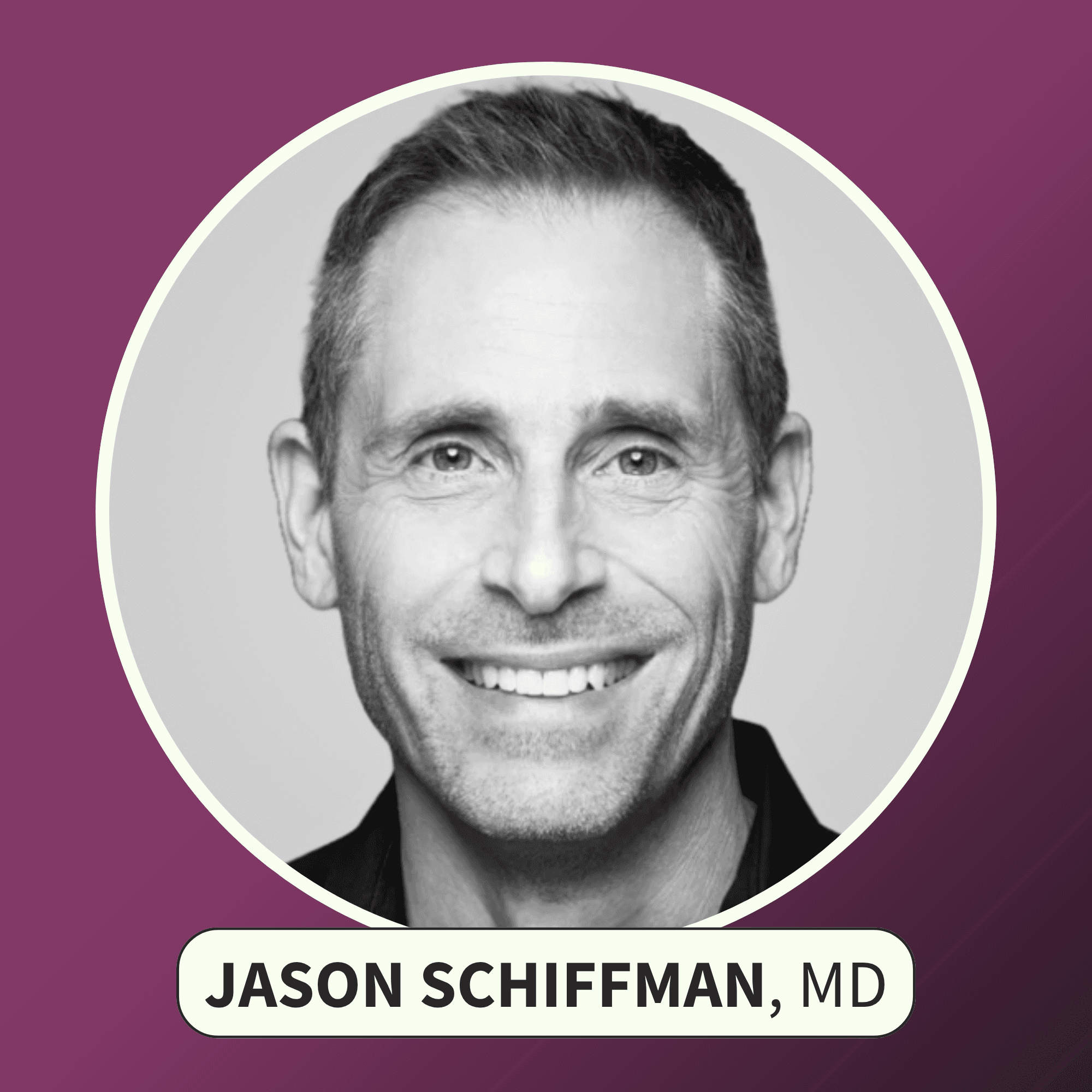
Healing Addiction with Jason Schiffman,MD
After surviving addiction himself, psychiatrist Dr. Jason Schiffman has devoted his career to understanding why people become addicted—and how they heal. We discuss trauma, shame, attachment, and his belief that lasting recovery begins not with treating addictive behaviors alone, but by healing deeper psychological injuries.
0:00/1:34
The Nocturnists
Season
1
Episode
0
|
Healing Addiction with Jason Schiffman,MD
After surviving addiction himself, psychiatrist Dr. Jason Schiffman has devoted his career to understanding why people become addicted—and how they heal. We discuss trauma, shame, attachment, and his belief that lasting recovery begins not with treating addictive behaviors alone, but by healing deeper psychological injuries.
0:00/1:34
About Our Guest
Jason Eric Schiffman, MD, MA, MBA is the founder of Camden Center. He is a Diplomate of the National Board of Psychiatry and Neurology and is certified in Addiction Medicine by the American Board of Preventive Medicine. He is also the founder and Medical Director of the UCLA Dual Diagnosis Program and has written extensively on the subjects of addiction, trauma, anxiety, and depression in both the academic and popular press. He completed his residency in psychiatry at the UCLA Semel Institute for Neuroscience and Human Behavior. He is a graduate of the MD/MBA program at the University of Southern California and received a Masters of Arts degree in Linguistics from UCLA where he specialized in syntax and semantics. Dr. Schiffman has extensive research experience in psychopharmacology and molecular biology and is the author of numerous scientific publications in these fields.
At Camden Center, Dr. Schiffman has pioneered the development of integrated healthcare systems for the treatment of psychiatric and addictive disorders that match patients with personalized treatments optimized for their unique biological, developmental, and psychological profile. The Camden model of care identifies and treats both the symptoms and causes of mental health disorders through diagnostic evaluation, feedback-based treatment planning, and the matching of patients with individualized, multidisciplinary teams of expert clinicians. Dr. Schiffman’s goal in the creation of Camden Center was to provide a facility offering compassionate, world-class treatment and the opportunity for each patient to achieve true recovery.
About The Show
The Nocturnists is an award-winning medical storytelling podcast, hosted by physician Emily Silverman. We feature personal stories from frontline clinicians, conversations with healthcare-related authors, and art-makers. Our mission is to humanize healthcare and foster joy, wonder, and curiosity among clinicians and patients alike.
resources
Credits
About Our Guest
Jason Eric Schiffman, MD, MA, MBA is the founder of Camden Center. He is a Diplomate of the National Board of Psychiatry and Neurology and is certified in Addiction Medicine by the American Board of Preventive Medicine. He is also the founder and Medical Director of the UCLA Dual Diagnosis Program and has written extensively on the subjects of addiction, trauma, anxiety, and depression in both the academic and popular press. He completed his residency in psychiatry at the UCLA Semel Institute for Neuroscience and Human Behavior. He is a graduate of the MD/MBA program at the University of Southern California and received a Masters of Arts degree in Linguistics from UCLA where he specialized in syntax and semantics. Dr. Schiffman has extensive research experience in psychopharmacology and molecular biology and is the author of numerous scientific publications in these fields.
At Camden Center, Dr. Schiffman has pioneered the development of integrated healthcare systems for the treatment of psychiatric and addictive disorders that match patients with personalized treatments optimized for their unique biological, developmental, and psychological profile. The Camden model of care identifies and treats both the symptoms and causes of mental health disorders through diagnostic evaluation, feedback-based treatment planning, and the matching of patients with individualized, multidisciplinary teams of expert clinicians. Dr. Schiffman’s goal in the creation of Camden Center was to provide a facility offering compassionate, world-class treatment and the opportunity for each patient to achieve true recovery.
About The Show
The Nocturnists is an award-winning medical storytelling podcast, hosted by physician Emily Silverman. We feature personal stories from frontline clinicians, conversations with healthcare-related authors, and art-makers. Our mission is to humanize healthcare and foster joy, wonder, and curiosity among clinicians and patients alike.
resources
Credits
Transcript
Note: The Nocturnists is an audio-first experience with emotion and sound design that can be difficult to fully capture in text. Transcripts are provided to support accessibility and reference, but may contain minor inaccuracies. If quoting in print, please consult the audio when possible.
Emily Silverman: This is The Nocturnists. I'm Emily Silverman. Today's episode features Dr. Jason Schiffman, psychiatrist, addiction specialist, UCLA faculty member, and founder of Camden Center, an innovative mental health clinic that takes an interdisciplinary approach to addiction and psychiatric care. Jason's own experience with addiction transformed not only his life, but the way he understands mental health and recovery. He believes addiction is rarely the primary problem. Instead, it's an attempt to relieve emotional pain that began long before the addiction itself.
His work asks a different question. Not simply how do we stop this behavior, but what was this behavior trying to solve in the first place? In our conversation, Jason and I talk about developmental trauma, shame, attachment, and why lasting recovery requires healing the wounds beneath the addiction. We also discuss Jason's forthcoming book, Epidemic of Excess, and his provocative idea that many of us, not just those with substance use disorders, are living somewhere on the spectrum of addiction. First, take a listen to Jason reading an excerpt from his upcoming book, Epidemic of Excess.
Dr. Jason Schiffman: A year before my first period of sobriety, I desperately wanted to stop using heroin. I hated my life and knew beyond a shadow of a doubt that my suffering was only going to get worse if I kept using it. In a moment of intense despair, I made the decision to quit. I flushed what I had left down the toilet, threw away my paraphernalia, deleted my dealer's number from my phone, and forced myself to suffer through terrible withdrawal symptoms. Then, two or three weeks later, the idea to use came back into my head with such force that I couldn't make it go away.
I tried to fight it off, reminding myself that all the misery I was in was only going to get worse if I relapsed. I went through all the glaringly self-evident reasons not to use. I forced myself to recount all of the things I had lost or given up for heroin. I reminded myself how empty and painful my life had become. I did all of that, came to the definitive conclusion that I should never use again, and then made the decision to go get heroin anyway. That relapse lasted about two weeks, after which I swore it off again with even more resolve than I had had the first time.
I again threw everything away, deleted my dealer's number off my phone, and went through terrible withdrawal. A few weeks later, I relapsed again. I repeated this cycle about 20 times that year. By the end, I was a shell of a person, physically and emotionally debilitated. The worst part of that year was the terrifying conclusion I reached at the end. I was completely incapable of stopping. I was trapped. I realized there was nothing I could do to give the clarity and resolve I had when I would quit to the version of myself that I knew would emerge in a few weeks and make the baffling decision to use again.
Not only did I not see a way out, I didn't see that there ever could be a way out. With the part of me that wanted to use totally unreachable by the rest of me, how could I ever escape? This is the seemingly unsolvable dilemma of addiction. How can you heal an addicted brain with an addicted brain? If you'd asked me at the moment before each of my relapses, can't you see this is a terrible idea? Aren't you aware that however good this is going to feel, it's nowhere near as bad as you are going to feel afterwards? Don't you care more about your relationships with your loved ones than you do about getting high?
The answer would have been yes to every one of those questions. Yet I used anyway because saying no to the part of me that wanted heroin in that moment created such intense dysphoria, I literally couldn't bear it. There is a scene in the book Dune by Frank Herbert where the protagonist is being put through a test. His hand is placed in a box that induces intense, progressively worsening pain. A poison needle is placed next to his neck that will be inserted and kill him if he removes his hand from the box. This is the experience of living with advanced addiction. Using is death and not using is torture.
I finally managed to put together a period of prolonged abstinence in 2001. My first day off heroin was the first day of my pre-med program at USC. I had applied to the program while in a panic about my life as a heroin addict. Being a doctor seemed like the opposite of what I had become, and enrolling in the program felt like filling out paperwork to become someone else. Once I got in, I spent the first several weeks walking around campus, nauseous and shivering, trying to distract myself by going to class and doing my homework in the library. The withdrawal was terrible, but the hardest part by far was the drive back home.
Back then, I lived in an apartment in Westwood, and when I left USC, I would have to drive north down Vermont Avenue and sit at a light to get on the 10 going west. One exit to the east was the spot where I used to buy heroin. I knew if I relapsed, I was going to die from my addiction, but another part of me demanded that I change lanes and go east. That part of me wielded a raging, unbearable thirst and used it as a weapon against the rest of me. It is difficult to describe how bad this was. It felt like being ripped in two. It was a feeling of profound, unresolvable desperation.
I would sit there at that light every day after school for weeks, often breaking down in tears while I waited for the light to turn. Somehow I managed to get on the freeway going west every time, but even now I am surprised I made it. Of all the horrific experience I endured in my heroin addiction, the psychological torture I experienced at that stoplight is the thing that motivates me most never to go back. Understanding how our drives use dysphoric feelings to influence our capacity for rational decision-making captures something of vital importance that is missed in the DSM.
There is a threshold, an invisible line, marked by the inhibitory limits of the prefrontal cortex. The moment a drive attains enough coercive power to exceed this limit is the moment it becomes an addiction. This is the moment someone goes from being a problematic drinker to being an alcoholic. It is the moment someone goes from really liking cocaine to being addicted to cocaine. It is the moment pornography use becomes a pornography addiction. It is the moment we lose the ability to stop even when we really want to.
[music]
Emily: I am sitting here with the wonderful Dr. Jason Schiffman. Jason, thank you so much for coming on the show.
Dr. Schiffman: Thank you so much for having me.
Emily: Jason, you wear many hats. You are on faculty at UCLA, and you do a lot of addiction work there. You're also an entrepreneur. You have your own clinic called Camden Center. You're also a writer, and you teach, and you speak. Maybe to begin with, you can just introduce us to the many different hats that you wear.
Dr. Schiffman: [chuckles] Well, let's see. The ones that you just named are the primary hats that I wear. The main thing that I do at this point is run Camden Center and the dual diagnosis program at UCLA. There is a connection between those two jobs. I did my psychiatry residency at UCLA after going to med school at USC. I was able, through a lot of cajoling, I guess, to convince the higher-ups at UCLA during my fourth year of residency to let me start the dual diagnosis program there. What motivated me to do that was the fact that I am an addict in recovery myself.
When I had gone through the addiction training during residency at UCLA, I kept having this feeling that I was participating in something that actually felt on the verge of unethical to me. The only offering at the time was the addiction medicine clinic. It was a medication management-only clinic, and patients would come in. Without exception, in addition to their substance use issues, they would have significant psychological problems, also depression, anxiety, often Cluster B personality issues, very often childhood trauma, including childhood sexual trauma.
When I would do these biopsychosocial assessments as a resident of these patients and then present them to my attendings, their eyes usually would glaze over and say, "Well, okay, that's great. We're going to give them Wellbutrin and Suboxone, and we'll see them back in three months." I knew in my heart-- not just in my heart, I knew in my brain that that was going to be an insufficient intervention to really move the needle to really help people. What was most disturbing to me was not that we were using ineffective tools. The medications, of course, were effective.
It was not only that we were using inadequate tools or insufficient tools, but we weren't providing the patients that were coming with an understanding of how to actually solve their problems so that they can become good stewards of their own care moving forward. That was what motivated me to start the dual diagnosis program at UCLA.
Emily: Dual diagnosis for people listening, they may have heard that phrase before, but they might not know exactly what that means. Can you explain what is that? Is that a term that you coined, or did that term already exist?
Dr. Schiffman: I definitely did not coin the term myself. It had already existed. What dual diagnosis means, at least in the context of addiction treatment, is when someone has a co-occurring substance use disorder with another psychiatric diagnosis. I'm actually glad you asked me about it because part of me regrets having named the program, the dual diagnosis program, because it implies that there exists monodiagnosis people with substance use disorders. If such people exist, I certainly have never met them.
Based upon my understanding of addiction, I actually don't think that they could exist. What I mean by that is that I believe that addiction is always a secondary issue. It is always something that starts off as a solution and then becomes its own problem.
Emily: I want to walk us back a little bit because you have a very compelling personal story. Did you always have aspirations to go into medicine, or was it your personal experience with addiction that inspired you to go into medicine and then psychiatry and then addiction psychiatry, or did wanting to be a doctor precede all of that?
Dr. Schiffman: I definitely did not always have aspirations to be a doctor. In fact, I would go so far as to say that at the time I applied to the post-baccalaureate program that enabled me to go to medical school with the intention of eventually applying to medical school, I at that point still wasn't even sure that I wanted to be a doctor. As the son of stereotypical Jewish parents, I think there was always the hope on my parents' part that I would become a doctor. There's a joke that's funny, which is, according to Jewish tradition, when does a fetus become a human being? When it graduates from medical school.
[laughter]
What I can say is, is that I definitely, in my own personal development, had significant developmental traumas that led to a shame-based sense of self. I have done multiple different things throughout my life to try to anesthetize or avoid the pain of that shame. At one point, it was drugs. I think to some degree I replaced drugs with work, which started off by going to medical school. I think the moment I decided to apply to my pre-medical program was in a moment of desperation when I was actually kicking opioids and experiencing profound opioid withdrawal.
Now, having been in decades of psychotherapy, I think I can look back on that decision and really recognize that what was going on was I had stopped taking the emotional anesthetic of the opioids. I, in a moment of exaggerated distress because of the withdrawal, was staring into the abyss of my own sense of worthlessness and shame that had been with me from the time I was a child. Had only been exacerbated by these ultimately dysfunctional ways of trying to anesthetize it, like becoming a heroin addict.
Not surprisingly, I think one of the things that popped into my head was, "Oh my God, I'll try to become a doctor," because within the culture that I developed in, that was something that was worthy of respect. That was something that I felt that at the time, "Oh, if I can become that, then I'll be worthy of love and respect."
Emily: You land in medical school, then residency. You're very successful. You develop this dual diagnosis program at UCLA. There's still some flaws in your mind in how the addiction medicine world functions, namely, like you just described, focusing disproportionately on medication management, focusing maybe not enough on the underlying developmental trauma that fuels the addiction in the first place.
Part of that journey then is striking out on your own and starting your own mental health treatment program called Camden Center. Tell us about Camden Center and how that got born. Also, I've heard you talk before about the Camden Diagnostic Ontology, I think it's called.
Dr. Schiffman: [chuckles] Yes.
Emily: I would also just love to hear about that ontology and how the philosophy of Camden Center makes it so unique.
Dr. Schiffman: Sure. I was able to start the dual diagnosis program at UCLA, and that program had to exist within the infrastructure of a large bureaucracy-ridden hospital-based system. There are benefits to large bureaucracy-ridden hospital-based systems, but there's also limitations. Given that what has really been the primary driver of my professional work has been to, I think, create what I wished would have existed when I was first getting into recovery, but didn't at the time. I recognized that to really pursue that, it was going to have to be in the private world. It was going to have to be outside of the confines of a large system.
To be honest, I started Camden a little bit on a lark and without a real understanding, I think, of whether it was going to work or not. My goal was to go out and build the best possible treatment or a system that could provide the best possible treatment for each individual. The way that started was I just did those same old thorough biopsychosocial assessments that I had done as a resident. That took into account not just the symptoms that qualified the person for whatever set of DSM diagnoses they had, but also really looked at what was the etiology of those diagnoses? What was the underlying cause?
With the understanding that, unlike a broken arm, the etiology of mental health diagnoses are crucial determinants of what effective treatment is going to look like. If you break your arm, it doesn't matter how you broke it. The solution is going to be the same. Two people with identical DSM diagnoses will have totally idiosyncratic pathways to that diagnosis, and effective treatment for them will depend crucially upon those idiosyncratic pathways.
What that meant was I would do these biopsychosocial assessments, and because I had trained in Los Angeles, because I'd been in recovery myself in Los Angeles, both addiction recovery and lots of my own psychotherapy. Because I'm generally a gregarious guy, I just knew lots and lots of clinicians across a lot of different subspecialties. What I would do is when someone would come in, I would say, "Okay, I know the team for you. I know the psychiatrist you're going to click with. I know the type of psychotherapy we need to start off with, and the specific psychotherapist that I think will be a good fit for you temperamentally."
I think the other piece was just also this understanding based, again, on my own experience of recovery, that because addiction is so multifactorial, it requires multiple different tools used in tight integration and coordination. If there was any special sauce that I created that enables Camden Center to do what it's able to do, it was actually something relatively technical and mundane. I just developed really sophisticated and redundant communication systems that essentially allowed clinicians across multiple different specialties to have a common language.
That's the Camden Diagnostic Ontology, which I can tell you about. Also, I created a system where there were multiple very easy ways for clinicians to communicate with one another outside of the traditional ways of just the clinical documentation and once-weekly staff meetings. I created daily staff meetings. I created an app that they can use to communicate asynchronously. We have this crazy way of creating HIPAA-compliant email groups that can be used among the clinicians treating a patient to communicate asynchronously, but in real time.
Again, those things seem technical and mundane, but they are the mechanism that permits the truly integrated care that I think is necessary in order to really help people actually get all the way better, which is something that the field of psychiatry and mental health in general doesn't really do right now. We help people anesthetize symptoms or attenuate symptoms, but we don't do a good job of identifying causes and healing them.
Emily: I've heard you talk about the diagnostic ontology and how often when people present to a place like UCLA or to a place like Camden Center, they're presenting with some kind of behavior. It could be an addiction behavior, that they're using a substance. It could be an eating disorder. It could be a cutting behavior. It could be any type of behavior. It doesn't even have to be addiction per se, and that you describe this inside-out way of working with the behaviors. Maybe you can explain to us how that works.
Dr. Schiffman: Well, that was a perfect setup for explaining the ontology, though. Thank you. Sometimes it can be a little bit difficult to explain just verbally without visuals. Yes, what you said is absolutely true. Most of what leads to someone presenting for help for treatment are the negative consequences of some behavior. Whether it is substance use disorder, whether it's self-injury, whether it is different types of phobic avoidance, whether it's compulsions, whether it's an eating disorder. People don't tend to present to treatment until something bad happens. [chuckles]
The unifying characteristic that every one of those behaviors has in common is that they are all really effective emotional anesthetics. They are all effective means of avoidance. They're not in and of themselves inherently bad. What causes the problems is when someone is using one of these behaviors as a coping mechanism to manage a problem that they are either unable or unwilling to identify and heal, so that the pain of that problem is chronically there.
When someone who has chronic pain that they don't understand the source of or don't know how to make go away, and then they discover something like alcohol or cannabis or bingeing on food or restricting their food or cutting themselves or engaging in some compulsion that at least temporarily replaces that chronic aching bad feeling with a moment of relief. It becomes very difficult for them not to start using that behavior like medicine and to use it chronically.
What happens then is all of the negative consequences of using something chronically to solve or to anesthetize the pain of a problem that isn't going away through that use. The thing I always say is it's like if somebody started using carrots like that, they'd eventually run into problems from eating too many carrots. In my mind, all of the focus on the specifics of the behaviors, which is how the treatment world is organized now. You go to an addiction treatment center, they're super focused on the substances you were using.
If you go to an eating disorder treatment center, they're super focused on the eating behaviors, the disordered eating behaviors. Of course, those need to be focused on, and of course, those need to be addressed. In my mind, those are reasonably superficial issues. The main problem is the purpose that that behavior was serving. The purpose it was serving was as a means of avoidance. Often, for those of us that end up with these problems, the only effective means of managing or coping with a longstanding underlying chronic source of anxiety and depression.
What we say, the model, this diagnostic ontology model basically posits that for any of these behaviorally based problems, these diagnoses that people come in with, substance use disorders, eating disorders, self-injury, et cetera. There are both biological contributions and psychological contributions. Because the DSM is agnostic in terms of underlying mechanism or etiology, it doesn't tell you. If you want to help somebody get better, you have to figure out, all right, what are the underlying biological and psychological causes? Those are going to be different for each person.
What we were just starting to talk about there was the psychological side. If there's underlying anxiety and depression-- anxiety and depression in and of themselves are not inherently pathological or bad. If there's a tiger in the room, it's appropriate to feel anxious. If you walk in on your partner cheating on you with your best friend, it's appropriate to have depressed mood after that. Those of us that go on to become addicts or people with eating disorders, or people with self-injury, it's not those of us that are just feeling anxious in the presence of tigers or just contextually having depressed mood. It's those of us who are feeling anxious or depressed all or most of the time in the absence of, or out of proportion to what's happening right now.
Emily: I want to get to the underlying drivers, biological and psychological. Before we do, I want to ask you one more question about behavior, because it's so interesting how people self-sort into these different behaviors. For example, some people might get a feeling of euphoria from cutting themselves. Some people might feel relief from restricting food and give them a sense of control. Some people might feel amazing when they drink a bunch of alcohol. Some people might feel horrible when they drink alcohol.
It's just super interesting how different people go to different behaviors for the relief and shopping addiction, porn addiction. It could be anything. I'm wondering, having probably seen hundreds, if not thousands, of patients, if you've thought at all about, is there a way to understand why people drift towards certain substances or certain behaviors? Is there a way to predict that in advance? I would love to be able to know, "You should really stay away from alcohol because you're really prone to that. It's okay for you to try dieting because you're not really prone to having a restrictive eating disorder."
It seems like people don't really know what they're prone to until they fall into the addiction. I'm just wondering if you have any thoughts about, yes, what is it about everybody's psychology that pushes them in these different directions?
Dr. Schiffman: That could be a very, very long answer, but I think I can provide a short, but hopefully satisfying one. [laughter] I think in certain cases, the coping behaviors make sense based upon what the underlying dysphoric feeling is. For example, people who have OCD, their compulsions, the reason those compulsions are what they are is because they provide relief for the underlying obsession.
If you have an underlying obsession that you are going to get sick and die because there's bacteria on you and you touch a doorknob, it makes sense that the compulsions that would bring relief to that anxiety are washing your hands. If you have developed what I call orthorexic anxiety or shame around certain food categories, which is what tends to underlie restrictive eating disorders, it makes sense that you would get relief by either avoiding eating those foods, or if you did eat them purging afterward.
I think to some degree, some of these behaviors just make logical sense because they, in a very direct way, undo or temporarily ameliorate a particular driving anxiety. However, I think that at least if we're looking at substance use disorders, my opinion is, is that this is really primarily genetically or biologically driven. I can tell you my own experience. I was a heavy but non-addicted "normal" user of alcohol, cannabis, and insufflated or sniffed cocaine when I was in college, and I never got addicted to them.
I subsequently did end up getting addicted to cocaine once I figured out that you could freebase it, and that definitely pushed me over the edge. I remember back in college, I would have a gram of cocaine just sitting in my cupboard for months, and I would go out, and I'd do a little bit and go out and have a good time and not think about it again. I would go out on the weekends and drink and have a great time. Sometimes I drank a little too much, but I never ended up crossing the line into addiction to those things.
It was not until I tried opioids, specifically heroin, that I ended up on the pathway to addiction. I think the simple reason for that is just given my neurochemistry and my biology, and however the way my brain generates my conscious experience of being alive. Those other drugs just didn't provide the level of relief or emotional numbing against my underlying shame and anxiety that opioids did. To this day, I remember the first time I smoked enough heroin to feel it, and I was a very apprehensive and cautious drug user back then, at least at the beginning.
I would only try a very little bit, and for the first several times, I didn't take enough to feel it. Because of its reputation, I kept expecting heroin to be this crazy, overwhelming rush like DMT or something. Something that was going to be transcendent. To my surprise, the first time I used enough to feel it, it was the most subtle shift, and all it felt like was relief. It just felt like, "Oh, everything's going to be okay." It felt like a knot in my chest that had been there since I was seven years old, just untied. It was a feeling I hadn't had since I was seven.
I remember I was standing in my hallway in my apartment in Westwood, and I was like, "Oh, this is exactly how it felt when I was in Allentown, Pennsylvania, when I was five years old." When I think back-- and it's funny, because I don't think most people think of Allentown, Pennsylvania, particularly like an Eden or some sort-- [laughter] For me, that's what it was because that was--
Emily: It was your childhood.
Dr. Schiffman: Well, it was before the things started that ended up being very difficult and hurtful for me, and my family started happening. I just remember, when I think back then, it's like the grass just seemed greener. The world just felt okay. I was me, and I was okay. That's what it felt like when the heroin kicked in. It was just like, "Oh, this is just what it feels like to be me, but without feeling anxious and without feeling like I'm a bad person."
Emily: Then when we slide into addiction, and I think you touched on this in your opening reading. The addiction starts to destroy your life, and you start to have this feeling of, like, "Well, I want to prioritize my relationships. I want to prioritize my career. I don't want to prioritize this." You arrive at that conclusion. Then I think you said a couple hours later, you were going to get heroin. It reminded me, I think, of a news story that I heard about screens and children. There was a parent giving an interview or something about their child.
They said that their child was sitting in the backseat of the car with an iPad, watching something or playing a game or something. I think the child was relatively young, I think around 10 or something. The child said to the parent, "I need you to take this iPad away from me right now, because I actually I can't stop playing with it." If I lean into that feeling, I've had that feeling myself we're all, on some level, addicted to our phones. I've definitely had feelings where I'm sitting on the couch and scrolling through social media or whatever, the news.
I'll say to myself in my head, "Okay, now you're going to stop and get up and go do the dishes. Now you're going to stop, and you're going to get up, and you're going to go do something useful." I can't, and I keep scrolling. It's like you're saying, it's like the executive part of the brain is just gets completely overridden, overriding, I don't know what the word is. I was wondering if you could speak a little bit to that. I think if people haven't experienced that before, personally, it might be difficult to understand what it feels like to know consciously that you should stop doing something and just not to be able to stop.
Dr. Schiffman: Well, actually, this is one of the main themes of the book that I'm writing right now, which is called the Epidemic of Excess. That was the book that I read the excerpt from at the beginning. One of the concepts that I develop in the book that I think is really useful is this idea of pre-addiction. In the same way that you can have diabetes and you can have pre diabetes, I believe very strongly that there is an invisible line that someone can cross over into addiction and that there is absolutely a categorical difference between being addicted to something and not being addicted to it.
By the way, that's something that is totally missed in the DSM diagnosis of addictive disorders. I feel like the DSM correctly captures the fact that there is a continuum, but it misses the fact that on that continuum, there is this invisible line that people can step over. One of the main points that I make in the book is some percentage of people in pre-addiction are going to cross the line into addiction. Even if they don't, all of the negative, life-destroying, or vitality-undermining, or quality-of-life-undermining characteristics that happen in the extreme form when somebody is in a full-blown addiction, like my heroin addiction, also take place in states of pre-addiction.
That we are living in a moment in time right now where there is an explosion in people that are on this continuum. In fact, I would argue that almost everyone in the modern world is somewhere on this continuum now. I think paradoxically, because it derives from things that we want to be doing, inventions that we have created because we want them. If you can tell me, I want to take your phone away, or I don't want to give it up. Yet the paradox is that it had a devastating effect on everyone's quality of life. The scenario that you were mentioning, and God, I wish my kids would have been able to say that to me at some point. It's definitely--
Emily: Seemed very insightful for a 10-year-old.
Dr. Schiffman: It was really the other side. It was me, many, many, many, many difficult arguments taking away the screens, usually unsuccessfully. That experience of existing in pre-addiction and sometimes in full addiction to our devices. To actually numerous other modern technologies, whether it is gambling, which has now become-- we're in the midst of a gambling use disorder explosion. Whether it is our relationship to highly processed foods, some people develop full-blown-- you get into dicey territory here with the eating disorder world if you start talking about food addiction.
The reality is, is that I think diagnoses like binge eating disorder can, for all intents and purposes, be conceptualized as that. What has happened is that I think around 2008, the world passed this important landmark where, prior to that point, I think most of the suffering throughout human history has been due to deprivation. I think starting around 2008, for a substantial portion of the world, the predominant source of suffering has actually been excess. Meaning it's been exposure to substances and technologies that hijack our motivational system, our reward system, and move us into the states of pre-addiction.
The pernicious thing about social media and screen-based technologies in particular, but particularly social media, is that it worsens the very origin of addiction, which is the attachment injuries that lead to states of anxiety and shame. Most people nowadays, I would argue, are caught up in at least small to moderate versions of the thing that every full-blown addict is engaged in. Which is the tragic attempt to anesthetize the shame and anxiety of attachment injuries via emotional anesthesia in ways that only end up worsening the shame and anxiety.
Emily: Right. I think at Camden Center, you've treated people who are very successful entrepreneurs, celebrities, actors, musicians, things like that. I've heard you talk about how often these very anxiety- and shame-based senses of self are what drive them to success to begin with. Rather than them getting to success first and then developing actually that meteoric ascent to professional or creative success is sometimes a symptom of trying to fill a hole inside. I don't know if that can or should be framed as a more constructive way to-- I think you were joking earlier about swapping out heroin for work, but how you think about that also?
Dr. Schiffman: One of the jokes that I make is just it's impossible for well-adjusted people to actually compete with those of us who are riddled with shame and anxiety. [laughter] At the end of the day, if you feel good about yourself and you have a sense of self where your core belief is that you're inherently worthy of love and respect, then you go out, and you enjoy your work, and you enjoy things that feel good. You tolerate things that feel bad, and you experience your life as an adventure that you get the opportunity to participate in.
You come home at the end of the day, and you spend it with your loved ones, and you enjoy yourself, and you have a meaningful life. If you have at your core belief that you are somehow inherently broken, bad, or defective, and that's the feeling that's waiting for you whenever things get quiet. Then you don't come home at the end of the day, you stay at work [laughs] trying to prove in some way that you are worthy of love and respect. Whether that's trying to make it in the entertainment industry or trying to become a doctor or get a million degrees.
Yes, of course, workaholism is a much more dysfunctional coping mechanism than heroin addiction. Yes, you're right. I do think that one of the things I have noticed is that almost every patient that I've treated who is successful in some regard, whether it's in the entertainment industry, whether it's in business, whether it's sports, whatever it is. The reason that they're that successful is, of course, obviously some degree of inherent skill and capability. Much more often it's because they have an insatiable level of drive that is fundamentally rooted in a coping mechanism to try to prove that they're worthy of love and respect.
Unfortunately, it never works. It's like being on a treadmill trying to get to a carrot that you never get to. If you don't have your own sense of lovability and respect worthiness as an axiom, [chuckles] then you don't ever get to it. You just get locked in an infinite attempt to try to prove it, and you never get there.
[music]
Emily: You talked about how these behaviors, whatever they may be, are often there to solve feelings that come up because of whatever it is. I think I've heard you in the past describe it as trauma templates. How something that can happen is you're a person, you have the history that you have, you have the predispositions that you have, you have the stories that you have in your head, and you navigate the world, and situations come up. You meet people, you get into situations, and there might be a moment where your trauma template gets activated. You might experience distress in a situation that wouldn't distress someone else, for example.
Tell us about that because if we're peeling back the layers, that is the distress that we're treating with these behaviors. Let's peel it a layer deeper and get into some of these trauma templates. I've heard you talk about these ideas of a false positive and teach us about that.
Dr. Schiffman: No, absolutely. That actually loops back to the Camden Diagnostic Ontology, which is, I'd said that for every behaviorally based DSM diagnosis, there are both biological and psychological contributions. On the psychological side, the origin are what I call trauma narrative templates, actually. Well, actually, trauma templates in general and trauma narrative templates are a specific instance of them. It is the activation of an old template by something that's happening currently that isn't actually dangerous or bad, but is sufficiently similar to something that was dangerous or bad that happened a long time ago and created a template.
It is that activation of that template that leads to somebody having chronic feelings of anxiety and depression, again, in the absence of or out of proportion to what's happening now. Again, it is that chronic disproportionate anxiety and depression that then leads people to seek chronic means of anesthesia through these behaviors that then lead to them having the problems that they present a treatment with. Yes, you're absolutely right. At the end of the day, if you really want to help someone who comes in with an addiction, or an eating disorder, or self-injury get all the way better, you have to work yourself from the outside in.
You have to help them learn how to stop those behaviors. You then have to give them tools to help manage and attenuate the dysphoria that those behaviors were anesthetizing. Ultimately, you have to help them identify the templates and then help them actually heal those templates. What do we mean by trauma template? The example I like to use is this idea, or an example of a bear attack. If you get attacked by a bear, your brain is going to create a template around that event. That makes perfect sense evolutionarily because it doesn't really help you to only remember to just be afraid of that one particular bear that attacks you.
It's the template of bear attack that enables you to generalize all of the thoughts and feelings and behaviors that helped you survive the initial bear attack to future situations that might be similar to a bear attack, like attacked by a different bear. If everything goes well and works as it should, then what happens is, is that bear attack template just lives dormantly in your brain until the next time there's a bear. What can happen is, is if we're not able to return to a sense of safety after a distressing event, that's where trauma happens.
In fact, one of the things that's often said in the psychotherapeutic work around trauma is that it's not actually the event that causes trauma. It's what happens afterward. Humans have an amazing resilience, an amazing capacity to get through horrific stuff and be actually emotionally okay afterward. In order for that to happen, in order not to develop PTSD in its varying forms, we have to be able to return to a sense of safety. The reason is easy to understand or self-evident when you think about what might happen in a bear attack if you're not able to return to a sense of safety.
If you get attacked by a bear and you survive it, but then you can never figure out, "Wait, how did I get attacked by a bear? Why did I get attacked by a bear? What are the circumstances that I can use to make sure that I don't get attacked by a bear again in the future?" Then what happens is that template that gets created from that event and is there to help you, really your brain has no idea when to activate it and when not to. What it does is it sets the threshold for activation incredibly low.
When our templates from our distressing events have really low activation thresholds, that's when they become trauma. That's when they become trauma templates. They become like fire alarms in our house that go off every time we make pasta or take a shower. There's no fire, but the fire alarm's going off. Using this bear attack example, if that's what happens, you have this really low threshold on your bear attack template, then what's going to start happening is it's going to start getting activated in situations that have nothing to do with getting attacked by a bear.
Hearing the leaves rustle, because the leaves rustling just arbitrarily was something that happened during the bear attack. If that happens, then every time the leaves rustle, your bear attack template gets activated, and you start feeling all of the impending sense of doom, and tension, and anxiety, and racing heartbeat, and sweaty palms, and a sense of needing to escape something terrible. The issue is there's no bear. In fact, our templates operate in the background. When that happens, you don't even know that the reason you're having all of those feelings is because of the bear attack.
All you know is it feels like that feeling of doom has to do with the leaves. What you start doing is you start avoiding leaves, and then you start maybe drinking a little bit before you go out if you know you're going to have to be around leaves. Ultimately, this is what all of us with addiction eventually have to discover for ourselves. What are those underlying trauma templates? Then what we have to do is do what didn't happen at the time, which is go back and get to a place of safety. Most of what happens to us when we're kids, we have no control over whether we get to a sense of safety or not.
If your dad beats the shit out of you and then doesn't come back to apologize afterward and tell you that he loves you and that that was a mistake, there is no return to a sense of safety after that. What you end up then developing is a trauma template where, when you're around men in position of authority, you start feeling anxious and shame and start doing compulsive things to try to convince them that you're not bad. If you take that to its logical conclusion, you end up going to medical school. [laughter]
Emily: Just as an example. Well, a bear attack is a pretty discreet event. People sometimes talk about capital T trauma, lowercase T trauma. Capital T trauma, I think of as more discreet. Maybe this isn't the right way to think about it, but I think of it as more discreet. Bear attack, car accident, rape event, something like that. Then there's all this little T trauma, which can be more chronic and more relational. For example, if you were in an abusive relationship with a parent or with a partner, or if somebody abandoned you, maybe they came back, and then they abandoned you again, or something like that.
Let's say you're a person with that history, and then you're going out in the world, and you're trying to date or something. You've been seeing someone for a few months. Then one day, they said that they would call you, and they don't. It just feels a little bit more muddy to me because that person is under no obligation to marry you and be with you forever. They can choose to stop dating you if they want. Yet you're carrying all of this abandonment trauma. This is just one example. I feel like the bear attack is a little easier to get your head around. What about these more murky traumas? How do you think about that differently?
Dr. Schiffman: Yes, it's an excellent question. The reason I use the bear attack example is precisely because it's so easy to get your head around. The reality is, is that the vast majority of human traumas have nothing to do with big events like getting attacked by a bear or being in an earthquake. Of course, there are major traumatic events that happen like that. The vast majority of our traumas are what I call relational traumas. Well, first off, the reason is because we've done a good job of insulating and protecting ourselves against the dangers of the natural world.
There's been a decrease in things like bear attacks. The more significant reason is because forming attachments with one another and developing a sense of self or identity that is based upon those attachments is the core thing that humans do. It is to humans what flying is to birds and swimming is to fish. If you look at, like, well, what is the human evolutionary adaptation? We've got prehensile thumbs, and we can do a few things, but we do almost nothing very well. You take a naked human and drop them off in the woods, and they're probably going to die.
In fact, there's been TV shows made about this because of that fact. We don't swim very fast. We don't run very fast. It's very, very hard for us without collaborating with others to get food. Yet you put us together, and we've become the most dominant species on Earth. Our core adaptation is the ability to form affiliative attachments, loving attachments with one another, and use language and other non-linguistic forms of communication to communicate our thoughts and feelings to one another.
The entirety of our cognitive emotional system is anchored in that process in the same way that I'm sure the entire cognitive emotional system of bats is probably anchored in echolocation in some way. This is our version of echolocation. We are exquisitely attuned and obsessional about who we are in the eyes of the people around us. That is the primary determinant of what we feel like. There is this very important period in our life, a critical period from birth until around puberty, when we are acquiring things that get programmed in at a deep level.
The classic one is language. You take a kid, and before puberty, you put them in France, they're going to speak French. You don't have to teach it to them. Then it gets really sunk in. After that, if you try to learn French afterward, it's very difficult. The same thing happens with our core sense of identity, our core sense of self. Who am I? We are born asking this question, and we're born asking it in a way of mostly like, am I lovable? Am I worthy of love? Am I worthy of respect? If I am, is that because inherently who I am can't be gained or lost, or is it dependent upon looking or being or performing or doing a certain thing?
We get answers to those questions, by the way, in the relationships with the important adults and peers and siblings in our line, soccer coaches. How we are treated, how we are viewed by the people around us when we are growing up, is who we believe ourselves to be. What's crazy about this is it's so fucking arbitrary. The thing that feels truest about you is who you were according to the arbitrary people that you happen to be born to and around.
Emily: It's so true because I was relinquished and then adopted when I was three days old and grew up in a house with parents, but I always knew I was adopted. I always did feel a little bit like an alien in my house and on the planet. I remember you'll be online and you'll see these personality quizzes, and it'll be like, which Disney princess are you? Or which character from Sex and the City are you? Then you'll take a quick-- or it'll be personality tests like the Myers-Briggs or the Enneagram, and things like that. I always loved those.
I think part of that was that I was just so desperate to understand what and who I was, because I really didn't have any information about where I came from until very late in life, until I was 33. Anyway, I just wanted to share that because I think that primal drive to understand, like, who am I? Where do I come from? How do I fit into all this? It is just so primal.
Dr. Schiffman: It is. One of the things that-- you can do a thought experiment right now, reflecting on it. Our sense of self is always there. It is the primary lens through which we are experiencing whatever's happening in the present moment. It is what gives the present moment its emotional flavor or color. If, in a particular moment, you believe yourself in that moment to be lovable and worthy of respect, the moment that you're in the world feels safe in that moment. The world feels open and full of opportunity. The stressors in your life feel like challenges that you get to work on.
Conversely, if who you believe yourself to be in that moment is somebody who might be bad or unlovable or unworthy of respect or gross or stupid or whatever, whatever, something negative, the environment feels hostile and cold and empty. Until you reflect on it, you don't really realize this. You start trying to fix your feelings by going and doing things in the world, which of course are important things to do. It's important to go out and do things in the world. If you don't have any food to eat, you're going to be hungry. If you don't have a place to live, you're going to be cold.
Hands down, the most effective thing that we can do is learn to update our sense of self in a way where we love ourselves, where we experience ourselves as inherently worthy of love and respect. It's not an intellectual thing. It's partially intellectual, but it really is a relational thing. The way I try to describe it to my patients is whatever you're doing inside with your dog, when you see your dog, and you're like, "Oh, I love you." It's some sort of action. That's what you have to do with yourself. You have to form a bond, a loving bond or connection with yourself.
The thing to get back to, how do we heal our developmental trauma templates? It's learning to be loving parents for ourselves in exactly the way in which our parents were unable to, not because we weren't lovable and not because our parents are bad people, but just because the combination of who we were temperamentally, the environment we were in. Our own parents' limitations left us with the impression, true or untrue, that we were somehow fundamentally flawed or broken or bad or unworthy of love and respect in a particular way.
Those are the little nooks and crannies we have to figure out and clean and learn to love in order to heal the source of the pain that we were anesthetizing with the food or the drugs or the cutting or the disordered eating.
Emily: It's a lot easier said than done, obviously. There's a bunch of different modalities for how to do this. I don't know, there's DBT, there's IFS, there's equine therapy and animal therapy, there's psychotherapy, there's psychedelic experiences. There's so many different ways to get at that problem of arriving at that sense of loving self-connection. In the addiction world, AA was an attempt, I think, to go deeper in that way.
How do you think about modalities and how to-- obviously, huge question, but with any given patient or any given individual, how do you know where to steer them? Like, "Oh, this person would be really great for this," or, "That person would really benefit from AA. This person, probably not a good candidate." How do you sort people?
Dr. Schiffman: That's an excellent question. It actually gets back to what we talked about at the very beginning, which is that I feel that the fundamental flaw of current addiction and mental health treatment that is the cause for the bad outcomes that are the norm is an inability to understand that each one of these modalities is just a tool. You have to select the right tool at the right time in the right combination. I think that tool analogy is really important to understand. It's not the tool that fixes the car. It's the mechanic selecting the right tool at the right time. [laughs]
In general, what I would say is that the behavioral therapies, so CBT and all of its offspring, like DBT and ACT and all of their offspring, they are excellent first passes. They do a really, really good job of helping people learn how to self-soothe, how to tolerate distress, how to be more effective interpersonally, to identify their cognitive distortions, how to change their cognitive distortions.
I think that without doing that first, it's very hard to do the more deeper work of the trauma modalities and in the more psychodynamic work, because it's a little bit like doing surgery. It's like when you start poking around at that deep stuff, it hurts. You need to have a certain level of ability to soothe yourself, to stay within a frame of safety to-
Emily: Distress tolerance.
Dr. Schiffman: -distress tolerance. When someone comes in with, for example, an addictive disorder, I will usually encourage them to make use of one of the community-based modalities, whether that's 12-step or Recovery Dharma or SMART Recovery. One of the things that is of crucial importance, I think, in recovery from addiction and probably recovery from almost everything else, but there's just not as many good options, is this ability to be part of a community of people who are in the path and the journey with you, and that's very difficult to attain in other circumstances.
There is a spiritual component to 12-Step, and some of the other ones, which I can talk about in a second, that can also be very helpful for some people, but I think even in the absence of that spiritual component, just the community-based component is helpful. Starting off with that, and a behavioral therapy like DBT is almost always the right first approach. The behavioral therapies do not identify underlying core trauma templates and use the relationship with the therapist as a way to heal those, and so that's when the other tools of the more psychodynamic therapies start becoming more useful.
I feel comfortable saying that as a general rule, but again, the whole point is that you got to use the right tools at the right time for each individual person. It might be that somebody comes in and all they need is 12-step. Listen, until 1935, there was no treatment for addiction. People either died with their addiction or died from it. Then, from 1935 until really recently, if AA didn't get you better, that was it for you. A lot of people got better enough, and so there are some people for whom that's enough. For me, it wasn't enough.
I would argue in my own recovery that that 12-step participation at the beginning was necessary but wasn't sufficient. I think the difference between the way that I approach treatment and the way we approach treatment at Camden, from the way that treatment was approached with me back then, and it still is very often, is just because what worked for me worked for me, I don't presume that that's the same thing that's going to work for the patient that happens to be sitting in front of me.
Emily: We've covered a lot of ground. Is there anything else that we didn't talk about that you want to leave us with as we bring this to a close? I would love to just hear any messages that you have for people listening. As you know, our audience is largely clinicians-not all, but many physicians and nurses and other healthcare workers who are prone to certain types of mental health disorders.
We did a whole podcast series on the topic of Shame in Medicine. I think in that exploration, we talked a lot about how the profession tends to attract, for better or for worse, people who have a shame-based sense of self. Which sounds like that might have been true for you, probably true for me too, on some level, and true for many of us. For our audience, anything that you would like to leave us with, any I don't know further reading or just final points that you'd like to share?
Dr. Schiffman: I think maybe with that as context, really just to emphasize the importance of self-care and learning to heal the things that I think for many of us that go into medicine or healthcare are also the sources of our sense of inadequacy. One of the things I like to say is that at least in therapy, psychotherapy, it's very hard to get your patients any better than you are.
I really view it as this wonderful synergy, which is the best thing you can do in your role as a healer is to really learn how to love and heal yourself. Let's put it this way. My hope is that the core principle at Camden, which is that you cannot fragment or take apart the biological from the psychological. You cannot treat yourself or your patient's biology without also, to some degree, taking into consideration their psychology hardware and software, and vice versa.
I just hope that that's where the field really is actually moving. People have been talking about the mind-body connection for decades or hundreds of years, probably, but I don't know that it has, in a pragmatic way, really been implemented into the way that we practice medicine here, both in the way that we treat our patients, the way that we organize our healthcare system, the way that we pay for healthcare, and also in the way that we treat ourselves.
I do have a little bit of a bone to pick with my own field of psychiatry, which is that I feel like it keeps trying to turn into. Neurology, [laugh] The advances that we're making in our understanding of the hardware of the brain are so exciting that I think we've become enchanted with them and myopically focused on them. This is by no means saying that we shouldn't be enchanted and focused on them, but not to the detriment or the abandonment of attention to the software component, meaning the product of what all of
that brain hardware is actually doing.
I do think, unfortunately, the way that we think about it is influencing the way the world thinks about it. I just feel the world right now moving more and more and more towards looking to pharmacology as the solution, and I am a die-hard psychopharmacologist. I was both as a user and as a prescriber. I love drugs, the bad kind and the good kind, and I've done a ton of research on drugs.
I love psychopharmacology, but I do think that the predominant practice in psychiatry of trying to fix things just with this one tool of medications is bound to be ineffective and in some way causing harm by implying that somehow that could be the sole answer. Somebody got depressed enough to need Prozac, they're depressed enough to need psychotherapy.
Emily: I feel like we could go on for so much longer, but I know that we have to end. One last thing before we do is, I know your book isn't going to be coming out for a while, but maybe you can just shout out the title and let people mark it in their mind, so that when it does come out, they can keep an eye out for it.
Dr. Schiffman: Book is titled Epidemic of Excess. It's coming out on Viking Penguin Random House, and if I get the manuscript done on time, it should be coming out somewhere mid-2027.
Emily: Amazing. Dr. Jason Schiffman, thank you so much for coming on The Nocturnists and teaching us so much today, so really, really enjoyed this conversation.
Dr. Schiffman: My pleasure. Thanks so much, Emily.
Transcript
Note: The Nocturnists is an audio-first experience with emotion and sound design that can be difficult to fully capture in text. Transcripts are provided to support accessibility and reference, but may contain minor inaccuracies. If quoting in print, please consult the audio when possible.
Emily Silverman: This is The Nocturnists. I'm Emily Silverman. Today's episode features Dr. Jason Schiffman, psychiatrist, addiction specialist, UCLA faculty member, and founder of Camden Center, an innovative mental health clinic that takes an interdisciplinary approach to addiction and psychiatric care. Jason's own experience with addiction transformed not only his life, but the way he understands mental health and recovery. He believes addiction is rarely the primary problem. Instead, it's an attempt to relieve emotional pain that began long before the addiction itself.
His work asks a different question. Not simply how do we stop this behavior, but what was this behavior trying to solve in the first place? In our conversation, Jason and I talk about developmental trauma, shame, attachment, and why lasting recovery requires healing the wounds beneath the addiction. We also discuss Jason's forthcoming book, Epidemic of Excess, and his provocative idea that many of us, not just those with substance use disorders, are living somewhere on the spectrum of addiction. First, take a listen to Jason reading an excerpt from his upcoming book, Epidemic of Excess.
Dr. Jason Schiffman: A year before my first period of sobriety, I desperately wanted to stop using heroin. I hated my life and knew beyond a shadow of a doubt that my suffering was only going to get worse if I kept using it. In a moment of intense despair, I made the decision to quit. I flushed what I had left down the toilet, threw away my paraphernalia, deleted my dealer's number from my phone, and forced myself to suffer through terrible withdrawal symptoms. Then, two or three weeks later, the idea to use came back into my head with such force that I couldn't make it go away.
I tried to fight it off, reminding myself that all the misery I was in was only going to get worse if I relapsed. I went through all the glaringly self-evident reasons not to use. I forced myself to recount all of the things I had lost or given up for heroin. I reminded myself how empty and painful my life had become. I did all of that, came to the definitive conclusion that I should never use again, and then made the decision to go get heroin anyway. That relapse lasted about two weeks, after which I swore it off again with even more resolve than I had had the first time.
I again threw everything away, deleted my dealer's number off my phone, and went through terrible withdrawal. A few weeks later, I relapsed again. I repeated this cycle about 20 times that year. By the end, I was a shell of a person, physically and emotionally debilitated. The worst part of that year was the terrifying conclusion I reached at the end. I was completely incapable of stopping. I was trapped. I realized there was nothing I could do to give the clarity and resolve I had when I would quit to the version of myself that I knew would emerge in a few weeks and make the baffling decision to use again.
Not only did I not see a way out, I didn't see that there ever could be a way out. With the part of me that wanted to use totally unreachable by the rest of me, how could I ever escape? This is the seemingly unsolvable dilemma of addiction. How can you heal an addicted brain with an addicted brain? If you'd asked me at the moment before each of my relapses, can't you see this is a terrible idea? Aren't you aware that however good this is going to feel, it's nowhere near as bad as you are going to feel afterwards? Don't you care more about your relationships with your loved ones than you do about getting high?
The answer would have been yes to every one of those questions. Yet I used anyway because saying no to the part of me that wanted heroin in that moment created such intense dysphoria, I literally couldn't bear it. There is a scene in the book Dune by Frank Herbert where the protagonist is being put through a test. His hand is placed in a box that induces intense, progressively worsening pain. A poison needle is placed next to his neck that will be inserted and kill him if he removes his hand from the box. This is the experience of living with advanced addiction. Using is death and not using is torture.
I finally managed to put together a period of prolonged abstinence in 2001. My first day off heroin was the first day of my pre-med program at USC. I had applied to the program while in a panic about my life as a heroin addict. Being a doctor seemed like the opposite of what I had become, and enrolling in the program felt like filling out paperwork to become someone else. Once I got in, I spent the first several weeks walking around campus, nauseous and shivering, trying to distract myself by going to class and doing my homework in the library. The withdrawal was terrible, but the hardest part by far was the drive back home.
Back then, I lived in an apartment in Westwood, and when I left USC, I would have to drive north down Vermont Avenue and sit at a light to get on the 10 going west. One exit to the east was the spot where I used to buy heroin. I knew if I relapsed, I was going to die from my addiction, but another part of me demanded that I change lanes and go east. That part of me wielded a raging, unbearable thirst and used it as a weapon against the rest of me. It is difficult to describe how bad this was. It felt like being ripped in two. It was a feeling of profound, unresolvable desperation.
I would sit there at that light every day after school for weeks, often breaking down in tears while I waited for the light to turn. Somehow I managed to get on the freeway going west every time, but even now I am surprised I made it. Of all the horrific experience I endured in my heroin addiction, the psychological torture I experienced at that stoplight is the thing that motivates me most never to go back. Understanding how our drives use dysphoric feelings to influence our capacity for rational decision-making captures something of vital importance that is missed in the DSM.
There is a threshold, an invisible line, marked by the inhibitory limits of the prefrontal cortex. The moment a drive attains enough coercive power to exceed this limit is the moment it becomes an addiction. This is the moment someone goes from being a problematic drinker to being an alcoholic. It is the moment someone goes from really liking cocaine to being addicted to cocaine. It is the moment pornography use becomes a pornography addiction. It is the moment we lose the ability to stop even when we really want to.
[music]
Emily: I am sitting here with the wonderful Dr. Jason Schiffman. Jason, thank you so much for coming on the show.
Dr. Schiffman: Thank you so much for having me.
Emily: Jason, you wear many hats. You are on faculty at UCLA, and you do a lot of addiction work there. You're also an entrepreneur. You have your own clinic called Camden Center. You're also a writer, and you teach, and you speak. Maybe to begin with, you can just introduce us to the many different hats that you wear.
Dr. Schiffman: [chuckles] Well, let's see. The ones that you just named are the primary hats that I wear. The main thing that I do at this point is run Camden Center and the dual diagnosis program at UCLA. There is a connection between those two jobs. I did my psychiatry residency at UCLA after going to med school at USC. I was able, through a lot of cajoling, I guess, to convince the higher-ups at UCLA during my fourth year of residency to let me start the dual diagnosis program there. What motivated me to do that was the fact that I am an addict in recovery myself.
When I had gone through the addiction training during residency at UCLA, I kept having this feeling that I was participating in something that actually felt on the verge of unethical to me. The only offering at the time was the addiction medicine clinic. It was a medication management-only clinic, and patients would come in. Without exception, in addition to their substance use issues, they would have significant psychological problems, also depression, anxiety, often Cluster B personality issues, very often childhood trauma, including childhood sexual trauma.
When I would do these biopsychosocial assessments as a resident of these patients and then present them to my attendings, their eyes usually would glaze over and say, "Well, okay, that's great. We're going to give them Wellbutrin and Suboxone, and we'll see them back in three months." I knew in my heart-- not just in my heart, I knew in my brain that that was going to be an insufficient intervention to really move the needle to really help people. What was most disturbing to me was not that we were using ineffective tools. The medications, of course, were effective.
It was not only that we were using inadequate tools or insufficient tools, but we weren't providing the patients that were coming with an understanding of how to actually solve their problems so that they can become good stewards of their own care moving forward. That was what motivated me to start the dual diagnosis program at UCLA.
Emily: Dual diagnosis for people listening, they may have heard that phrase before, but they might not know exactly what that means. Can you explain what is that? Is that a term that you coined, or did that term already exist?
Dr. Schiffman: I definitely did not coin the term myself. It had already existed. What dual diagnosis means, at least in the context of addiction treatment, is when someone has a co-occurring substance use disorder with another psychiatric diagnosis. I'm actually glad you asked me about it because part of me regrets having named the program, the dual diagnosis program, because it implies that there exists monodiagnosis people with substance use disorders. If such people exist, I certainly have never met them.
Based upon my understanding of addiction, I actually don't think that they could exist. What I mean by that is that I believe that addiction is always a secondary issue. It is always something that starts off as a solution and then becomes its own problem.
Emily: I want to walk us back a little bit because you have a very compelling personal story. Did you always have aspirations to go into medicine, or was it your personal experience with addiction that inspired you to go into medicine and then psychiatry and then addiction psychiatry, or did wanting to be a doctor precede all of that?
Dr. Schiffman: I definitely did not always have aspirations to be a doctor. In fact, I would go so far as to say that at the time I applied to the post-baccalaureate program that enabled me to go to medical school with the intention of eventually applying to medical school, I at that point still wasn't even sure that I wanted to be a doctor. As the son of stereotypical Jewish parents, I think there was always the hope on my parents' part that I would become a doctor. There's a joke that's funny, which is, according to Jewish tradition, when does a fetus become a human being? When it graduates from medical school.
[laughter]
What I can say is, is that I definitely, in my own personal development, had significant developmental traumas that led to a shame-based sense of self. I have done multiple different things throughout my life to try to anesthetize or avoid the pain of that shame. At one point, it was drugs. I think to some degree I replaced drugs with work, which started off by going to medical school. I think the moment I decided to apply to my pre-medical program was in a moment of desperation when I was actually kicking opioids and experiencing profound opioid withdrawal.
Now, having been in decades of psychotherapy, I think I can look back on that decision and really recognize that what was going on was I had stopped taking the emotional anesthetic of the opioids. I, in a moment of exaggerated distress because of the withdrawal, was staring into the abyss of my own sense of worthlessness and shame that had been with me from the time I was a child. Had only been exacerbated by these ultimately dysfunctional ways of trying to anesthetize it, like becoming a heroin addict.
Not surprisingly, I think one of the things that popped into my head was, "Oh my God, I'll try to become a doctor," because within the culture that I developed in, that was something that was worthy of respect. That was something that I felt that at the time, "Oh, if I can become that, then I'll be worthy of love and respect."
Emily: You land in medical school, then residency. You're very successful. You develop this dual diagnosis program at UCLA. There's still some flaws in your mind in how the addiction medicine world functions, namely, like you just described, focusing disproportionately on medication management, focusing maybe not enough on the underlying developmental trauma that fuels the addiction in the first place.
Part of that journey then is striking out on your own and starting your own mental health treatment program called Camden Center. Tell us about Camden Center and how that got born. Also, I've heard you talk before about the Camden Diagnostic Ontology, I think it's called.
Dr. Schiffman: [chuckles] Yes.
Emily: I would also just love to hear about that ontology and how the philosophy of Camden Center makes it so unique.
Dr. Schiffman: Sure. I was able to start the dual diagnosis program at UCLA, and that program had to exist within the infrastructure of a large bureaucracy-ridden hospital-based system. There are benefits to large bureaucracy-ridden hospital-based systems, but there's also limitations. Given that what has really been the primary driver of my professional work has been to, I think, create what I wished would have existed when I was first getting into recovery, but didn't at the time. I recognized that to really pursue that, it was going to have to be in the private world. It was going to have to be outside of the confines of a large system.
To be honest, I started Camden a little bit on a lark and without a real understanding, I think, of whether it was going to work or not. My goal was to go out and build the best possible treatment or a system that could provide the best possible treatment for each individual. The way that started was I just did those same old thorough biopsychosocial assessments that I had done as a resident. That took into account not just the symptoms that qualified the person for whatever set of DSM diagnoses they had, but also really looked at what was the etiology of those diagnoses? What was the underlying cause?
With the understanding that, unlike a broken arm, the etiology of mental health diagnoses are crucial determinants of what effective treatment is going to look like. If you break your arm, it doesn't matter how you broke it. The solution is going to be the same. Two people with identical DSM diagnoses will have totally idiosyncratic pathways to that diagnosis, and effective treatment for them will depend crucially upon those idiosyncratic pathways.
What that meant was I would do these biopsychosocial assessments, and because I had trained in Los Angeles, because I'd been in recovery myself in Los Angeles, both addiction recovery and lots of my own psychotherapy. Because I'm generally a gregarious guy, I just knew lots and lots of clinicians across a lot of different subspecialties. What I would do is when someone would come in, I would say, "Okay, I know the team for you. I know the psychiatrist you're going to click with. I know the type of psychotherapy we need to start off with, and the specific psychotherapist that I think will be a good fit for you temperamentally."
I think the other piece was just also this understanding based, again, on my own experience of recovery, that because addiction is so multifactorial, it requires multiple different tools used in tight integration and coordination. If there was any special sauce that I created that enables Camden Center to do what it's able to do, it was actually something relatively technical and mundane. I just developed really sophisticated and redundant communication systems that essentially allowed clinicians across multiple different specialties to have a common language.
That's the Camden Diagnostic Ontology, which I can tell you about. Also, I created a system where there were multiple very easy ways for clinicians to communicate with one another outside of the traditional ways of just the clinical documentation and once-weekly staff meetings. I created daily staff meetings. I created an app that they can use to communicate asynchronously. We have this crazy way of creating HIPAA-compliant email groups that can be used among the clinicians treating a patient to communicate asynchronously, but in real time.
Again, those things seem technical and mundane, but they are the mechanism that permits the truly integrated care that I think is necessary in order to really help people actually get all the way better, which is something that the field of psychiatry and mental health in general doesn't really do right now. We help people anesthetize symptoms or attenuate symptoms, but we don't do a good job of identifying causes and healing them.
Emily: I've heard you talk about the diagnostic ontology and how often when people present to a place like UCLA or to a place like Camden Center, they're presenting with some kind of behavior. It could be an addiction behavior, that they're using a substance. It could be an eating disorder. It could be a cutting behavior. It could be any type of behavior. It doesn't even have to be addiction per se, and that you describe this inside-out way of working with the behaviors. Maybe you can explain to us how that works.
Dr. Schiffman: Well, that was a perfect setup for explaining the ontology, though. Thank you. Sometimes it can be a little bit difficult to explain just verbally without visuals. Yes, what you said is absolutely true. Most of what leads to someone presenting for help for treatment are the negative consequences of some behavior. Whether it is substance use disorder, whether it's self-injury, whether it is different types of phobic avoidance, whether it's compulsions, whether it's an eating disorder. People don't tend to present to treatment until something bad happens. [chuckles]
The unifying characteristic that every one of those behaviors has in common is that they are all really effective emotional anesthetics. They are all effective means of avoidance. They're not in and of themselves inherently bad. What causes the problems is when someone is using one of these behaviors as a coping mechanism to manage a problem that they are either unable or unwilling to identify and heal, so that the pain of that problem is chronically there.
When someone who has chronic pain that they don't understand the source of or don't know how to make go away, and then they discover something like alcohol or cannabis or bingeing on food or restricting their food or cutting themselves or engaging in some compulsion that at least temporarily replaces that chronic aching bad feeling with a moment of relief. It becomes very difficult for them not to start using that behavior like medicine and to use it chronically.
What happens then is all of the negative consequences of using something chronically to solve or to anesthetize the pain of a problem that isn't going away through that use. The thing I always say is it's like if somebody started using carrots like that, they'd eventually run into problems from eating too many carrots. In my mind, all of the focus on the specifics of the behaviors, which is how the treatment world is organized now. You go to an addiction treatment center, they're super focused on the substances you were using.
If you go to an eating disorder treatment center, they're super focused on the eating behaviors, the disordered eating behaviors. Of course, those need to be focused on, and of course, those need to be addressed. In my mind, those are reasonably superficial issues. The main problem is the purpose that that behavior was serving. The purpose it was serving was as a means of avoidance. Often, for those of us that end up with these problems, the only effective means of managing or coping with a longstanding underlying chronic source of anxiety and depression.
What we say, the model, this diagnostic ontology model basically posits that for any of these behaviorally based problems, these diagnoses that people come in with, substance use disorders, eating disorders, self-injury, et cetera. There are both biological contributions and psychological contributions. Because the DSM is agnostic in terms of underlying mechanism or etiology, it doesn't tell you. If you want to help somebody get better, you have to figure out, all right, what are the underlying biological and psychological causes? Those are going to be different for each person.
What we were just starting to talk about there was the psychological side. If there's underlying anxiety and depression-- anxiety and depression in and of themselves are not inherently pathological or bad. If there's a tiger in the room, it's appropriate to feel anxious. If you walk in on your partner cheating on you with your best friend, it's appropriate to have depressed mood after that. Those of us that go on to become addicts or people with eating disorders, or people with self-injury, it's not those of us that are just feeling anxious in the presence of tigers or just contextually having depressed mood. It's those of us who are feeling anxious or depressed all or most of the time in the absence of, or out of proportion to what's happening right now.
Emily: I want to get to the underlying drivers, biological and psychological. Before we do, I want to ask you one more question about behavior, because it's so interesting how people self-sort into these different behaviors. For example, some people might get a feeling of euphoria from cutting themselves. Some people might feel relief from restricting food and give them a sense of control. Some people might feel amazing when they drink a bunch of alcohol. Some people might feel horrible when they drink alcohol.
It's just super interesting how different people go to different behaviors for the relief and shopping addiction, porn addiction. It could be anything. I'm wondering, having probably seen hundreds, if not thousands, of patients, if you've thought at all about, is there a way to understand why people drift towards certain substances or certain behaviors? Is there a way to predict that in advance? I would love to be able to know, "You should really stay away from alcohol because you're really prone to that. It's okay for you to try dieting because you're not really prone to having a restrictive eating disorder."
It seems like people don't really know what they're prone to until they fall into the addiction. I'm just wondering if you have any thoughts about, yes, what is it about everybody's psychology that pushes them in these different directions?
Dr. Schiffman: That could be a very, very long answer, but I think I can provide a short, but hopefully satisfying one. [laughter] I think in certain cases, the coping behaviors make sense based upon what the underlying dysphoric feeling is. For example, people who have OCD, their compulsions, the reason those compulsions are what they are is because they provide relief for the underlying obsession.
If you have an underlying obsession that you are going to get sick and die because there's bacteria on you and you touch a doorknob, it makes sense that the compulsions that would bring relief to that anxiety are washing your hands. If you have developed what I call orthorexic anxiety or shame around certain food categories, which is what tends to underlie restrictive eating disorders, it makes sense that you would get relief by either avoiding eating those foods, or if you did eat them purging afterward.
I think to some degree, some of these behaviors just make logical sense because they, in a very direct way, undo or temporarily ameliorate a particular driving anxiety. However, I think that at least if we're looking at substance use disorders, my opinion is, is that this is really primarily genetically or biologically driven. I can tell you my own experience. I was a heavy but non-addicted "normal" user of alcohol, cannabis, and insufflated or sniffed cocaine when I was in college, and I never got addicted to them.
I subsequently did end up getting addicted to cocaine once I figured out that you could freebase it, and that definitely pushed me over the edge. I remember back in college, I would have a gram of cocaine just sitting in my cupboard for months, and I would go out, and I'd do a little bit and go out and have a good time and not think about it again. I would go out on the weekends and drink and have a great time. Sometimes I drank a little too much, but I never ended up crossing the line into addiction to those things.
It was not until I tried opioids, specifically heroin, that I ended up on the pathway to addiction. I think the simple reason for that is just given my neurochemistry and my biology, and however the way my brain generates my conscious experience of being alive. Those other drugs just didn't provide the level of relief or emotional numbing against my underlying shame and anxiety that opioids did. To this day, I remember the first time I smoked enough heroin to feel it, and I was a very apprehensive and cautious drug user back then, at least at the beginning.
I would only try a very little bit, and for the first several times, I didn't take enough to feel it. Because of its reputation, I kept expecting heroin to be this crazy, overwhelming rush like DMT or something. Something that was going to be transcendent. To my surprise, the first time I used enough to feel it, it was the most subtle shift, and all it felt like was relief. It just felt like, "Oh, everything's going to be okay." It felt like a knot in my chest that had been there since I was seven years old, just untied. It was a feeling I hadn't had since I was seven.
I remember I was standing in my hallway in my apartment in Westwood, and I was like, "Oh, this is exactly how it felt when I was in Allentown, Pennsylvania, when I was five years old." When I think back-- and it's funny, because I don't think most people think of Allentown, Pennsylvania, particularly like an Eden or some sort-- [laughter] For me, that's what it was because that was--
Emily: It was your childhood.
Dr. Schiffman: Well, it was before the things started that ended up being very difficult and hurtful for me, and my family started happening. I just remember, when I think back then, it's like the grass just seemed greener. The world just felt okay. I was me, and I was okay. That's what it felt like when the heroin kicked in. It was just like, "Oh, this is just what it feels like to be me, but without feeling anxious and without feeling like I'm a bad person."
Emily: Then when we slide into addiction, and I think you touched on this in your opening reading. The addiction starts to destroy your life, and you start to have this feeling of, like, "Well, I want to prioritize my relationships. I want to prioritize my career. I don't want to prioritize this." You arrive at that conclusion. Then I think you said a couple hours later, you were going to get heroin. It reminded me, I think, of a news story that I heard about screens and children. There was a parent giving an interview or something about their child.
They said that their child was sitting in the backseat of the car with an iPad, watching something or playing a game or something. I think the child was relatively young, I think around 10 or something. The child said to the parent, "I need you to take this iPad away from me right now, because I actually I can't stop playing with it." If I lean into that feeling, I've had that feeling myself we're all, on some level, addicted to our phones. I've definitely had feelings where I'm sitting on the couch and scrolling through social media or whatever, the news.
I'll say to myself in my head, "Okay, now you're going to stop and get up and go do the dishes. Now you're going to stop, and you're going to get up, and you're going to go do something useful." I can't, and I keep scrolling. It's like you're saying, it's like the executive part of the brain is just gets completely overridden, overriding, I don't know what the word is. I was wondering if you could speak a little bit to that. I think if people haven't experienced that before, personally, it might be difficult to understand what it feels like to know consciously that you should stop doing something and just not to be able to stop.
Dr. Schiffman: Well, actually, this is one of the main themes of the book that I'm writing right now, which is called the Epidemic of Excess. That was the book that I read the excerpt from at the beginning. One of the concepts that I develop in the book that I think is really useful is this idea of pre-addiction. In the same way that you can have diabetes and you can have pre diabetes, I believe very strongly that there is an invisible line that someone can cross over into addiction and that there is absolutely a categorical difference between being addicted to something and not being addicted to it.
By the way, that's something that is totally missed in the DSM diagnosis of addictive disorders. I feel like the DSM correctly captures the fact that there is a continuum, but it misses the fact that on that continuum, there is this invisible line that people can step over. One of the main points that I make in the book is some percentage of people in pre-addiction are going to cross the line into addiction. Even if they don't, all of the negative, life-destroying, or vitality-undermining, or quality-of-life-undermining characteristics that happen in the extreme form when somebody is in a full-blown addiction, like my heroin addiction, also take place in states of pre-addiction.
That we are living in a moment in time right now where there is an explosion in people that are on this continuum. In fact, I would argue that almost everyone in the modern world is somewhere on this continuum now. I think paradoxically, because it derives from things that we want to be doing, inventions that we have created because we want them. If you can tell me, I want to take your phone away, or I don't want to give it up. Yet the paradox is that it had a devastating effect on everyone's quality of life. The scenario that you were mentioning, and God, I wish my kids would have been able to say that to me at some point. It's definitely--
Emily: Seemed very insightful for a 10-year-old.
Dr. Schiffman: It was really the other side. It was me, many, many, many, many difficult arguments taking away the screens, usually unsuccessfully. That experience of existing in pre-addiction and sometimes in full addiction to our devices. To actually numerous other modern technologies, whether it is gambling, which has now become-- we're in the midst of a gambling use disorder explosion. Whether it is our relationship to highly processed foods, some people develop full-blown-- you get into dicey territory here with the eating disorder world if you start talking about food addiction.
The reality is, is that I think diagnoses like binge eating disorder can, for all intents and purposes, be conceptualized as that. What has happened is that I think around 2008, the world passed this important landmark where, prior to that point, I think most of the suffering throughout human history has been due to deprivation. I think starting around 2008, for a substantial portion of the world, the predominant source of suffering has actually been excess. Meaning it's been exposure to substances and technologies that hijack our motivational system, our reward system, and move us into the states of pre-addiction.
The pernicious thing about social media and screen-based technologies in particular, but particularly social media, is that it worsens the very origin of addiction, which is the attachment injuries that lead to states of anxiety and shame. Most people nowadays, I would argue, are caught up in at least small to moderate versions of the thing that every full-blown addict is engaged in. Which is the tragic attempt to anesthetize the shame and anxiety of attachment injuries via emotional anesthesia in ways that only end up worsening the shame and anxiety.
Emily: Right. I think at Camden Center, you've treated people who are very successful entrepreneurs, celebrities, actors, musicians, things like that. I've heard you talk about how often these very anxiety- and shame-based senses of self are what drive them to success to begin with. Rather than them getting to success first and then developing actually that meteoric ascent to professional or creative success is sometimes a symptom of trying to fill a hole inside. I don't know if that can or should be framed as a more constructive way to-- I think you were joking earlier about swapping out heroin for work, but how you think about that also?
Dr. Schiffman: One of the jokes that I make is just it's impossible for well-adjusted people to actually compete with those of us who are riddled with shame and anxiety. [laughter] At the end of the day, if you feel good about yourself and you have a sense of self where your core belief is that you're inherently worthy of love and respect, then you go out, and you enjoy your work, and you enjoy things that feel good. You tolerate things that feel bad, and you experience your life as an adventure that you get the opportunity to participate in.
You come home at the end of the day, and you spend it with your loved ones, and you enjoy yourself, and you have a meaningful life. If you have at your core belief that you are somehow inherently broken, bad, or defective, and that's the feeling that's waiting for you whenever things get quiet. Then you don't come home at the end of the day, you stay at work [laughs] trying to prove in some way that you are worthy of love and respect. Whether that's trying to make it in the entertainment industry or trying to become a doctor or get a million degrees.
Yes, of course, workaholism is a much more dysfunctional coping mechanism than heroin addiction. Yes, you're right. I do think that one of the things I have noticed is that almost every patient that I've treated who is successful in some regard, whether it's in the entertainment industry, whether it's in business, whether it's sports, whatever it is. The reason that they're that successful is, of course, obviously some degree of inherent skill and capability. Much more often it's because they have an insatiable level of drive that is fundamentally rooted in a coping mechanism to try to prove that they're worthy of love and respect.
Unfortunately, it never works. It's like being on a treadmill trying to get to a carrot that you never get to. If you don't have your own sense of lovability and respect worthiness as an axiom, [chuckles] then you don't ever get to it. You just get locked in an infinite attempt to try to prove it, and you never get there.
[music]
Emily: You talked about how these behaviors, whatever they may be, are often there to solve feelings that come up because of whatever it is. I think I've heard you in the past describe it as trauma templates. How something that can happen is you're a person, you have the history that you have, you have the predispositions that you have, you have the stories that you have in your head, and you navigate the world, and situations come up. You meet people, you get into situations, and there might be a moment where your trauma template gets activated. You might experience distress in a situation that wouldn't distress someone else, for example.
Tell us about that because if we're peeling back the layers, that is the distress that we're treating with these behaviors. Let's peel it a layer deeper and get into some of these trauma templates. I've heard you talk about these ideas of a false positive and teach us about that.
Dr. Schiffman: No, absolutely. That actually loops back to the Camden Diagnostic Ontology, which is, I'd said that for every behaviorally based DSM diagnosis, there are both biological and psychological contributions. On the psychological side, the origin are what I call trauma narrative templates, actually. Well, actually, trauma templates in general and trauma narrative templates are a specific instance of them. It is the activation of an old template by something that's happening currently that isn't actually dangerous or bad, but is sufficiently similar to something that was dangerous or bad that happened a long time ago and created a template.
It is that activation of that template that leads to somebody having chronic feelings of anxiety and depression, again, in the absence of or out of proportion to what's happening now. Again, it is that chronic disproportionate anxiety and depression that then leads people to seek chronic means of anesthesia through these behaviors that then lead to them having the problems that they present a treatment with. Yes, you're absolutely right. At the end of the day, if you really want to help someone who comes in with an addiction, or an eating disorder, or self-injury get all the way better, you have to work yourself from the outside in.
You have to help them learn how to stop those behaviors. You then have to give them tools to help manage and attenuate the dysphoria that those behaviors were anesthetizing. Ultimately, you have to help them identify the templates and then help them actually heal those templates. What do we mean by trauma template? The example I like to use is this idea, or an example of a bear attack. If you get attacked by a bear, your brain is going to create a template around that event. That makes perfect sense evolutionarily because it doesn't really help you to only remember to just be afraid of that one particular bear that attacks you.
It's the template of bear attack that enables you to generalize all of the thoughts and feelings and behaviors that helped you survive the initial bear attack to future situations that might be similar to a bear attack, like attacked by a different bear. If everything goes well and works as it should, then what happens is, is that bear attack template just lives dormantly in your brain until the next time there's a bear. What can happen is, is if we're not able to return to a sense of safety after a distressing event, that's where trauma happens.
In fact, one of the things that's often said in the psychotherapeutic work around trauma is that it's not actually the event that causes trauma. It's what happens afterward. Humans have an amazing resilience, an amazing capacity to get through horrific stuff and be actually emotionally okay afterward. In order for that to happen, in order not to develop PTSD in its varying forms, we have to be able to return to a sense of safety. The reason is easy to understand or self-evident when you think about what might happen in a bear attack if you're not able to return to a sense of safety.
If you get attacked by a bear and you survive it, but then you can never figure out, "Wait, how did I get attacked by a bear? Why did I get attacked by a bear? What are the circumstances that I can use to make sure that I don't get attacked by a bear again in the future?" Then what happens is that template that gets created from that event and is there to help you, really your brain has no idea when to activate it and when not to. What it does is it sets the threshold for activation incredibly low.
When our templates from our distressing events have really low activation thresholds, that's when they become trauma. That's when they become trauma templates. They become like fire alarms in our house that go off every time we make pasta or take a shower. There's no fire, but the fire alarm's going off. Using this bear attack example, if that's what happens, you have this really low threshold on your bear attack template, then what's going to start happening is it's going to start getting activated in situations that have nothing to do with getting attacked by a bear.
Hearing the leaves rustle, because the leaves rustling just arbitrarily was something that happened during the bear attack. If that happens, then every time the leaves rustle, your bear attack template gets activated, and you start feeling all of the impending sense of doom, and tension, and anxiety, and racing heartbeat, and sweaty palms, and a sense of needing to escape something terrible. The issue is there's no bear. In fact, our templates operate in the background. When that happens, you don't even know that the reason you're having all of those feelings is because of the bear attack.
All you know is it feels like that feeling of doom has to do with the leaves. What you start doing is you start avoiding leaves, and then you start maybe drinking a little bit before you go out if you know you're going to have to be around leaves. Ultimately, this is what all of us with addiction eventually have to discover for ourselves. What are those underlying trauma templates? Then what we have to do is do what didn't happen at the time, which is go back and get to a place of safety. Most of what happens to us when we're kids, we have no control over whether we get to a sense of safety or not.
If your dad beats the shit out of you and then doesn't come back to apologize afterward and tell you that he loves you and that that was a mistake, there is no return to a sense of safety after that. What you end up then developing is a trauma template where, when you're around men in position of authority, you start feeling anxious and shame and start doing compulsive things to try to convince them that you're not bad. If you take that to its logical conclusion, you end up going to medical school. [laughter]
Emily: Just as an example. Well, a bear attack is a pretty discreet event. People sometimes talk about capital T trauma, lowercase T trauma. Capital T trauma, I think of as more discreet. Maybe this isn't the right way to think about it, but I think of it as more discreet. Bear attack, car accident, rape event, something like that. Then there's all this little T trauma, which can be more chronic and more relational. For example, if you were in an abusive relationship with a parent or with a partner, or if somebody abandoned you, maybe they came back, and then they abandoned you again, or something like that.
Let's say you're a person with that history, and then you're going out in the world, and you're trying to date or something. You've been seeing someone for a few months. Then one day, they said that they would call you, and they don't. It just feels a little bit more muddy to me because that person is under no obligation to marry you and be with you forever. They can choose to stop dating you if they want. Yet you're carrying all of this abandonment trauma. This is just one example. I feel like the bear attack is a little easier to get your head around. What about these more murky traumas? How do you think about that differently?
Dr. Schiffman: Yes, it's an excellent question. The reason I use the bear attack example is precisely because it's so easy to get your head around. The reality is, is that the vast majority of human traumas have nothing to do with big events like getting attacked by a bear or being in an earthquake. Of course, there are major traumatic events that happen like that. The vast majority of our traumas are what I call relational traumas. Well, first off, the reason is because we've done a good job of insulating and protecting ourselves against the dangers of the natural world.
There's been a decrease in things like bear attacks. The more significant reason is because forming attachments with one another and developing a sense of self or identity that is based upon those attachments is the core thing that humans do. It is to humans what flying is to birds and swimming is to fish. If you look at, like, well, what is the human evolutionary adaptation? We've got prehensile thumbs, and we can do a few things, but we do almost nothing very well. You take a naked human and drop them off in the woods, and they're probably going to die.
In fact, there's been TV shows made about this because of that fact. We don't swim very fast. We don't run very fast. It's very, very hard for us without collaborating with others to get food. Yet you put us together, and we've become the most dominant species on Earth. Our core adaptation is the ability to form affiliative attachments, loving attachments with one another, and use language and other non-linguistic forms of communication to communicate our thoughts and feelings to one another.
The entirety of our cognitive emotional system is anchored in that process in the same way that I'm sure the entire cognitive emotional system of bats is probably anchored in echolocation in some way. This is our version of echolocation. We are exquisitely attuned and obsessional about who we are in the eyes of the people around us. That is the primary determinant of what we feel like. There is this very important period in our life, a critical period from birth until around puberty, when we are acquiring things that get programmed in at a deep level.
The classic one is language. You take a kid, and before puberty, you put them in France, they're going to speak French. You don't have to teach it to them. Then it gets really sunk in. After that, if you try to learn French afterward, it's very difficult. The same thing happens with our core sense of identity, our core sense of self. Who am I? We are born asking this question, and we're born asking it in a way of mostly like, am I lovable? Am I worthy of love? Am I worthy of respect? If I am, is that because inherently who I am can't be gained or lost, or is it dependent upon looking or being or performing or doing a certain thing?
We get answers to those questions, by the way, in the relationships with the important adults and peers and siblings in our line, soccer coaches. How we are treated, how we are viewed by the people around us when we are growing up, is who we believe ourselves to be. What's crazy about this is it's so fucking arbitrary. The thing that feels truest about you is who you were according to the arbitrary people that you happen to be born to and around.
Emily: It's so true because I was relinquished and then adopted when I was three days old and grew up in a house with parents, but I always knew I was adopted. I always did feel a little bit like an alien in my house and on the planet. I remember you'll be online and you'll see these personality quizzes, and it'll be like, which Disney princess are you? Or which character from Sex and the City are you? Then you'll take a quick-- or it'll be personality tests like the Myers-Briggs or the Enneagram, and things like that. I always loved those.
I think part of that was that I was just so desperate to understand what and who I was, because I really didn't have any information about where I came from until very late in life, until I was 33. Anyway, I just wanted to share that because I think that primal drive to understand, like, who am I? Where do I come from? How do I fit into all this? It is just so primal.
Dr. Schiffman: It is. One of the things that-- you can do a thought experiment right now, reflecting on it. Our sense of self is always there. It is the primary lens through which we are experiencing whatever's happening in the present moment. It is what gives the present moment its emotional flavor or color. If, in a particular moment, you believe yourself in that moment to be lovable and worthy of respect, the moment that you're in the world feels safe in that moment. The world feels open and full of opportunity. The stressors in your life feel like challenges that you get to work on.
Conversely, if who you believe yourself to be in that moment is somebody who might be bad or unlovable or unworthy of respect or gross or stupid or whatever, whatever, something negative, the environment feels hostile and cold and empty. Until you reflect on it, you don't really realize this. You start trying to fix your feelings by going and doing things in the world, which of course are important things to do. It's important to go out and do things in the world. If you don't have any food to eat, you're going to be hungry. If you don't have a place to live, you're going to be cold.
Hands down, the most effective thing that we can do is learn to update our sense of self in a way where we love ourselves, where we experience ourselves as inherently worthy of love and respect. It's not an intellectual thing. It's partially intellectual, but it really is a relational thing. The way I try to describe it to my patients is whatever you're doing inside with your dog, when you see your dog, and you're like, "Oh, I love you." It's some sort of action. That's what you have to do with yourself. You have to form a bond, a loving bond or connection with yourself.
The thing to get back to, how do we heal our developmental trauma templates? It's learning to be loving parents for ourselves in exactly the way in which our parents were unable to, not because we weren't lovable and not because our parents are bad people, but just because the combination of who we were temperamentally, the environment we were in. Our own parents' limitations left us with the impression, true or untrue, that we were somehow fundamentally flawed or broken or bad or unworthy of love and respect in a particular way.
Those are the little nooks and crannies we have to figure out and clean and learn to love in order to heal the source of the pain that we were anesthetizing with the food or the drugs or the cutting or the disordered eating.
Emily: It's a lot easier said than done, obviously. There's a bunch of different modalities for how to do this. I don't know, there's DBT, there's IFS, there's equine therapy and animal therapy, there's psychotherapy, there's psychedelic experiences. There's so many different ways to get at that problem of arriving at that sense of loving self-connection. In the addiction world, AA was an attempt, I think, to go deeper in that way.
How do you think about modalities and how to-- obviously, huge question, but with any given patient or any given individual, how do you know where to steer them? Like, "Oh, this person would be really great for this," or, "That person would really benefit from AA. This person, probably not a good candidate." How do you sort people?
Dr. Schiffman: That's an excellent question. It actually gets back to what we talked about at the very beginning, which is that I feel that the fundamental flaw of current addiction and mental health treatment that is the cause for the bad outcomes that are the norm is an inability to understand that each one of these modalities is just a tool. You have to select the right tool at the right time in the right combination. I think that tool analogy is really important to understand. It's not the tool that fixes the car. It's the mechanic selecting the right tool at the right time. [laughs]
In general, what I would say is that the behavioral therapies, so CBT and all of its offspring, like DBT and ACT and all of their offspring, they are excellent first passes. They do a really, really good job of helping people learn how to self-soothe, how to tolerate distress, how to be more effective interpersonally, to identify their cognitive distortions, how to change their cognitive distortions.
I think that without doing that first, it's very hard to do the more deeper work of the trauma modalities and in the more psychodynamic work, because it's a little bit like doing surgery. It's like when you start poking around at that deep stuff, it hurts. You need to have a certain level of ability to soothe yourself, to stay within a frame of safety to-
Emily: Distress tolerance.
Dr. Schiffman: -distress tolerance. When someone comes in with, for example, an addictive disorder, I will usually encourage them to make use of one of the community-based modalities, whether that's 12-step or Recovery Dharma or SMART Recovery. One of the things that is of crucial importance, I think, in recovery from addiction and probably recovery from almost everything else, but there's just not as many good options, is this ability to be part of a community of people who are in the path and the journey with you, and that's very difficult to attain in other circumstances.
There is a spiritual component to 12-Step, and some of the other ones, which I can talk about in a second, that can also be very helpful for some people, but I think even in the absence of that spiritual component, just the community-based component is helpful. Starting off with that, and a behavioral therapy like DBT is almost always the right first approach. The behavioral therapies do not identify underlying core trauma templates and use the relationship with the therapist as a way to heal those, and so that's when the other tools of the more psychodynamic therapies start becoming more useful.
I feel comfortable saying that as a general rule, but again, the whole point is that you got to use the right tools at the right time for each individual person. It might be that somebody comes in and all they need is 12-step. Listen, until 1935, there was no treatment for addiction. People either died with their addiction or died from it. Then, from 1935 until really recently, if AA didn't get you better, that was it for you. A lot of people got better enough, and so there are some people for whom that's enough. For me, it wasn't enough.
I would argue in my own recovery that that 12-step participation at the beginning was necessary but wasn't sufficient. I think the difference between the way that I approach treatment and the way we approach treatment at Camden, from the way that treatment was approached with me back then, and it still is very often, is just because what worked for me worked for me, I don't presume that that's the same thing that's going to work for the patient that happens to be sitting in front of me.
Emily: We've covered a lot of ground. Is there anything else that we didn't talk about that you want to leave us with as we bring this to a close? I would love to just hear any messages that you have for people listening. As you know, our audience is largely clinicians-not all, but many physicians and nurses and other healthcare workers who are prone to certain types of mental health disorders.
We did a whole podcast series on the topic of Shame in Medicine. I think in that exploration, we talked a lot about how the profession tends to attract, for better or for worse, people who have a shame-based sense of self. Which sounds like that might have been true for you, probably true for me too, on some level, and true for many of us. For our audience, anything that you would like to leave us with, any I don't know further reading or just final points that you'd like to share?
Dr. Schiffman: I think maybe with that as context, really just to emphasize the importance of self-care and learning to heal the things that I think for many of us that go into medicine or healthcare are also the sources of our sense of inadequacy. One of the things I like to say is that at least in therapy, psychotherapy, it's very hard to get your patients any better than you are.
I really view it as this wonderful synergy, which is the best thing you can do in your role as a healer is to really learn how to love and heal yourself. Let's put it this way. My hope is that the core principle at Camden, which is that you cannot fragment or take apart the biological from the psychological. You cannot treat yourself or your patient's biology without also, to some degree, taking into consideration their psychology hardware and software, and vice versa.
I just hope that that's where the field really is actually moving. People have been talking about the mind-body connection for decades or hundreds of years, probably, but I don't know that it has, in a pragmatic way, really been implemented into the way that we practice medicine here, both in the way that we treat our patients, the way that we organize our healthcare system, the way that we pay for healthcare, and also in the way that we treat ourselves.
I do have a little bit of a bone to pick with my own field of psychiatry, which is that I feel like it keeps trying to turn into. Neurology, [laugh] The advances that we're making in our understanding of the hardware of the brain are so exciting that I think we've become enchanted with them and myopically focused on them. This is by no means saying that we shouldn't be enchanted and focused on them, but not to the detriment or the abandonment of attention to the software component, meaning the product of what all of
that brain hardware is actually doing.
I do think, unfortunately, the way that we think about it is influencing the way the world thinks about it. I just feel the world right now moving more and more and more towards looking to pharmacology as the solution, and I am a die-hard psychopharmacologist. I was both as a user and as a prescriber. I love drugs, the bad kind and the good kind, and I've done a ton of research on drugs.
I love psychopharmacology, but I do think that the predominant practice in psychiatry of trying to fix things just with this one tool of medications is bound to be ineffective and in some way causing harm by implying that somehow that could be the sole answer. Somebody got depressed enough to need Prozac, they're depressed enough to need psychotherapy.
Emily: I feel like we could go on for so much longer, but I know that we have to end. One last thing before we do is, I know your book isn't going to be coming out for a while, but maybe you can just shout out the title and let people mark it in their mind, so that when it does come out, they can keep an eye out for it.
Dr. Schiffman: Book is titled Epidemic of Excess. It's coming out on Viking Penguin Random House, and if I get the manuscript done on time, it should be coming out somewhere mid-2027.
Emily: Amazing. Dr. Jason Schiffman, thank you so much for coming on The Nocturnists and teaching us so much today, so really, really enjoyed this conversation.
Dr. Schiffman: My pleasure. Thanks so much, Emily.
0:00/1:34

Humanizing healthcare through storytelling.
podcast
Humanizing healthcare through storytelling.
podcast