
The Nocturnists
Season
1
Episode
0
|
Four Days Postpartum with Gabby Pina, DO
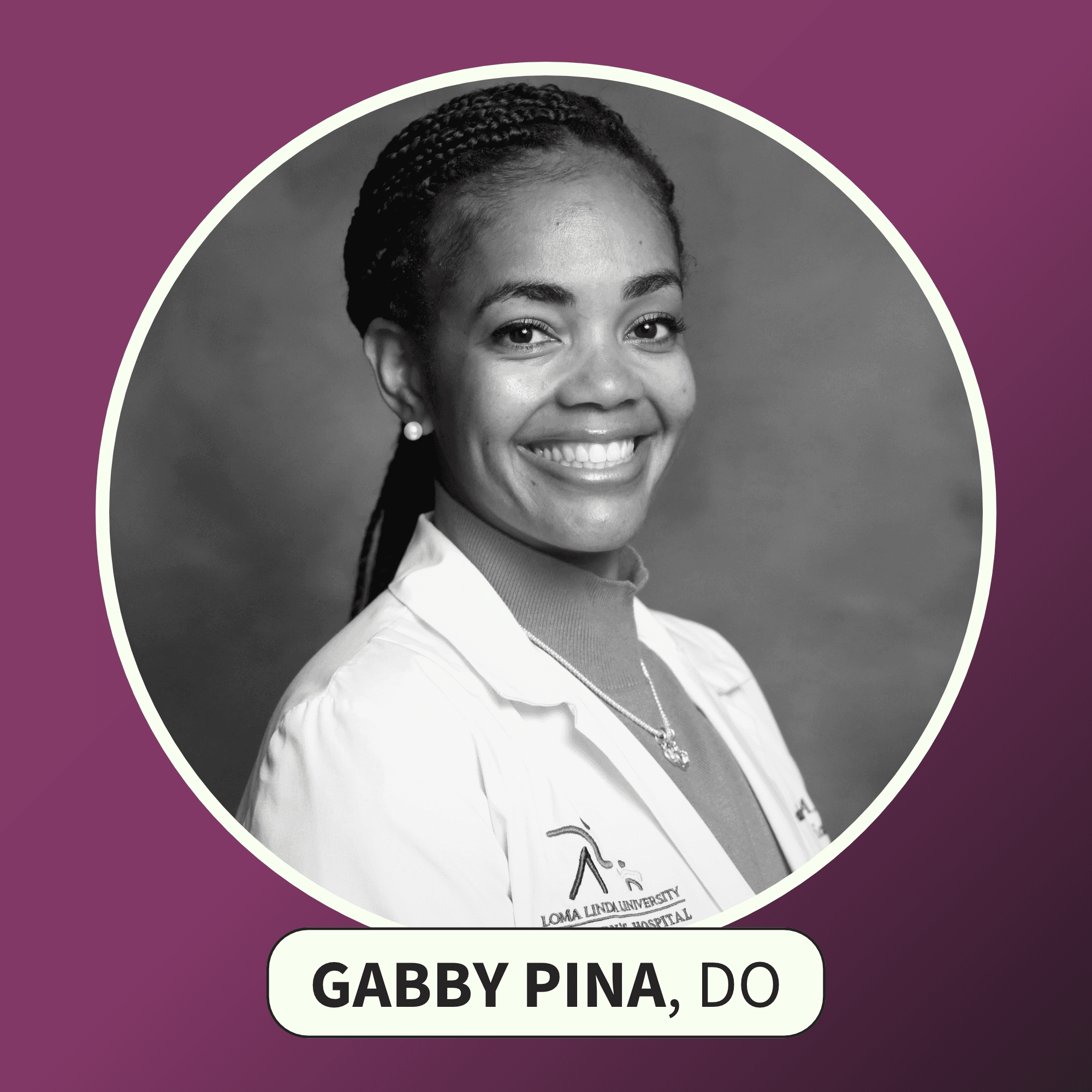
Just four days after giving birth, pediatrician Dr. Gabby Pina returned to the hospital for what she thought would be a routine blood pressure check—and instead found herself readmitted with postpartum preeclampsia. In this deeply personal conversation, she reflects on postpartum depression, the invisible labor of caregiving, and how learning to accept help transformed the way she thinks about medicine and motherhood.
0:00/1:34
The Nocturnists
Season
1
Episode
0
|
Four Days Postpartum with Gabby Pina, DO
Just four days after giving birth, pediatrician Dr. Gabby Pina returned to the hospital for what she thought would be a routine blood pressure check—and instead found herself readmitted with postpartum preeclampsia. In this deeply personal conversation, she reflects on postpartum depression, the invisible labor of caregiving, and how learning to accept help transformed the way she thinks about medicine and motherhood.
0:00/1:34
About Our Guest
Dr. Gabrielle Pina, DO, is a Pediatric Hospitalist at Loma Linda University Children’s Hospital and a dedicated medical educator and mentor. She holds multiple leadership roles within the pediatric residency program and is passionate about advancing health equity, workforce diversity, and community-based education. Rooted in the Inland Empire, she is committed to serving children, families, and trainees through advocacy, mentorship, and innovative programming.
About The Show
The Nocturnists is an award-winning medical storytelling podcast, hosted by physician Emily Silverman. We feature personal stories from frontline clinicians, conversations with healthcare-related authors, and art-makers. Our mission is to humanize healthcare and foster joy, wonder, and curiosity among clinicians and patients alike.
resources
Credits
Transcript
Note: The Nocturnists is an audio-first experience with emotion and sound design that can be difficult to fully capture in text. Transcripts are provided to support accessibility and reference, but may contain minor inaccuracies. If quoting in print, please consult the audio when possible.
Emily Silverman: This is The Nocturnists. I'm Emily Silverman. Today's episode features Dr. Gabby Pina, a pediatrician who thought she was making a quick trip back to the hospital for a routine blood pressure check just four days after giving birth, and then instead found herself readmitted with postpartum preeclampsia, separated from her newborn, and forced into a role that felt completely foreign, being the one who needed care.
As someone who had spent her life caring for others, it was a difficult shift. In our conversation, we talk about postpartum preeclampsia, depression, caregiving, and the invisible labor so many women carry. We also explore what it means to receive help, set boundaries, and discover that sometimes the strongest thing you can do is let others hold you. Gabby told her story live on stage at a Nocturnist Satellites event produced in partnership with CAFP, the California Academy of Family Physicians. I'm thrilled she's here today to speak with me about it. Here's Gabby.
[music]
I am sitting here with Gabby Pena. Gabby, thank you so much for coming on the show.
Gabby Pina: Yes, thanks for having me. It's been really cool.
Emily: Gabby, tell us what it was like to tell your story on stage?
Gabby: Yes, it was scary, but really cathartic. I tend to go into this void when I speak, because I don't actually know what I'm going to say. I'm not a good practicer when it comes to public speaking, but I've been doing public speaking for a long time because my mom made sure I was very well-rounded as a child, and so I never know what's going to resonate, and what feelings are going to bring up, and how I'm going to react, how they're going to react. Initially, I was very nervous, but really beautiful experience by the end of it.
Emily: What kind of response did you get from your peers and from your community?
Gabby: I mean, I got really positive experiences and feelings and feedback, but I think what resonated most is people felt seen. A lot of women who heard it, really understood what that phase of life looks like, or what a phase could look like. I didn't even know who was in the audience, because my family couldn't make it. I had my baby at home and my husband was working, and so I was a little surprised by who came up to me after, and brought up some things.
I want everything in my life that hasn't been all roses and flowers to resonate with people, so that they feel seen and don't feel so alone, because it can be very lonely to experience postpartum depression, and being the foundation for your family, and all the expectations of being a perfectionist.
Emily: Absolutely. I want to dive into the story itself, but first, maybe we can talk a bit about you and your journey to medicine. I know you're a pediatrician, so talk about growing up and going to med school, and going into pediatrics.
Gabby: Yes. I started out wanting to be a dancer because nobody actually comes out the womb wanting to be a doctor, and if they do, they're all lying, so don't listen to them.
Emily: [laughs]
Gabby: My grandmother got really sick when I was a kid, and we were really close. My mom is one of 12, and we all lived in the Inland Empire, and so we took care of my grandmother when she developed Alzheimer's. With majority being the female sisters really taking shifts to make sure she didn't run out the house, or try to drive herself to the store, and so my mom and I were real close. We still are, but we were like two peas in the pod, so wherever my mom went, I went.
I learned how to draw insulin really early. I learned how to manage her hypertension meds and things like that. Was pretty fascinated just by the human body, and so decided I was going to go into research actually. I was going to solve Alzheimer's. I was very pragmatic as an eight-year-old. Then, I fell in love with kids. I think kids are great. They believe that tomorrow can be better. They smile even when they have cancer diagnoses, and I just knew I wanted to be around that kind of positive experience.
I went to Baylor for undergrad, which coming from the Inland Empire was a very huge reverse culture shock for me, where 90-some-odd percent minority, and then I went to a very majority White undergrad. Learned a lot about myself, learned a lot about what I consider my culture. Made some really great friends, but realized I did not know how to study, so had a pretty subpar GPA and a questionable MCAT, and so was debating between getting my master's in public health versus going to med school.
I applied to four med schools, two DO, two MDs, got one interview and one acceptance, so I always tell people, "It's just, you just need one chance."
Emily: You just need one.
Gabby: You just need one. I remember leaving the interview because my mom had went with me. It was in Vegas, and I was so anxious and nervous. I totally threw up after the interview, on the freeway. I was like, "Mom, pull over, I got to do this." Someone took a chance on me with a 24 MCAT, which I don't know how they score MCATs now, but I'm pretty sure it's still the bottom quartile. I loved it.
First year was really hard. I went from the Inland Empire in a predominantly Christian household to Baylor, which was a very Southern Baptist school. It's the largest Baptist university in the world, by the way, in Waco, Texas, which has its own questionable history, which is fun to talk about. Then, ended up in Vegas for four years, living with some of my best friends now. I lived in a house with two other girls. That first year was really hard. I made a lot of questionable decisions living in Vegas as a--
Emily: You know what they say about Vegas?
Gabby: It ends up on the internet.
Emily: That.
Gabby: Yes, but I'm a millennial. [laughs]
Emily: I was going to say, what happens in Vegas, stays in Vegas, but I guess that's the opposite.
Gabby: [crosstalk] [unintelligible 00:06:25] in TikTok. [laughs]
Emily: Oh, okay. [chuckles]
Gabby: Okay, but when I went, I'm a millennial, so we still didn't have as much, right? We had Facebook. I think Instagram was just starting, so we still had some safety and privacy, but it was good time had by all. Anyways, I loved med school. Had a really great experience. Fell in love with medicine in my second year, and fell in love with peds during my third year on clinical rotations all over again, and really liked the person I was on peds.
Internal medicine or adult medicine, human bodies is super cool. Just the fact that our bodies do what they do. They have babies. They change. They grow. They shape, but I didn't like the physician I was when I took care of adults. Adults are really whiny, like really. I felt like I was getting a little bit jaded on my rotations by the people I was around, and by my own responses, and so, I never felt jaded on peds.
I always felt like, "Oh, I can do this. I can fight for you. I can look something up. I can explain it eight times to the families without an issue because it's their kid." I was like, "That's it. I'm going to do peds." I knew I wanted to come home, so I applied to California, and got in at Loma Linda, and that's where my story has ever been. Been deeply rooted in the IE and refused to really leave anywhere else right now.
Emily: One of the things that you said that stood out was when your grandmother got sick, that there was a lot of family caregiving happening, and that it was often the women caregivers. It reminded me of this book that I read a few years ago called Elderhood, written by Louise Aronson, and she talks a lot about aging. I remember in the book she's talking about how, ever since she started studying this topic, her friends ask her, "What's the single most important thing I can do to protect myself as I age, or to try to age well?"
She always says the same thing, which is, "Have a daughter," [chuckles] which is funny. I have two daughters now. I was thinking about that the other day.
I was like, "Oh, I hope they take care of me when I get old." Before, because I think this ties into your story later. If you could talk a bit about growing up, and having that caregiving. You were swimming in the soup of caregiving with your grandmother, and learning all these things from, sounds like women in the family, and how you think about that, because women are very nurturing in general, but sometimes the burden can fall disproportionately on women in a way that can feel like it's not valued. I was just wondering if you thought about those things growing up in that way?
Gabby: Oh, yes. I have a brother, and he's 13 years older than me. He's like fully fledged human before I was ever even sort of a human, right? He has no responsibilities to my parents, like none. [chuckles] He lives his best life in Hawaii. We see him twice a year. He comes and hangs out. He's really great with my boys. I don't have any daughters, so I'm just praying that they marry really nice people.
Yes, I thought about it a lot, especially going through med school, because my mom got hurt when I was an undergrad, so she had to medically retire from her job. When I moved back home for residency, I became a caretaker again. Every time I was on break, she had rotator cuff surgery or knee surgery, and I was the one taking her to her appointments. I was there in the OR with her. I have taken her to every surgery.
When my dad was hospitalized, I was there at bedside. Now, part of that's because I'm the doctor in the family, but a lot of that is because I needed to know how to take care of them when they got home. My brother just calls. I was like, "Bro, [chuckles] you could do something." I understand that's also not his skill set. You don't want to force people to be caregivers that don't have the heart to be caregivers, because then it makes them resentful, and it makes the healing a problem, right?
I've always put myself in a position where I find my personal value in caring for others, and it's been something that both is my strength and my weakness. It's my inherent people pleasing that I've had to fight most of my adulthood against, but it's been also something that's cultivated really strong relationships, and I think modeled for my children how to care for me when I'm older, or care for others.
They live in this three generational house, and they've seen what it looks like when grandpa has an emergency and goes to the ICU, or when grandma has surgery and needs help
around the house, so they've seen what happens when you age, and how to care for those who age around you, and I think that's also really important.
Emily: You're working as a pediatrician. You're building your own family. You have a husband. You're pregnant, and you've just had this baby. I think, in the story you say something along the lines of, "I just have to run out to the doctor for this quick check. Just keep the baby alive while I'm gone." [chuckles] Then, you go to the doctor, and I know you described it in the story, but maybe for our audience, you can just describe the, I guess, realization that you were not okay.
Gabby: Yes. I think about this time a lot now. Now that I'm in therapy and on Zoloft, it helps to process both things quite well. I should have known that something was off, because I was really jittery. Have you ever been so tired that you are driving, and every car that gets a little close to you, you flinch? It's almost like you feel like they're going to hit you.
Emily: The hypervigilance?
Gabby: Yes, I was really glitchy. My drive is a 25-minute drive on the freeway, so not the best place to be glitchy. Then, I pulled up into the hospital, which is my hospital, so I gave birth at my hospital. I was walking across the parking lot, and it was so hot. It had to be like 101, because it was July. I just remember sweating and being super-uncomfortable. I was wearing my husband's shoes, because I couldn't fit mine, because I was still so swollen.
All I could think about was, "I hope my baby doesn't wake up, and scream for me, like, where am I? 'Where's mommy?'" Then, I go inside and check in, and it's like super refreshing. It's 75 degrees inside the hospital, but I'm still sweating, and I'm still uncomfortable. I now have marks on my feet from the shoes, because they got more swollen while I walked. I should have known that I wasn't okay, but I wasn't taking the time to really check in with myself.
I was just trying to survive to get back to my tiny human and back to my tiny family, and my aging parents, and not add any more responsibility to people because I made this decision to get pregnant. Sitting there while they checked my blood pressure, and it got higher and higher, I just-- I have this conversation with God a lot, because I've been pretty stubborn most of my life.
I'm always like, "All right, God, tell me what you want me to do." Then, He'll tell me, but He tells me, and like, "Yo, go that way." I'm like, "Okay, it's okay, I'm not going to go that way." He's like, "No, no, I want you to go that way." I'm like, "Cool, cool, cool, cool, cool." What He does is He puts a giant roadblock, just like the biggest wall in directions in which I am not supposed to go, and it looks like this, or it looks like divorce, or it looks like a not getting an interview, or an accident because I'm stubborn and hardheaded, and He each time forces me to pause, and really focus on myself.
Emily: I remember when I was in my residency in internal medicine, I was working really long hours. I was-- 28 hour shifts every fourth night, and then I ended up on this weird split rotation, where it was two weeks in the ICU, two weeks on the wards, and they each had different call schedules. Then, when I switched in the middle of the month from one to the other, there was a glitch in the schedule where I had to work two 28 hour shifts in a row.
I did that, and I had a lot of feelings about that, and just anger and bitterness and resentment [chuckles] about the fact that I had to do that. Then, the next month, I started developing symptoms, and very long story short, I had this whole year-long journey with chronic pelvic pain and endometriosis, which eventually cleared up after some surgery, and some pelvic PT, but most importantly, I think cleared up with finishing residency, [chuckles] not having to work like that anymore.
I just remember processing that whole experience in retrospect and thinking, sometimes, when you as a person aren't able to say, "No," or set a boundary, your body will do it for you. For me, I just really feel like that was my body being like, "No, [chuckles] you're working too hard, and because you won't set the boundary, we're going to actually set the boundary here in your body."
I don't know. Obviously, this is not how all disease works, but I'm wondering if you have a similar feeling about your preeclampsia. Do you feel like you were taking on just a lot of responsibilities in such a way that, that happening was a way of, I guess, resetting or your body being like, "Hey, slow down," or do you think about it in that way?
Gabby: Yes, I do because during that time, I had done too much. I'm a too-mucher at baseline. We had bought a house in May and moved in June. I had a baby in July, so the entire idea of packing up my whole life before having a baby, trying to get settled into that while still working, I had a full week of clinical inpatient service on our busy unit in July before leaving for maternity. Then, my husband and my mom were at odds about moving, because it was a little bit abrupt, and it wasn't necessarily where they wanted to go, and so there was a lot of internal stress on top of external stress.
Then, my ex had flipped the switch. He was supposed to take our eldest for a year, because they'd been getting closer, and he wanted to do a year of high school out there, and he did not, so now I had to enroll this one for school that I hadn't planned to. This one, and how are we going to get to school? I think for me, it's not even the work anymore, because the work is what gives me a break.
It's all the internal planning, the uneven distribution of chores and responsibilities for caring for the family that I am pretty sure everyone in the family is unaware of. There's been a lot of conversations since then about, "I need you to take this task. I need you to take this task. I need this task off my plate." Still need to be more conversations about it, but I can tell you, I've never had that conversation with anyone before, and so, to feel safe enough in my relationships with both my parents and my husband to be like, "I can't do this, I need you to do this," even for simple things, really has been really profound for my personal growth and development.
[pause 00:18:28]
[music]
Emily: You're in the hospital. They check your blood pressure. They check it again. They check it again. They tell you, you have preeclampsia. You go through that whole process. I think you mentioned you got a bunch of magnesium. At some point, I think it's your husband who says to you, like, "You're the glue," or, "You're the glue holding the family together."
I was just wondering if you could talk to us about, I don't know, that word "glue." It's a very specific word, and how that landed, and especially, in the middle of this medical crisis, what that was like?
Gabby: He actually told me that during labor. I was like-
Emily: Oh, okay. [chuckles]
Gabby: "Do you think this is the best time to say this?" Because we hadn't had that talk about what if something goes wrong with me. He was like, "Hey, in case something happens, it's you or baby, I'm picking you." I was like, "What?" He was like, "Yes, yes. No, I'm picking you because you're the glue." I was like--
Emily: Right.
Gabby: "Cool, cool, cool, cool, cool, cool."
Emily: Meaning, just for the audience to clarify that if something went wrong, and had to choose [chuckles] between the mom's life and the baby's life, he was saying, "I'll choose you."
Gabby: Yes, exactly. He's like, "We can adopt another kid. We can try for another kid, or we could just live our lives being partners, but this family, your family, I need you.
The boys need you. You are the thing that holds us together." One, I was like, "Bro, this is not the time for that conversation. I get it. You choose me. That's great. I'm going to give you the freedom, but also that's a lot of pressure to put on somebody who is just trying to survive giving birth to a human."
My husband and I have always been really honest with each other. Really honest about where we stand with things, about how we plan our future. He means exactly what he says, and so, I'd never heard him vocalize that as clearly as in that moment, and so it's something that's deeply embedded into my brain now, probably because it's associated with something that was so traumatic as birth, but also because of the weight of the words. As I was in the hospital on magnesium, which is miserable. I really don't think they do justice by warning you how bad it is.
Emily: You mean the infusion itself? It burns in your arms?
Gabby: Yes, the IV magnesium. Everyone, even when I was talking about magnesium, because my husband takes it for his workout, like post-workout routine and stuff, helps him sleep. People are like, "Oh, yes, magnesium is great for my sleep." No, the level of magnesium that you get is substantially higher, and you feel like your brain is on fire.
The processing is so slow. I had friends talking to me, and I was literally like, "What are you saying?" Then, it wasn't fevers, but you felt like you were quite literally on fire. I had ice packs everywhere, and I was only allowed three ounces of water every hour, but that's only in ice chips. I could have 50 ccs, which is like almost 2 ounces of water every hour, or 100 ccs, which is a little over 3 ounces of ice every hour.
The idea of not being able to drink when I wanted to, and I was being woken up every hour for blood pressure checks, and every blood pressure monitor sounds the same. I don't know why they need to alarm. Why do they need to alarm? I would panic. I would be like, "I'm Zen. It's the ocean. The waves are good." Because my medical knowledge told me that, if my blood pressure is not better in 24 hours, I'm staying another 24 hours. I was like, "Ocean, zen," and I would wait for the beep, and to see if the alarm would go off, and if it did, I was done. I was like, "Oh, another hour down the drain."
Emily: Like you were saying, you're the glue, you're holding the family together, and how that felt like a lot of pressure. It just makes me think about caregiving in general, and how there are so many different ways that women hold families together, but also hold society together. [chuckles] This became a moment where you really needed the family to hold you, or society to hold you. Not only needing people to hold you, but you had to be able to receive it, which, in some ways is the harder part. Tell me about that. Did you feel-- Were you able to relax into the caregiving recipient role, or was that uncomfortable? Yes, tell me more about that.
Gabby: No, I did-- I'm a very poor receiver of care. Even when I was in the hospital, the first 24 hours, I wanted my baby. I wanted my baby there. In fact, before they even hospitalized me, I lost my ever-loving mind in the lobby, just crying, because I wanted my baby. I knew that I needed like a day without. I just needed to heal. I just needed to take the meds.
I would have been a mess. I was loopy. Also, it was hard, because, in order for me to have the baby, another adult had to stay. My husband's daughter, my bonus daughter was down, and we only have her for several weeks a year during summers and vacation, and so I really wanted to make sure she didn't feel neglected during the shift in our family She's his only kid. Her mom's only kid, the only grandkid, so she was already struggling.
I was like, "Well, I don't want to take him away again, and then have her never want to come back, or resent him for choosing the baby over her." That first night, I stayed by myself, and it was weird and uncomfortable, and I cried. I checked on my husband. It felt like every hour, "Is the baby alive?" He would send me pictures. He's like, "Yes, I'm not going to kill our baby." I was like, "Okay." I had really great friends. They sent formula to the house, overnighted it. I had friends bring me, because I couldn't drink anything, so they would just bring me hugs, and hang out with me.
They called my family to see if they needed anything. Then, the next night I was like, "Bring me my baby. I want my baby." My mom came and baby stayed with me, and she was like, "I'll do all the diaper changes. I'll hand the baby to you to feed." I refused. As soon as she fell asleep, I was like, "Okay, the baby's mine. I'm going to pick up the baby." She got so mad at me.
Emily: [laughs]
Gabby: I'm really bad at receiving it. Even when I went home, my version of receiving care is delegating all other responsibilities that was not the baby to everybody else, and it took me a few weeks to just sit on the couch and watch TV, and do absolutely nothing else. Before, I was like, "Oh, this is actually pretty nice."
Emily: [chuckles] Yes, I was going to say, did you get to a place where you were? I imagine the first day or two, you're managing everyone else's needs. You're thinking about the bonus daughter. You're thinking about who's going to change the diapers, but it sounds like, eventually, those voices were able to quiet down, and you were able to just be?
Gabby: Yes, but I will say, I think the only reason why it did is because I spiraled into postpartum depression. My husband was like, "You're not okay." It's like he was like, "We need to get out the house." He took me out to lunch and the baby, and we just like spent time together, and he made an effort to-- Him and my mom worked pretty closely together during that time to just make sure the house stayed fluid, so I could just heal both emotionally, physically, mentally.
I don't know if I hadn't spiraled into postpartum depression, if it had been different, but this is the story I'm living, and so I fully embraced maternity leave, which is something I didn't do with my first baby. I just sat and watched a lot of trash television, and ate snacks, and nursed my baby, and napped. That was a really tough, but really beautiful time for me to discover what it's like to put me and my needs first.
Emily: Yes, and in your story, you mentioned the postpartum depression. You don't get really that deep into it, but was that weeks? Was that months? How did that chapter of the story end?
Gabby: Well, I'm still on Zoloft. Per my PCP, who's also my best friend, it's always good to make friends in good places, but she had said that women who struggle with postpartum depression and end up on Zoloft, do better if they continue for a year just for recovery, and emotional healing. The postpartum depression snuck up about a week or two after discharge.
My husband found me just crying in the chair, holding my baby. He'd be like, "What's up?" I was like, "I don't know." I was just crying. That's when it became a really real, and I was like, "Let me just Edinburgh myself real quick."
Emily: What's that?
Gabby: The postpartum depression screen.
Emily: Oh, the tool.
Gabby: Yes, I was like, "Let me just," because he had his well-child check coming up, and they asked that at the two-week checkup, but I was like, "Let me just see," and I was like, "Ooh, this is pretty positive. Should probably check this out." Initially, I didn't want to start meds because I was like, "Oh, it's just baby blues." I was hospitalized, separated from my baby. I have all these reasons to be sad.
Then, it just-- My PCP had recommended going on a date night with my husband, no baby, just like a couple hours out, and I bawled literally as soon as she said that, I just started bawling. She was like, "Okay, can we talk about Zoloft now?"
Emily: [laughs]
Gabby: I think, since then met with a therapist, started processing just the whole loss of a dream that I had, because part of the sadness was rooted in the fact that I wanted my water to break. I wanted to labor and come in, and I wanted to have this beautiful birth, and have a baby that's a good, healthy size, and breastfeed well, and then go home, and none of that happened.
I got induced. My epidural failed. It was miserable, so I went through most of my labor natural, up until about nine centimeters. He was super small, which, in my head feels stupid for me to blame myself, but does because both my babies were small. It feels like at the end of my pregnancy, my body is just like, "Look, we done." Then, having to be readmitted, all of that loss of what I thought my last baby was going to be like, because he said, "I'm not doing this again processing that."
Emily: Yes. Having gone through all of that experience as a pediatrician, as a mom, as a woman, as a caregiver, what do you feel like you learned from that experience? What change? What did you take away from it? How do you see yourself differently? The world differently after all of that?
Gabby: Yes. I talk about postpartum depression a lot more. I'm very open about it with my families. I check in with all my newborns. I do newborn nursery rounds on the weekend when I'm at my home hospital. I say, "Hey, it's okay. It's okay to not be okay, but just don't not tell somebody." I talk a lot to the caregivers of being like, "You need to watch your person. When they change, you need to say something."
In fact, so my ex and I have a pretty friendly relationship, considering all, and he just had his-- His fiancé got pregnant, and as he was preparing, he was asking me questions, so I was like, "Bro, we're cool, but not that cool."
Emily: [laughs]
Gabby: Even in that conversation, I was like, "Hey, you need to watch her. The first four to eight weeks after delivery, if she changes personality, you need to be the one that's like, 'Let's go,' because she may not want to." I talk a lot more about that. When it comes to being a mom, I am more present. My husband had said, my relationship with my middle child, who's, my oldest is my non-biological child. Love him. He's his own person. We have a great time together.
My eight-year-old is my little shadow, because he is what kept me alive. I was really depressed during my pregnancy with him, and going through a separation, and trying to finish residency, so I look at him, and just thank my stars for him, because he's a reason why I'm still here. Our relationship is rooted in survival. We both were just fighting each day to survive. He had really bad colic. He was really small. His dad had left, and so we had a lot going on.
This relationship with my baby, Ezekiel, is different. We're on the same wavelength. I can feel his moods shift. Sometimes we just sit together. He comes for me for comfort. He's almost eight months old, and he will cry, "Mama," when he wants a hug, or wants to be held. He had told me this relationship's going to be different, and I was like, "Okay, whatever," but it's true.
I'm slower, more intentional. I am taking each day just living life with him, instead of holding him to some invisible standard that I have. I now carry that into my relationships with my friends and my families, and with my coworkers, and so I've really slowed down at work, because there was a part of me that really wanted to climb that ladder, and I still do. I still have ambitions and goals, but I've turned down jobs that I think in a past self, I would have taken it without a thought, because it brought value to me, but because it interrupts my ability to watch my eight-year-old go play flag football, or spend more time at home with my baby, or teach my oldest how to drive, I've decided to take some alternative routes.
Emily: What about the role of storytelling? Obviously, you had the experience of preparing this story, sharing it on stage. We already talked a bit about what that was like, and the response. I don't know if you write, or you journal. You seem to have a little bit of a storytelling flair. There's sort of a theatrical energy to you. I don't know if you ever acted or anything, but I'm just curious how storytelling has figured in this process, in this journey?
Gabby: Yes, so I tried acting. I thought it'd be really fun, and then I messed up every line every time, because I was like, "I have a different way to say that." That's not acting, and I'm like, "You're right." I grew up in a Southern Baptist church, who, if you spend enough time around pastors, you learn how to cadence appropriately, and so that helped a lot with my background.
When I was going through the transition out of residency into attendinghood, which was a huge shift in my life, I had, had-- In residency, I not only gotten married, but gotten-- My marriage dissolved in residency. Also, had pregnant and got a six-year-old, so I had a lot of growing up during residency, which residency itself is a lot of forced growing up.
Emily: Yes, it's super accelerated development.
Gabby: It just exposes all your traumas and triggers. That's what I tell my residents all the time. I'm like, "Look, residency is great. You learn so much. It's the last opportunity you get to really mess up at things and then learn, but you still are going to mess up things as attendings and learn, but this is the show, but it's going to expose all the things that you've never dealt with."
On top of that, plus, all the stuff going on at home, I learned a lot about my own traumas and triggers. I used that exercise itself to start working with my coworkers and my residents on what trauma are you working in that's having you act that way. I've done a lot of research into how your trauma manifests in your day-to-day interactions, and I apply that to my residents.
I have them fill out and reflect on instances in which they have felt triggered, so that they can go forward and identify situations that might be triggering, and how do they work through those? Because the triggers don't really go away. You just learn how to operate in a headspace that is better dealing with the triggers. Since then, and really interacting with residents and getting them to tell their story, and really understand their story, it's become part of my everyday conversation with people. In fact, to the point where people sometimes don't want to talk to me because I'm like, "Hey, girl, you seem off."
Emily: [chuckles] You disarm them.
Gabby: I do, and I'm okay with it, and they know it's-- I hope they know it's coming from a place of just love and growth. I have an intern in specific that I've spent a lot of time with. She is wonderful, but works with a lot of in personal insecurity, and every time we work together, she's like, "Just, don't look at me. Can you just look away?" I'm like, "Sure. Sure can."
Emily: [chuckles] It's a very clear ask.
Gabby: Yes. I'm like, "Thank you for letting me know." Then, eventually, she'll come back around and we'll do feedback, and she'll be like, "That was really helpful, but I just needed the space to not be looked at today." I was like, "That's okay. I'm glad we can communicate on this level, where you can tell me what you need, but yet we can still grow."
Emily: That's great. Well, it's been really great to meet you and hear about your story, and everything leading up to it. Our audience is healthcare workers, so as we wind this to an end, wondering if there's any last few things you'd like to share with the listeners?
Gabby: Oh, yes. I think my biggest takeaway point from this last year of a lot of change and self-reflection is, it's okay to not say, "Yes," even when everything on paper looks great. It's okay to say, "No," to that job. It's okay to say, "No," to that friendship. It's okay to say, "No," to that relationship. It's okay, especially as a female in medicine, to not need someone to recognize you, but it's also okay to want the recognition.
I think just staying true to yourself, staying true to the things that bring you joy, and not allowing others to dictate what that looks like going forward is really important for healthy, mentally, physically, emotionally people, but also physicians. We do a hard job, a very thankless, soul-serving job that is becoming monetized even more every day, but I think it's the human nature that makes medicine so beautiful and so recognizing, that when you're whole and when you're healthy, and when you're healed, you can provide care to those that are broken, and I think that's the goal.
Emily: I think that's a great note to end on. I have been speaking with Dr. Gabby Pina. Gabby, thank you so much for coming on the show.
Gabby: Thank you so much, guys. This has been a blast.
0:00/1:34

Humanizing healthcare through storytelling.
podcast
Humanizing healthcare through storytelling.
podcast