
The Nocturnists
Season
1
Episode
0
|
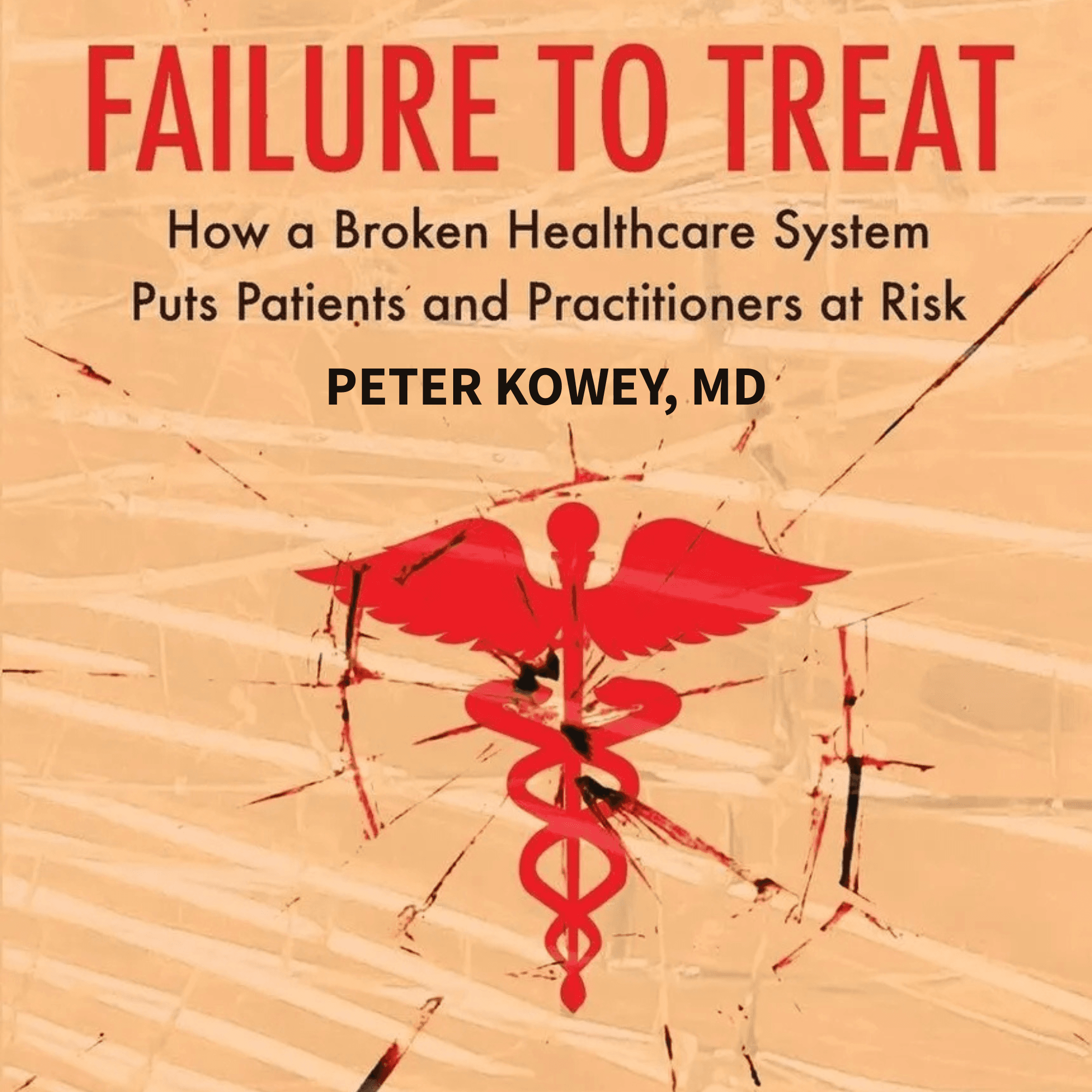
Failure to Treat with Peter Kowey, MD
Drawing on a lifetime in medicine and the stories behind his new book Failure to Treat, cardiologist Dr. Peter Kowey explores how profit, bureaucracy, and the corporatization of healthcare have transformed the practice of medicine. We discuss what has been lost, what can still be reclaimed, and why he remains hopeful that technology may ultimately give physicians back their most precious resource: time with patients.
0:00/1:34
The Nocturnists
Season
1
Episode
0
|
Failure to Treat with Peter Kowey, MD
Drawing on a lifetime in medicine and the stories behind his new book Failure to Treat, cardiologist Dr. Peter Kowey explores how profit, bureaucracy, and the corporatization of healthcare have transformed the practice of medicine. We discuss what has been lost, what can still be reclaimed, and why he remains hopeful that technology may ultimately give physicians back their most precious resource: time with patients.
0:00/1:34
About Our Guest
Dr. Kowey is Professor of Medicine and Clinical Pharmacology at Thomas Jefferson University, Emeritus Chief of the Division of Cardiovascular Diseases at the Lankenau Heart Institute, and the William Wikoff Smith Chair in Cardiovascular Research at the Lankenau Institute for Medical Research.
An internationally recognized expert in heart rhythm disorders, his research, regulatory and clinical trial expertise have led to the development of innovative therapies for cardiac arrhythmias. Dr. Kowey is the recipient of over 150 grants, has written over 450 papers and scientific reports, and has co-edited 5 textbooks on cardiac arrhythmia. He has trained hundreds of fellows who practice cardiology and cardiac electrophysiology around the world.
Dr. Kowey is a Fellow of the American Heart Association, the American College of Cardiology, the American College of Physicians and the Heart Rhythm Society and several other professional organizations. He was a member of the Cardio-Renal Drug Advisory Committee and the Cardiovascular Devices Advisory Committee of the Food and Drug Administration. Dr. Kowey has been the recipient of numerous awards including the Edward S. Cooper Award from the American Heart Association, and the William Osler Award from the University of Miami.
About The Show
The Nocturnists is an award-winning medical storytelling podcast, hosted by physician Emily Silverman. We feature personal stories from frontline clinicians, conversations with healthcare-related authors, and art-makers. Our mission is to humanize healthcare and foster joy, wonder, and curiosity among clinicians and patients alike.
resources
Credits
About Our Guest
Dr. Kowey is Professor of Medicine and Clinical Pharmacology at Thomas Jefferson University, Emeritus Chief of the Division of Cardiovascular Diseases at the Lankenau Heart Institute, and the William Wikoff Smith Chair in Cardiovascular Research at the Lankenau Institute for Medical Research.
An internationally recognized expert in heart rhythm disorders, his research, regulatory and clinical trial expertise have led to the development of innovative therapies for cardiac arrhythmias. Dr. Kowey is the recipient of over 150 grants, has written over 450 papers and scientific reports, and has co-edited 5 textbooks on cardiac arrhythmia. He has trained hundreds of fellows who practice cardiology and cardiac electrophysiology around the world.
Dr. Kowey is a Fellow of the American Heart Association, the American College of Cardiology, the American College of Physicians and the Heart Rhythm Society and several other professional organizations. He was a member of the Cardio-Renal Drug Advisory Committee and the Cardiovascular Devices Advisory Committee of the Food and Drug Administration. Dr. Kowey has been the recipient of numerous awards including the Edward S. Cooper Award from the American Heart Association, and the William Osler Award from the University of Miami.
About The Show
The Nocturnists is an award-winning medical storytelling podcast, hosted by physician Emily Silverman. We feature personal stories from frontline clinicians, conversations with healthcare-related authors, and art-makers. Our mission is to humanize healthcare and foster joy, wonder, and curiosity among clinicians and patients alike.
resources
Credits
Transcript
Note: The Nocturnists is an audio-first experience with emotion and sound design that can be difficult to fully capture in text. Transcripts are provided to support accessibility and reference, but may contain minor inaccuracies. If quoting in print, please consult the audio when possible.
Emily Silverman: This is The Nocturnists, and I'm Emily Silverman. Today's episode features Dr. Peter Kowey, a cardiologist whose career spans more than five decades, and whose latest book asks a difficult question: How did medicine lose its way? Peter entered medicine at a time when doctors made house calls, knew their patients intimately, and relied on bedside skills as much as technology. Over the course of his career, he watched healthcare become increasingly shaped by insurance companies, corporate consolidation, administrative burdens, and financial incentives that often compete with patient care.
In our conversation, we talk about his book, Failure to Treat, a collection of fictionalized stories drawn from real experiences across a lifetime in medicine. We explore what has changed, what has been lost, and why Peter believes the future of medicine still holds reason for optimism if we can find our way back to the human relationships at the center of healing. First, take a listen to Peter reading from his book, Failure to Treat.
Peter Kowey: What follows is a series of short stories which were synthesized from hundreds of patient cases in which I participated during my many years of clinical research, regulatory, and consulting activities. Every story reveals a part of what is wrong with our healthcare system and how patients and healthcare providers are being harmed by obstacles to good care that are frequently generated by greed. As noted in the book's disclaimer, none of these stories come from a particular institution or from any one patient or patient family.
In addition, fictional details have been added to preserve anonymity and to make the stories readable, and to illustrate important patient care issues. I did not write this book with a hostile or destructive intention. Neither doctors nor patients have anything to gain from turning medicine into a mushroom cloud. Most healthcare providers are highly principled, well-intentioned people. My own experiences as a patient have reinforced my high opinion of providers at all levels. It is a minority of practitioners who have chosen greed over principle and have besmirched the reputation of our profession. It is their egregious actions that capture the attention of the media.
Instead of banishing these villains from our profession, we, their colleagues, compound the scandal by turning a blind eye.
[music]
Emily Silverman: I am sitting here with Dr. Peter Kowey. Peter, thank you so much for coming on the show.
Peter Kowey: I'm very grateful for the opportunity. Thank you.
Emily Silverman: I loved reading this book, 20 Vignettes: Human Stories That Illustrate Different Facets of the Health Care System. Things that are working sometimes in some cases, but mostly things that aren't working. I want to dive into that in a bit, but first, I was wondering if we could start by talking about the world you came up in. Where are you from? What was it like growing up? I know in the book you mention a bit about your experience with your pediatrician and community doctors. Talk to us about that era.
Peter Kowey: I came from parents who never graduated from high school. My father was a truck driver, and my mother was a stay-at-home mom. No one in my family had ever gone to college, let alone professional school. I was really starting out without really knowing a whole lot about what I was getting myself into. It all turned out fine, but I can't say that I really planned the journey. It was very fortunate.
You're right. I did start the book with some of this background because I think it's important for people to understand that I honestly don't have an ax to grind. I'm really speaking up at the end of my career because I believe that there's still a very large opportunity to make changes to enhance the medical care of people, not only in the United States but around the world. I felt like my experiences as a young person and then as a young physician helped me to put in perspective what's happening today.
As you know, medicine is much different today than it was when we were growing up. It was a much more hands-on, healing, interactive experience to go to the doctor. The story that I told in the book about my primary care family doctor, and how much of an influence he had on me, was mainly because he was such a human being. He was a giant in my parents' mind; they spoke of him with great reverence. I remember very vividly him coming to our house and doing house calls.
Emily Silverman: Oh, wow.
Peter Kowey: When he walked into the house, we all felt like things were going to be fine. He was going to take care of things, even though the reality was, when you look back on this, what he had, his tools were very primitive. He didn't have all the fancy schmancy stuff we have these days, but he had a stethoscope, and he had a light to look in her throat and in my ears and whatever he needed to do very quickly at the bedside, and then had some medicine with him to give us, and we got better. How much of a hand he had in that, I don't know, but it really impressed me with the power that doctors have at the bedside.
Doctors have no idea how powerful they are, and how much patients pay attention to things like gestures, nuances in a conversation. I had a patient one time who had a very interesting murmur. It wasn't a malignant murmur. It was just a very high-pitched cooing mitral murmur. I spent more time listening to it than I usually listened to her heart, and she almost came off the table. She was frantic. "Dr. Kowey, what are you doing?" I said, "I'm listening to your heart," and she said, "You listened a lot longer than you usually do. There's a problem, isn't there?"
That subtlety was not unusual. It happened in all of our interactions. The powerful physicians, my mentors, knew how to use that and knew how to employ all of their skills in coming to the bedside and making patients better. Whether or not they actually treated the disease or they just got better on their own, the fact was that they felt better. There's a saying that said God heals and doctors take the credit. My background was important because I have that perspective coming into the stories themselves,
Emily Silverman: This reverence that you and your family had for this community doctor who would come into your home and take care of you, is that what inspired you to pursue medicine as a career, or was there a different driving force, or how did you decide, "I want to do that"?
Peter Kowey: It may sound naive, but it was. He did have a lot to do with it. I didn't know anything about medicine, but I was so terribly impressed by him. I like science. I like biology. When people would ask me, when I was very, very little, what I wanted to be, I would say, "I want to be a doctor," knowing nothing about what I was choosing. My parents, who were very pro-education and were very motivated to see us advance, latched onto that idea and reinforced it constantly, so that by the time I was in high school, it was firmly entrenched in my mind that I was going to go to medical school, again, even though I really didn't have a good understanding of it.
It just flowed from there. It turned out that medicine did suit my talents, and that it was an appropriate decision, but it was made with a good deal of naivety.
Emily Silverman: If you don't mind me asking, can you tell us around what time period, what year did you enter med school, residency, fellowship? What era are we in?
Peter Kowey: We're in the high school graduation, late '60s, college graduation, early '70s, med school graduation, the mid-'70s, 1975. I was a resident in internal medicine in the late 1970s, and then I trained in cardiology into the early 1980s. We're talking 40-some years ago when I was in my training process.
Emily Silverman: It must have been a really exciting time to become a cardiologist because that was really the golden age of cardiology. Can you tell us a bit about residency and fellowship, and what did it feel like to be coming of age in that time?
Peter Kowey: You're absolutely right about how poignant it was to start training in cardiology when I did, and it wasn't just cardiology. I was actually very interested in cardiac arrhythmias from the get-go. In fact, I knew I wanted to do that even before I did my cardiology fellowship. Part of it was because during my internal medicine training, I was mentored by a couple of very powerful people, a woman and a man who had just finished their training in cardiac arrhythmia. By the way, electrophysiology training was in its infancy at that point.
There weren't any cardiology, electrophysiology training programs. There were five or six places in the country where people were just beginning to put catheters in hearts and make electrical measurements. It was the infancy for electrophysiology. They had trained at prestigious places. They were my mentors, and I loved it. I loved the whole idea of being able to record an ECG on the body surface and be able to examine the physiology of the heart. I love the idea that it was so logical. The cardiac conduction system was so well laid out and could be understood, and that you could put catheters in the heart and make precise measurements of the physiology.
It was just a wonderful idea in my mind, and so I gravitated very quickly to that particular area of cardiology. Yes, it was the birth. I was one of the charter members of an organization that was then called NASPE, which is now the Heart Rhythm Society, which is the professional organization of cardiac electrophysiologists in the world. In my hospital, in our operating room, we placed the third defibrillator in the world in 1982. We were really on the vanguard of what now is a very sophisticated subspecialty. It was a wonderful time to be in the field that I chose.
Emily Silverman: In those days, obviously there was no electronic medical record. There was no electronic notes. There were no prior offs. There was a lot that you didn't have, but there were some things that you had to do that current medical trainees don't have to do. For example, my understanding is back then, the doctor did a lot more of the blood draws. The doctor did a lot more of the urinalyses themselves, or the blood smears themselves.
Obviously, now a lot of that is automated, or we have entire labs and departments that we outsource that to, and then unfortunately, our time gets taken up by some of these more mundane tasks. I was wondering if you could just talk a little bit about the kinetic experience of being in a hospital or being in a clinic, and how it felt different in the '70s and in the '80s.
Peter Kowey: Oh, you're absolutely correct. It was an experience far different from what our house officers are expected to do or do in their training. One of the things that really was very important that you mentioned was that we were expected to carry out a number of our own laboratory tests. There used to be a thing called a house officers' lab where we had some stains and microscopes. We could take a urine sample or a blood smear or cerebrospinal fluid if we did a spinal tap and examine it ourselves and come to some idea of what was going on with the patient.
In fact, I train in a very regimented training program, and if you didn't do that, you were really called to task. If they asked you what was in the urinalysis and you didn't know, or you were depending on the laboratory to give you the results, there was hell to pay for that. We were infused with the idea that we needed to do a lot of our own work. The other thing that was different was that bedside skills were highly emphasized. History and physical examination were paramount, and then we were expected to synthesize the case and present it in a cohesive fashion without notes.
We were also expected to be able to write a history and physical, no templates, no easy path. It was like all longhand stuff, but it had to be legible, and it had to be cohesive. Then finally, we were expected to follow all of our patients all of the time. Yes, we weren't on call 24 hours a day, seven days a week, but we were on call about every third night. There were three interns on our team. Each intern was on call every third night, so our team knew our patients. There were no handoffs. There were no shifts. There were no nocturnists or hospitalists. We were responsible for the patients, and we took that as a very strong responsibility.
I had the opportunity of spending several months during my medical school training at Oxford at the Radcliffe Infirmary, and there, bedside skills were even more emphasized. What they could extract at the bedside from a patient was just phenomenal, and really was a tremendous method of improving my own skills by spending time there. Yes, it was a different time, it was a different way we practice medicine. I think, although we all like to think that the old times are the good times, I think back then patients really did get better care.
Emily Silverman: You go into cardiology. You go into more specifically, electrophysiology, and you go into practice. When did you first feel like medicine was changing in a way that worried you?
Peter Kowey: It happened, I believe, in the middle of the 1990s, say around 1995 through 2005 or so. There were some seismic changes in medical care. The largest change that occurred during that time is that doctors, under a progressively larger amount of regulatory responsibility and documentation, and business needs, began to back away from the business of medicine. In the old days, doctors took care of their own records. They did their own billing. They had somebody in the office that may have helped them, but they were really responsible.
Talking about my family doctor again, I remember my father handing him a $10 bill and paying him for the office visit. There was no insurance. It was fee-for-service, but at a reasonable rate. What was happening around that time that I quoted is that insurance companies were becoming more powerful, and doctors, because of a lot of the things that were happening in medicine, began to pull away from the business part of medicine. We ceded control of medicine to people who were not doctors. I think that was probably, of all the things that have happened, the most fundamental mistake that we made.
Instead of staying engaged, we backed away, and we lost our focus. Before we knew it, they had taken over, and they were running organizations that were beginning to run us. That's when the acquiring of practices by large healthcare systems, by private equity and the like, really kicked into gear. Physicians, over a relatively short period of time, went from being in control to being employees. Once it was clear that the motive was profit and not necessarily patient care, things began to unravel very quickly.
[music]
Emily Silverman: At some point, you decide to write a book about this, and you decide to write it in a very particular format, which I love since we're a storytelling podcast. You decided to adopt a storytelling lens and create these 20 fictionalized vignettes, where each vignette looks at a different facet of this sprawling healthcare system that we now inhabit, and all the different ways it can go wrong. Tell us about the decision to write the book. It sounds like in the book you had a physician mentor who nudged you and who wanted you to write this book. Tell us about how the book got born.
Peter Kowey: There were several factors, and the one you mentioned, I'll get to because that may have been the most important. About 20 years ago, I decided to try to do some creative writing, and I authored five published novels over those 15 or 20 years or so that have been pretty popular. They're medical murder mysteries, but they're fiction. They're real cases turned into stories and murder mysteries. Although it's been a lot of fun, it just didn't seem to have enough meaning for me.
During a visit that I had with my mentor, my mentor was a person named Dr. Bernard Lown. He was a laureate, a Nobel Peace Prize laureate, actually, but also was a phenomenal cardiologist who was responsible for inventing the defibrillator developed lidocaine as one of the first anti-arrhythmic drugs. At that time, I was having lunch with him in Boston. He was 98 years old, and he was explaining to me all the difficulties he was experiencing during a few hospitalizations that he had had in Boston.
He was complaining about the fact that there weren't enough nurses, they weren't paying attention, he couldn't get anybody to answer his questions, he was getting information from a variety of sources that didn't make a lot of sense. He was just very uncomfortable with the entire situation. He and I talked about this, and I actually said, "It sounds like this is something that I should really consider writing about." He was very enthusiastic about the idea. That's why the book is dedicated to him, because he really did sow that seed.
The other thing about Dr. Lown that was influential is that he was a master storyteller. As you just said, and I completely agree, storytelling is a very powerful art form. In fact, in medicine, in the old days, medical grand rounds would start with a patient story, and many times they bring the patient in to tell the story about their illness before they launched into a discussion of what that disease was. I knew that storytelling was a very powerful way to communicate. I came from a tradition of storytelling. I had written some books in story form, and so it was only logical for me to turn to this kind of a genre.
The other reason I did it is because, again, I was always considering my audience. My audience was not just healthcare providers, but also patients and the public. It was much easier to tell a real story about a person, grab their interest, and then expose them to some of the science behind the stories. That's where all of this came from. It came from my desire to be a good communicator.
Emily Silverman: Of the 20 stories, are there one or two that are your favorite and that stand out? It's like asking which child is your favorite.
[laughter]
Peter Kowey: I would have to say that going back to what we were just talking about a few minutes ago, the story about the rise of the administrators was probably the one that caused me the most catharsis, if you will.
Emily Silverman: For the audience who hasn't read the book yet, tell us a bit about that particular story.
Peter Kowey: It's a story of a person that sounds very much like the story I just told you about Dr. Lown, a woman who's in the hospital after having had surgery, and having discomfort and being vulnerable and not being able to get out of bed, and having the experience of simply not having anybody respond to her. There weren't enough nurses on the floor. There weren't enough nurses' assistants to give her a bath or to help her with her shower, to do all the stuff that you'd like somebody to do for you.
The only person that actually sat down and talked to her was a third-year medical student because she needed to do a history and physical examination. That was the longest conversation this patient had in the hospital. Then, when she's getting ready to leave, this person in a long white coat and a clipboard comes in and says, "I am the patient satisfaction coordinator," and began to ask her a bunch of questions about, "How did it go here in the hospital?" The woman thinking, "If you would just put the white coat away and come in and maybe help take care of me, it would have been a much better experience."
The reason why that plays into the administration idea is because we spend a tremendous amount of money on regulation and administration in hospitals. If just a portion of that money was placed in hiring more true healthcare providers, more healers, more nurses, more orderlies, more people working in the cafeteria, if we staff the hospitals better and did a much better job of planning that, the quality of care would certainly be enhanced. It was my way of introducing the idea that we need to reorder the way we think about running healthcare institutions to get physicians and other healthcare providers more involved in the decision-making process.
Emily Silverman: One of the stories that stood out to me was story 16: research data and how to manipulate them. The reason it stood out is we here at The Nocturnists are currently working on a new series on the topic of trust in medicine. For obvious reasons, that was one that jumped out, and I think is a bit of the sign of the times that we live in these really bizarre information environments right now. I was wondering if you could speak a bit about that story and how you think about that story right now.
Peter Kowey: It's appropriate that you brought that up because one of the things that I'm working on now is actually another novel about research fraud because the incidents of outright lying and cheating in medical research is very low. There's just not a whole lot of people who are intentionally changing data, but there are many opportunities, as you saw in this story, of people trying to manipulate data or exaggerate the research results in order to be able to make a profit. That's where I think we have bastardized the process. We've placed so much emphasis on profits.
Again, this is just like it is in medical care. The pharmaceutical industry is making billions and billions, if not trillions of dollars. If you've seen recently, when these large pharmaceutical companies get sued, they're willing to put literally hundreds of billions of dollars on the table to settle class action. That tells you that if they have that kind of resource and can stay open after making those settlements, that they must have a tremendous amount of money in the bank. They also exaggerate the results in order to justify the price of the drugs that they're selling, or the devices that they're making.
Again, I don't think that this is flat-out fraud. It's just it is intrinsic bias in favor of finding something that they may be able to market and to make money from. As an academic community, we're always on guard when we deal with scientific data to try to make sure that we've eliminated any of the biases or subtle confounders that can change the focus or the results of a research study.
Emily Silverman: Are there any particular infamous examples of this, or cases of this that-- I know that in your story it was they were all fictionalized, but any real-world examples of this that you can talk about?
Peter Kowey: Let me tell you a story without-- I won't obviously give anything away, but one of the things that I did a lot of during my career is I sat on FDA advisory committees. It was a very rich experience, by the way. It's tremendous. I learned so much over many years of doing this because, again, you're looking at data in a granular way. You're looking at data from, in many cases, thousands of patients in research trials, but you're looking at the data very, very carefully because you have to make a fundamental recommendation to the agency about whether to approve the drug and then how to label it so that it's it's used correctly. It's a big responsibility.
There was a case where a drug that was developed for heart failure came to our committee. Before it got to our committee, the main results of the trial were published in the New England Journal of Medicine, which is obviously the most important journal that we have in medical science. Publishes only the most important science, and it deserves its reputation. It was published in the New England Journal as a lead article with an editorial, and everybody was very enthusiastic. That's when we got a chance to look at not the top-line data, not the data that was just in the New England Journal, but all of the data.
It turned out that the person who had done most of the research, the lead investigator, who was an academician, had used a statistical method that had not been prescribed in their protocols, in order to enhance the magnitude of the effect size in the study. We would never have known that unless we had taken a deep dive into the data. Everyone at the meeting was just astounded that somebody of that stature would do something like that.
He wasn't punished. He wasn't driven out of the profession. I don't think that most people in the world even knew that this happened because most people weren't paying a whole lot of attention to regulatory medicine, but the people who were in that room understood that the process had been adulterated. The drug was not approved, even though it looked so good in a publication. It taught me that don't just read the top-line results, because again, there are biases and there are ways of manipulating data that may be adverse.
[music]
Emily Silverman: We have this enormous, complex healthcare system with hospital systems, pharmaceutical industry, insurance industry, these kind of interlocking mega businesses that create so much bureaucracy and dysfunction. A lot of the stories you write are about this. For an individual doctor or nurse, what can we do to try and reclaim a little bit of agency inside of that system? None of us as individuals, obviously, are going to be able to fix the system overnight. I'm wondering how we can try to, I don't know, just create a little bit more of a sense of autonomy, if possible, as we're navigating the system.
Peter Kowey: You're absolutely right. No individual has the bandwidth to make major changes that would be meaningful. I wrote an op-ed a few months ago about doctors communicating with their patients and making the patients aware of the things that are happening in the healthcare system because patients are very powerful. Whether it's in discussing things with their insurance company, making choices about how they become insured, voting, which I think is really the most important thing that they can do, the only way we're ever going to be able to make those changes is by partnering with our patients.
The other thing that an individual physician or healthcare provider should do and can do is influence their professional organizations as best they can to represent them in a way that is appropriate. I think our professional organizations have become more bureaucratic, more concerned with appearances and less concerned with what the rank and file is actually going through. Our professional organizations have been hearing for years that doctors and nurses are burning out, and yet we've not seen any meaningful changes within the healthcare system to unburden them.
There's some a few things on the horizon that might be helpful, but it is really our professional organizations that need to represent us better. There are some avenues for change, but as you said, unfortunately, it's not going to happen quickly, and it'll only happen incrementally.
Emily Silverman: I also wanted to ask about the future, because the arrow of time points in one direction, and we're not going back to the time where we're reading our own urine samples in the hospital lab. We're not going back to the time of the $10 bill, but we're also not going to stay in this. We have now this explosion of technology, artificial intelligence, the outsourcing of knowledge jobs, and knowledge economies. So much of medical school when I was a student was about memorization, and that has just been obliterated by these external brains that we have now in our pockets.
There's a lot of benefits to that, but there's also some things I'm nervous about. For example, and this isn't even an AI technology, but we all got a stethoscope on the first day of medical school, and now we have pocket ultrasounds. Are we even-- Earlier in the interview you said, "Oh, this patient had this really subtle, non-pathological, high-pitched cooing murmur." I was thinking to myself, like, "I don't think I would be able to detect a murmur with that level of specificity, that level of attunement, and auditory."
Discernment is a really refined skill. With stethoscopes, and then now with ultrasounds and echoes and things like that, is that a skill that's going to be lost the same way that we used to navigate by the stars and now we have GPS? Is that good or bad or neutral? Doesn't matter. Similar with AI and things like diagnostic reasoning. Is that skill going to be something that we externalize? I'm just curious what you think about that. Having come up, you've already seen so much of this arc, and it's just still going. Curious what you're thinking about that.
Peter Kowey: Your comments are spot on, and one of the stories in the book, as you'll recall, is about medical education, where we've gone wrong, and some suggestions for how we might make it better. I was very encouraged, by the way, last week. I don't know if you saw it or not, but there was a pronouncement from, I believe, it was the AAMC talking about making sure that nutrition is taught in medical school and all the curricula. Think about that. Why did it take us this long to figure that one out? My wife is always needling me about nutrition because I know so little because it wasn't something that I learned.
Emily Silverman: We don't learn it.
Peter Kowey: We never learned it. I think that there are some opportunities in medical education to bring us back to some of the basic skill sets that we need, number one. Number two, I don't perceive AI as a competitor or as a disruptor. I look at it as an aid, and if it's possible, perhaps for AI to take up some of the nonsensical work that we have to do these days in order to keep our patients flowing through our office. For example, if people are beginning to use AI for note-keeping rather than having to do your own note after the visit, if it's properly supervised and properly edited, I think that would be a reasonably good idea.
If it's tied to the notion that if I don't have to do that much clacking at my keyboard, I should be able to sit down and cross my legs and talk to the patient. I remain somewhat optimistic that our young people want to do that, and if properly trained and pointed in the right direction, that that will happen. That we may see a resurgence in more of the touch, the feel, the healing part of the medical profession that we cherished so much. I also think that there is a progressive movement now for doctors to come back and take more responsibility for what's happening in the hospital.
As you recall from the book, the last paragraph of every chapter was a list of things that we might be able to do to make things better. One of the things that I really think is very important is to get practicing doctors back into the boardrooms of major healthcare institutions in order to give their input when administrators are making decisions about things that are off base or not necessarily germane. There's a movement for that. Then finally, with the honing of technology, we should be better at diagnostics. We should be able to employ AI to make a diagnosis faster and get treatment started faster for patients.
Again, the trick here is going to be making sure that we adopt AI in a meaningful, methodical, thoughtful way, so that it doesn't consume us, but rather frees us up to do the kinds of things that we really do enjoy.
Emily Silverman: As you were talking, I was wondering if we're on the cusp of a new golden age of humanism in medicine, where we had a golden age back in your time when you were young and growing up. What these house calls and this intimate family and community medicine model, and then there's this death pit in the middle where the corporatization happens and electronic health records get introduced, but the AI doesn't exist yet, so we have to do all of this ourselves. Then maybe it will be a third era where we get AI, and then we get our time back.
Maybe my era was the death pit, but I don't know. That could also be wishful thinking because it's just so hard to predict what could happen. I'm just wondering if you imagine yourself now as the 98-year-old talking to your mentee who's in their 50s or whatever. What might you be saying to them?
Peter Kowey: Your point is very well taken. I think that we will evolve. The key issue is if we thoughtfully mentor the people who are coming into the medical profession. The other factor here is that we are going to see the development of a very large number of physician associates. That population is growing appropriately.
Emily Silverman: Nurse practitioners as well.
Peter Kowey: Exactly. When they're appropriately supervised and taught and trained, they're amazingly effective. The ability to have those people around to mentor, physicians mentoring those people to become good caregivers, will be phenomenally important. Again, we get into this thing where a lot of the professional organizations are screaming about the idea that nurse practitioners and physician assistants or associates are going to be autonomous and opposing those organizations.
We should be working with those organizations to optimize the way that those people are employed and used in the medical profession, because they are enormously valuable and will serve as part of the solution for the doctor shortages that we're going to see over the next 10 to 15 to 20 years.
Emily Silverman: With the explosion of nurse practitioners and PAs, and with the explosion of AI, and the explosion of medical knowledge and medical technology, how do you see the physician identity evolving? I feel like it's such an ancient thing. You trace it back to-- We just interviewed a historian, and she was joking that back in, I think it was ancient Rome, you would get sick, you would go to the place on the hill and wait in the antechamber and pay your pittance to the person, and then you would wait longer, and then you would go into the chamber, and then the priest would come.
She was like, "This was all ancient stuff," but it's shocking how similar it is to what we have today, where you go and there's a waiting room, an antechamber, and then you're pulled back into the priestly area, and then you wait, and then the doctor comes in. It's just such a rich tradition. There's scientific traditions. There's cultural traditions. There's medical literary traditions. There's medical writers, whether it was Hippocrates-style science writing to more Chekhovian cultural physician-artist writing, to some of the more contemporary writing of Atul Gawande's and things like that, and the prototypical Nobel laureate physician-scientist. It is just such a rich culture and tradition.
Then the little cherry on top is your crowning achievement is like that. You're smart, that you've you've gone to school for a million years and you've learned all this stuff, and now AI might be better at generating a differential diagnosis than we are. Then there's all these NPs and PAs around who are doing similar stuff. Do you feel like there's a threat to the physician ego or the physician identity as we move forward? How do you see what it means to be a physician changing as we move into this new uncertain era?
Peter Kowey: There's a tremendous temptation to succumb as a young physician to come out of medical school and out of training, take a job along an assembly line, do the procedures that the hospital, your employer, wants you to do, and generate revenue, and just go along with it. However, I'm encouraged because I think the people who are going in the front end, the people who are entering medical school, the kids that are coming out of college who want to go into medical school are not of that mind. They're of the mind that they truly do want to help people.
If we can change the education system so that those people are exposed to true physicians, people who really are good bedside clinicians, people who can really talk to patients and families, and have them as role models for training. Then I remain optimistic that these kids are going to do a very good job, especially if we can get them out from under this horrible fee-for-service reimbursement system that we enforce. People ask me, "What are the root causes of the problems that we have?" One is that we do a fee-for-service system that really produces perverse incentives. The other, I always refer to as the 15-minute visit.
Emily Silverman: Time scarcity.
Peter Kowey: We have to reorder things so that doctors have more time with the patients in their offices. You were just talking about going to see the high priest. When you went in to see the high priest, they didn't have a clock on the wall saying, "You got 10 minutes, and then I got to go to see another patient." It's evil. It's an evil thing to do because what it does is it makes the doctor hurry; it makes the patient unhappy, and the interaction is never complete.
How can you go through a 10-point problem list and 8 medications with somebody, examine them, talk to them, ask them what the hell is going on with their life, and then make some kind of an enduring record of the encounter in 15 minutes? Everybody knows it's impossible, and yet that's the way that healthcare systems make money. We have to reorder things. We have to change the way we pay doctors. We need to change the way we incentivize doctors and doctors' associates before we'll ever see any change in behavior.
Emily Silverman: I like this vision. Is there anything else you want to share with our audience before we wrap up about the book or about doctorhood or anything else?
Peter Kowey: The first step in trying to make important change is conversation, is recognizing the problem, talking about it, getting it out on the table. One of the things that has been a revelation to me is since the book was published, and I've done hundreds of interviews and talked to thousands of people about the book, is everybody has a story. As soon as we talk about the stories, they say, "Let me tell you about my mother, my sister, me, my husband, and what they went through." Everybody is under the gun here, and so together we need--
First of all, what I hope to do is open the lines of communication, and then begin to bring pressure on people in positions of authority to make meaningful changes in some of the things we've been talking about. There's reason to be optimistic, but the first step is to educate ourselves. One of the ways of doing that is read the book because it's a pretty easy read, and it has-- I think I've touched upon the major issues in medicine these days. As I said, at the end of each of the stories, I've made some suggestions about how we might be able to implement change.
I hope people read it. Not so much I want to sell books. That's the last thing in my mind. It is to get everybody up to speed, and that we can all move in the right direction to make meaningful change.
Emily Silverman: I have been speaking to Dr. Kowey here about his wonderful book, Failure to Treat. Consider picking it up. It's great. It's very digestible. Like I said, the vignettes. I just love that format. It feels like a mosaic, and it was just such a pleasure to have you on the show and speak with you today. Thank you.
Peter Kowey: I thank you for doing such a great job of interviewing me and bringing up the issues that I think are the most important. Again, I'm very appreciative. Thank you.
Transcript
Note: The Nocturnists is an audio-first experience with emotion and sound design that can be difficult to fully capture in text. Transcripts are provided to support accessibility and reference, but may contain minor inaccuracies. If quoting in print, please consult the audio when possible.
Emily Silverman: This is The Nocturnists, and I'm Emily Silverman. Today's episode features Dr. Peter Kowey, a cardiologist whose career spans more than five decades, and whose latest book asks a difficult question: How did medicine lose its way? Peter entered medicine at a time when doctors made house calls, knew their patients intimately, and relied on bedside skills as much as technology. Over the course of his career, he watched healthcare become increasingly shaped by insurance companies, corporate consolidation, administrative burdens, and financial incentives that often compete with patient care.
In our conversation, we talk about his book, Failure to Treat, a collection of fictionalized stories drawn from real experiences across a lifetime in medicine. We explore what has changed, what has been lost, and why Peter believes the future of medicine still holds reason for optimism if we can find our way back to the human relationships at the center of healing. First, take a listen to Peter reading from his book, Failure to Treat.
Peter Kowey: What follows is a series of short stories which were synthesized from hundreds of patient cases in which I participated during my many years of clinical research, regulatory, and consulting activities. Every story reveals a part of what is wrong with our healthcare system and how patients and healthcare providers are being harmed by obstacles to good care that are frequently generated by greed. As noted in the book's disclaimer, none of these stories come from a particular institution or from any one patient or patient family.
In addition, fictional details have been added to preserve anonymity and to make the stories readable, and to illustrate important patient care issues. I did not write this book with a hostile or destructive intention. Neither doctors nor patients have anything to gain from turning medicine into a mushroom cloud. Most healthcare providers are highly principled, well-intentioned people. My own experiences as a patient have reinforced my high opinion of providers at all levels. It is a minority of practitioners who have chosen greed over principle and have besmirched the reputation of our profession. It is their egregious actions that capture the attention of the media.
Instead of banishing these villains from our profession, we, their colleagues, compound the scandal by turning a blind eye.
[music]
Emily Silverman: I am sitting here with Dr. Peter Kowey. Peter, thank you so much for coming on the show.
Peter Kowey: I'm very grateful for the opportunity. Thank you.
Emily Silverman: I loved reading this book, 20 Vignettes: Human Stories That Illustrate Different Facets of the Health Care System. Things that are working sometimes in some cases, but mostly things that aren't working. I want to dive into that in a bit, but first, I was wondering if we could start by talking about the world you came up in. Where are you from? What was it like growing up? I know in the book you mention a bit about your experience with your pediatrician and community doctors. Talk to us about that era.
Peter Kowey: I came from parents who never graduated from high school. My father was a truck driver, and my mother was a stay-at-home mom. No one in my family had ever gone to college, let alone professional school. I was really starting out without really knowing a whole lot about what I was getting myself into. It all turned out fine, but I can't say that I really planned the journey. It was very fortunate.
You're right. I did start the book with some of this background because I think it's important for people to understand that I honestly don't have an ax to grind. I'm really speaking up at the end of my career because I believe that there's still a very large opportunity to make changes to enhance the medical care of people, not only in the United States but around the world. I felt like my experiences as a young person and then as a young physician helped me to put in perspective what's happening today.
As you know, medicine is much different today than it was when we were growing up. It was a much more hands-on, healing, interactive experience to go to the doctor. The story that I told in the book about my primary care family doctor, and how much of an influence he had on me, was mainly because he was such a human being. He was a giant in my parents' mind; they spoke of him with great reverence. I remember very vividly him coming to our house and doing house calls.
Emily Silverman: Oh, wow.
Peter Kowey: When he walked into the house, we all felt like things were going to be fine. He was going to take care of things, even though the reality was, when you look back on this, what he had, his tools were very primitive. He didn't have all the fancy schmancy stuff we have these days, but he had a stethoscope, and he had a light to look in her throat and in my ears and whatever he needed to do very quickly at the bedside, and then had some medicine with him to give us, and we got better. How much of a hand he had in that, I don't know, but it really impressed me with the power that doctors have at the bedside.
Doctors have no idea how powerful they are, and how much patients pay attention to things like gestures, nuances in a conversation. I had a patient one time who had a very interesting murmur. It wasn't a malignant murmur. It was just a very high-pitched cooing mitral murmur. I spent more time listening to it than I usually listened to her heart, and she almost came off the table. She was frantic. "Dr. Kowey, what are you doing?" I said, "I'm listening to your heart," and she said, "You listened a lot longer than you usually do. There's a problem, isn't there?"
That subtlety was not unusual. It happened in all of our interactions. The powerful physicians, my mentors, knew how to use that and knew how to employ all of their skills in coming to the bedside and making patients better. Whether or not they actually treated the disease or they just got better on their own, the fact was that they felt better. There's a saying that said God heals and doctors take the credit. My background was important because I have that perspective coming into the stories themselves,
Emily Silverman: This reverence that you and your family had for this community doctor who would come into your home and take care of you, is that what inspired you to pursue medicine as a career, or was there a different driving force, or how did you decide, "I want to do that"?
Peter Kowey: It may sound naive, but it was. He did have a lot to do with it. I didn't know anything about medicine, but I was so terribly impressed by him. I like science. I like biology. When people would ask me, when I was very, very little, what I wanted to be, I would say, "I want to be a doctor," knowing nothing about what I was choosing. My parents, who were very pro-education and were very motivated to see us advance, latched onto that idea and reinforced it constantly, so that by the time I was in high school, it was firmly entrenched in my mind that I was going to go to medical school, again, even though I really didn't have a good understanding of it.
It just flowed from there. It turned out that medicine did suit my talents, and that it was an appropriate decision, but it was made with a good deal of naivety.
Emily Silverman: If you don't mind me asking, can you tell us around what time period, what year did you enter med school, residency, fellowship? What era are we in?
Peter Kowey: We're in the high school graduation, late '60s, college graduation, early '70s, med school graduation, the mid-'70s, 1975. I was a resident in internal medicine in the late 1970s, and then I trained in cardiology into the early 1980s. We're talking 40-some years ago when I was in my training process.
Emily Silverman: It must have been a really exciting time to become a cardiologist because that was really the golden age of cardiology. Can you tell us a bit about residency and fellowship, and what did it feel like to be coming of age in that time?
Peter Kowey: You're absolutely right about how poignant it was to start training in cardiology when I did, and it wasn't just cardiology. I was actually very interested in cardiac arrhythmias from the get-go. In fact, I knew I wanted to do that even before I did my cardiology fellowship. Part of it was because during my internal medicine training, I was mentored by a couple of very powerful people, a woman and a man who had just finished their training in cardiac arrhythmia. By the way, electrophysiology training was in its infancy at that point.
There weren't any cardiology, electrophysiology training programs. There were five or six places in the country where people were just beginning to put catheters in hearts and make electrical measurements. It was the infancy for electrophysiology. They had trained at prestigious places. They were my mentors, and I loved it. I loved the whole idea of being able to record an ECG on the body surface and be able to examine the physiology of the heart. I love the idea that it was so logical. The cardiac conduction system was so well laid out and could be understood, and that you could put catheters in the heart and make precise measurements of the physiology.
It was just a wonderful idea in my mind, and so I gravitated very quickly to that particular area of cardiology. Yes, it was the birth. I was one of the charter members of an organization that was then called NASPE, which is now the Heart Rhythm Society, which is the professional organization of cardiac electrophysiologists in the world. In my hospital, in our operating room, we placed the third defibrillator in the world in 1982. We were really on the vanguard of what now is a very sophisticated subspecialty. It was a wonderful time to be in the field that I chose.
Emily Silverman: In those days, obviously there was no electronic medical record. There was no electronic notes. There were no prior offs. There was a lot that you didn't have, but there were some things that you had to do that current medical trainees don't have to do. For example, my understanding is back then, the doctor did a lot more of the blood draws. The doctor did a lot more of the urinalyses themselves, or the blood smears themselves.
Obviously, now a lot of that is automated, or we have entire labs and departments that we outsource that to, and then unfortunately, our time gets taken up by some of these more mundane tasks. I was wondering if you could just talk a little bit about the kinetic experience of being in a hospital or being in a clinic, and how it felt different in the '70s and in the '80s.
Peter Kowey: Oh, you're absolutely correct. It was an experience far different from what our house officers are expected to do or do in their training. One of the things that really was very important that you mentioned was that we were expected to carry out a number of our own laboratory tests. There used to be a thing called a house officers' lab where we had some stains and microscopes. We could take a urine sample or a blood smear or cerebrospinal fluid if we did a spinal tap and examine it ourselves and come to some idea of what was going on with the patient.
In fact, I train in a very regimented training program, and if you didn't do that, you were really called to task. If they asked you what was in the urinalysis and you didn't know, or you were depending on the laboratory to give you the results, there was hell to pay for that. We were infused with the idea that we needed to do a lot of our own work. The other thing that was different was that bedside skills were highly emphasized. History and physical examination were paramount, and then we were expected to synthesize the case and present it in a cohesive fashion without notes.
We were also expected to be able to write a history and physical, no templates, no easy path. It was like all longhand stuff, but it had to be legible, and it had to be cohesive. Then finally, we were expected to follow all of our patients all of the time. Yes, we weren't on call 24 hours a day, seven days a week, but we were on call about every third night. There were three interns on our team. Each intern was on call every third night, so our team knew our patients. There were no handoffs. There were no shifts. There were no nocturnists or hospitalists. We were responsible for the patients, and we took that as a very strong responsibility.
I had the opportunity of spending several months during my medical school training at Oxford at the Radcliffe Infirmary, and there, bedside skills were even more emphasized. What they could extract at the bedside from a patient was just phenomenal, and really was a tremendous method of improving my own skills by spending time there. Yes, it was a different time, it was a different way we practice medicine. I think, although we all like to think that the old times are the good times, I think back then patients really did get better care.
Emily Silverman: You go into cardiology. You go into more specifically, electrophysiology, and you go into practice. When did you first feel like medicine was changing in a way that worried you?
Peter Kowey: It happened, I believe, in the middle of the 1990s, say around 1995 through 2005 or so. There were some seismic changes in medical care. The largest change that occurred during that time is that doctors, under a progressively larger amount of regulatory responsibility and documentation, and business needs, began to back away from the business of medicine. In the old days, doctors took care of their own records. They did their own billing. They had somebody in the office that may have helped them, but they were really responsible.
Talking about my family doctor again, I remember my father handing him a $10 bill and paying him for the office visit. There was no insurance. It was fee-for-service, but at a reasonable rate. What was happening around that time that I quoted is that insurance companies were becoming more powerful, and doctors, because of a lot of the things that were happening in medicine, began to pull away from the business part of medicine. We ceded control of medicine to people who were not doctors. I think that was probably, of all the things that have happened, the most fundamental mistake that we made.
Instead of staying engaged, we backed away, and we lost our focus. Before we knew it, they had taken over, and they were running organizations that were beginning to run us. That's when the acquiring of practices by large healthcare systems, by private equity and the like, really kicked into gear. Physicians, over a relatively short period of time, went from being in control to being employees. Once it was clear that the motive was profit and not necessarily patient care, things began to unravel very quickly.
[music]
Emily Silverman: At some point, you decide to write a book about this, and you decide to write it in a very particular format, which I love since we're a storytelling podcast. You decided to adopt a storytelling lens and create these 20 fictionalized vignettes, where each vignette looks at a different facet of this sprawling healthcare system that we now inhabit, and all the different ways it can go wrong. Tell us about the decision to write the book. It sounds like in the book you had a physician mentor who nudged you and who wanted you to write this book. Tell us about how the book got born.
Peter Kowey: There were several factors, and the one you mentioned, I'll get to because that may have been the most important. About 20 years ago, I decided to try to do some creative writing, and I authored five published novels over those 15 or 20 years or so that have been pretty popular. They're medical murder mysteries, but they're fiction. They're real cases turned into stories and murder mysteries. Although it's been a lot of fun, it just didn't seem to have enough meaning for me.
During a visit that I had with my mentor, my mentor was a person named Dr. Bernard Lown. He was a laureate, a Nobel Peace Prize laureate, actually, but also was a phenomenal cardiologist who was responsible for inventing the defibrillator developed lidocaine as one of the first anti-arrhythmic drugs. At that time, I was having lunch with him in Boston. He was 98 years old, and he was explaining to me all the difficulties he was experiencing during a few hospitalizations that he had had in Boston.
He was complaining about the fact that there weren't enough nurses, they weren't paying attention, he couldn't get anybody to answer his questions, he was getting information from a variety of sources that didn't make a lot of sense. He was just very uncomfortable with the entire situation. He and I talked about this, and I actually said, "It sounds like this is something that I should really consider writing about." He was very enthusiastic about the idea. That's why the book is dedicated to him, because he really did sow that seed.
The other thing about Dr. Lown that was influential is that he was a master storyteller. As you just said, and I completely agree, storytelling is a very powerful art form. In fact, in medicine, in the old days, medical grand rounds would start with a patient story, and many times they bring the patient in to tell the story about their illness before they launched into a discussion of what that disease was. I knew that storytelling was a very powerful way to communicate. I came from a tradition of storytelling. I had written some books in story form, and so it was only logical for me to turn to this kind of a genre.
The other reason I did it is because, again, I was always considering my audience. My audience was not just healthcare providers, but also patients and the public. It was much easier to tell a real story about a person, grab their interest, and then expose them to some of the science behind the stories. That's where all of this came from. It came from my desire to be a good communicator.
Emily Silverman: Of the 20 stories, are there one or two that are your favorite and that stand out? It's like asking which child is your favorite.
[laughter]
Peter Kowey: I would have to say that going back to what we were just talking about a few minutes ago, the story about the rise of the administrators was probably the one that caused me the most catharsis, if you will.
Emily Silverman: For the audience who hasn't read the book yet, tell us a bit about that particular story.
Peter Kowey: It's a story of a person that sounds very much like the story I just told you about Dr. Lown, a woman who's in the hospital after having had surgery, and having discomfort and being vulnerable and not being able to get out of bed, and having the experience of simply not having anybody respond to her. There weren't enough nurses on the floor. There weren't enough nurses' assistants to give her a bath or to help her with her shower, to do all the stuff that you'd like somebody to do for you.
The only person that actually sat down and talked to her was a third-year medical student because she needed to do a history and physical examination. That was the longest conversation this patient had in the hospital. Then, when she's getting ready to leave, this person in a long white coat and a clipboard comes in and says, "I am the patient satisfaction coordinator," and began to ask her a bunch of questions about, "How did it go here in the hospital?" The woman thinking, "If you would just put the white coat away and come in and maybe help take care of me, it would have been a much better experience."
The reason why that plays into the administration idea is because we spend a tremendous amount of money on regulation and administration in hospitals. If just a portion of that money was placed in hiring more true healthcare providers, more healers, more nurses, more orderlies, more people working in the cafeteria, if we staff the hospitals better and did a much better job of planning that, the quality of care would certainly be enhanced. It was my way of introducing the idea that we need to reorder the way we think about running healthcare institutions to get physicians and other healthcare providers more involved in the decision-making process.
Emily Silverman: One of the stories that stood out to me was story 16: research data and how to manipulate them. The reason it stood out is we here at The Nocturnists are currently working on a new series on the topic of trust in medicine. For obvious reasons, that was one that jumped out, and I think is a bit of the sign of the times that we live in these really bizarre information environments right now. I was wondering if you could speak a bit about that story and how you think about that story right now.
Peter Kowey: It's appropriate that you brought that up because one of the things that I'm working on now is actually another novel about research fraud because the incidents of outright lying and cheating in medical research is very low. There's just not a whole lot of people who are intentionally changing data, but there are many opportunities, as you saw in this story, of people trying to manipulate data or exaggerate the research results in order to be able to make a profit. That's where I think we have bastardized the process. We've placed so much emphasis on profits.
Again, this is just like it is in medical care. The pharmaceutical industry is making billions and billions, if not trillions of dollars. If you've seen recently, when these large pharmaceutical companies get sued, they're willing to put literally hundreds of billions of dollars on the table to settle class action. That tells you that if they have that kind of resource and can stay open after making those settlements, that they must have a tremendous amount of money in the bank. They also exaggerate the results in order to justify the price of the drugs that they're selling, or the devices that they're making.
Again, I don't think that this is flat-out fraud. It's just it is intrinsic bias in favor of finding something that they may be able to market and to make money from. As an academic community, we're always on guard when we deal with scientific data to try to make sure that we've eliminated any of the biases or subtle confounders that can change the focus or the results of a research study.
Emily Silverman: Are there any particular infamous examples of this, or cases of this that-- I know that in your story it was they were all fictionalized, but any real-world examples of this that you can talk about?
Peter Kowey: Let me tell you a story without-- I won't obviously give anything away, but one of the things that I did a lot of during my career is I sat on FDA advisory committees. It was a very rich experience, by the way. It's tremendous. I learned so much over many years of doing this because, again, you're looking at data in a granular way. You're looking at data from, in many cases, thousands of patients in research trials, but you're looking at the data very, very carefully because you have to make a fundamental recommendation to the agency about whether to approve the drug and then how to label it so that it's it's used correctly. It's a big responsibility.
There was a case where a drug that was developed for heart failure came to our committee. Before it got to our committee, the main results of the trial were published in the New England Journal of Medicine, which is obviously the most important journal that we have in medical science. Publishes only the most important science, and it deserves its reputation. It was published in the New England Journal as a lead article with an editorial, and everybody was very enthusiastic. That's when we got a chance to look at not the top-line data, not the data that was just in the New England Journal, but all of the data.
It turned out that the person who had done most of the research, the lead investigator, who was an academician, had used a statistical method that had not been prescribed in their protocols, in order to enhance the magnitude of the effect size in the study. We would never have known that unless we had taken a deep dive into the data. Everyone at the meeting was just astounded that somebody of that stature would do something like that.
He wasn't punished. He wasn't driven out of the profession. I don't think that most people in the world even knew that this happened because most people weren't paying a whole lot of attention to regulatory medicine, but the people who were in that room understood that the process had been adulterated. The drug was not approved, even though it looked so good in a publication. It taught me that don't just read the top-line results, because again, there are biases and there are ways of manipulating data that may be adverse.
[music]
Emily Silverman: We have this enormous, complex healthcare system with hospital systems, pharmaceutical industry, insurance industry, these kind of interlocking mega businesses that create so much bureaucracy and dysfunction. A lot of the stories you write are about this. For an individual doctor or nurse, what can we do to try and reclaim a little bit of agency inside of that system? None of us as individuals, obviously, are going to be able to fix the system overnight. I'm wondering how we can try to, I don't know, just create a little bit more of a sense of autonomy, if possible, as we're navigating the system.
Peter Kowey: You're absolutely right. No individual has the bandwidth to make major changes that would be meaningful. I wrote an op-ed a few months ago about doctors communicating with their patients and making the patients aware of the things that are happening in the healthcare system because patients are very powerful. Whether it's in discussing things with their insurance company, making choices about how they become insured, voting, which I think is really the most important thing that they can do, the only way we're ever going to be able to make those changes is by partnering with our patients.
The other thing that an individual physician or healthcare provider should do and can do is influence their professional organizations as best they can to represent them in a way that is appropriate. I think our professional organizations have become more bureaucratic, more concerned with appearances and less concerned with what the rank and file is actually going through. Our professional organizations have been hearing for years that doctors and nurses are burning out, and yet we've not seen any meaningful changes within the healthcare system to unburden them.
There's some a few things on the horizon that might be helpful, but it is really our professional organizations that need to represent us better. There are some avenues for change, but as you said, unfortunately, it's not going to happen quickly, and it'll only happen incrementally.
Emily Silverman: I also wanted to ask about the future, because the arrow of time points in one direction, and we're not going back to the time where we're reading our own urine samples in the hospital lab. We're not going back to the time of the $10 bill, but we're also not going to stay in this. We have now this explosion of technology, artificial intelligence, the outsourcing of knowledge jobs, and knowledge economies. So much of medical school when I was a student was about memorization, and that has just been obliterated by these external brains that we have now in our pockets.
There's a lot of benefits to that, but there's also some things I'm nervous about. For example, and this isn't even an AI technology, but we all got a stethoscope on the first day of medical school, and now we have pocket ultrasounds. Are we even-- Earlier in the interview you said, "Oh, this patient had this really subtle, non-pathological, high-pitched cooing murmur." I was thinking to myself, like, "I don't think I would be able to detect a murmur with that level of specificity, that level of attunement, and auditory."
Discernment is a really refined skill. With stethoscopes, and then now with ultrasounds and echoes and things like that, is that a skill that's going to be lost the same way that we used to navigate by the stars and now we have GPS? Is that good or bad or neutral? Doesn't matter. Similar with AI and things like diagnostic reasoning. Is that skill going to be something that we externalize? I'm just curious what you think about that. Having come up, you've already seen so much of this arc, and it's just still going. Curious what you're thinking about that.
Peter Kowey: Your comments are spot on, and one of the stories in the book, as you'll recall, is about medical education, where we've gone wrong, and some suggestions for how we might make it better. I was very encouraged, by the way, last week. I don't know if you saw it or not, but there was a pronouncement from, I believe, it was the AAMC talking about making sure that nutrition is taught in medical school and all the curricula. Think about that. Why did it take us this long to figure that one out? My wife is always needling me about nutrition because I know so little because it wasn't something that I learned.
Emily Silverman: We don't learn it.
Peter Kowey: We never learned it. I think that there are some opportunities in medical education to bring us back to some of the basic skill sets that we need, number one. Number two, I don't perceive AI as a competitor or as a disruptor. I look at it as an aid, and if it's possible, perhaps for AI to take up some of the nonsensical work that we have to do these days in order to keep our patients flowing through our office. For example, if people are beginning to use AI for note-keeping rather than having to do your own note after the visit, if it's properly supervised and properly edited, I think that would be a reasonably good idea.
If it's tied to the notion that if I don't have to do that much clacking at my keyboard, I should be able to sit down and cross my legs and talk to the patient. I remain somewhat optimistic that our young people want to do that, and if properly trained and pointed in the right direction, that that will happen. That we may see a resurgence in more of the touch, the feel, the healing part of the medical profession that we cherished so much. I also think that there is a progressive movement now for doctors to come back and take more responsibility for what's happening in the hospital.
As you recall from the book, the last paragraph of every chapter was a list of things that we might be able to do to make things better. One of the things that I really think is very important is to get practicing doctors back into the boardrooms of major healthcare institutions in order to give their input when administrators are making decisions about things that are off base or not necessarily germane. There's a movement for that. Then finally, with the honing of technology, we should be better at diagnostics. We should be able to employ AI to make a diagnosis faster and get treatment started faster for patients.
Again, the trick here is going to be making sure that we adopt AI in a meaningful, methodical, thoughtful way, so that it doesn't consume us, but rather frees us up to do the kinds of things that we really do enjoy.
Emily Silverman: As you were talking, I was wondering if we're on the cusp of a new golden age of humanism in medicine, where we had a golden age back in your time when you were young and growing up. What these house calls and this intimate family and community medicine model, and then there's this death pit in the middle where the corporatization happens and electronic health records get introduced, but the AI doesn't exist yet, so we have to do all of this ourselves. Then maybe it will be a third era where we get AI, and then we get our time back.
Maybe my era was the death pit, but I don't know. That could also be wishful thinking because it's just so hard to predict what could happen. I'm just wondering if you imagine yourself now as the 98-year-old talking to your mentee who's in their 50s or whatever. What might you be saying to them?
Peter Kowey: Your point is very well taken. I think that we will evolve. The key issue is if we thoughtfully mentor the people who are coming into the medical profession. The other factor here is that we are going to see the development of a very large number of physician associates. That population is growing appropriately.
Emily Silverman: Nurse practitioners as well.
Peter Kowey: Exactly. When they're appropriately supervised and taught and trained, they're amazingly effective. The ability to have those people around to mentor, physicians mentoring those people to become good caregivers, will be phenomenally important. Again, we get into this thing where a lot of the professional organizations are screaming about the idea that nurse practitioners and physician assistants or associates are going to be autonomous and opposing those organizations.
We should be working with those organizations to optimize the way that those people are employed and used in the medical profession, because they are enormously valuable and will serve as part of the solution for the doctor shortages that we're going to see over the next 10 to 15 to 20 years.
Emily Silverman: With the explosion of nurse practitioners and PAs, and with the explosion of AI, and the explosion of medical knowledge and medical technology, how do you see the physician identity evolving? I feel like it's such an ancient thing. You trace it back to-- We just interviewed a historian, and she was joking that back in, I think it was ancient Rome, you would get sick, you would go to the place on the hill and wait in the antechamber and pay your pittance to the person, and then you would wait longer, and then you would go into the chamber, and then the priest would come.
She was like, "This was all ancient stuff," but it's shocking how similar it is to what we have today, where you go and there's a waiting room, an antechamber, and then you're pulled back into the priestly area, and then you wait, and then the doctor comes in. It's just such a rich tradition. There's scientific traditions. There's cultural traditions. There's medical literary traditions. There's medical writers, whether it was Hippocrates-style science writing to more Chekhovian cultural physician-artist writing, to some of the more contemporary writing of Atul Gawande's and things like that, and the prototypical Nobel laureate physician-scientist. It is just such a rich culture and tradition.
Then the little cherry on top is your crowning achievement is like that. You're smart, that you've you've gone to school for a million years and you've learned all this stuff, and now AI might be better at generating a differential diagnosis than we are. Then there's all these NPs and PAs around who are doing similar stuff. Do you feel like there's a threat to the physician ego or the physician identity as we move forward? How do you see what it means to be a physician changing as we move into this new uncertain era?
Peter Kowey: There's a tremendous temptation to succumb as a young physician to come out of medical school and out of training, take a job along an assembly line, do the procedures that the hospital, your employer, wants you to do, and generate revenue, and just go along with it. However, I'm encouraged because I think the people who are going in the front end, the people who are entering medical school, the kids that are coming out of college who want to go into medical school are not of that mind. They're of the mind that they truly do want to help people.
If we can change the education system so that those people are exposed to true physicians, people who really are good bedside clinicians, people who can really talk to patients and families, and have them as role models for training. Then I remain optimistic that these kids are going to do a very good job, especially if we can get them out from under this horrible fee-for-service reimbursement system that we enforce. People ask me, "What are the root causes of the problems that we have?" One is that we do a fee-for-service system that really produces perverse incentives. The other, I always refer to as the 15-minute visit.
Emily Silverman: Time scarcity.
Peter Kowey: We have to reorder things so that doctors have more time with the patients in their offices. You were just talking about going to see the high priest. When you went in to see the high priest, they didn't have a clock on the wall saying, "You got 10 minutes, and then I got to go to see another patient." It's evil. It's an evil thing to do because what it does is it makes the doctor hurry; it makes the patient unhappy, and the interaction is never complete.
How can you go through a 10-point problem list and 8 medications with somebody, examine them, talk to them, ask them what the hell is going on with their life, and then make some kind of an enduring record of the encounter in 15 minutes? Everybody knows it's impossible, and yet that's the way that healthcare systems make money. We have to reorder things. We have to change the way we pay doctors. We need to change the way we incentivize doctors and doctors' associates before we'll ever see any change in behavior.
Emily Silverman: I like this vision. Is there anything else you want to share with our audience before we wrap up about the book or about doctorhood or anything else?
Peter Kowey: The first step in trying to make important change is conversation, is recognizing the problem, talking about it, getting it out on the table. One of the things that has been a revelation to me is since the book was published, and I've done hundreds of interviews and talked to thousands of people about the book, is everybody has a story. As soon as we talk about the stories, they say, "Let me tell you about my mother, my sister, me, my husband, and what they went through." Everybody is under the gun here, and so together we need--
First of all, what I hope to do is open the lines of communication, and then begin to bring pressure on people in positions of authority to make meaningful changes in some of the things we've been talking about. There's reason to be optimistic, but the first step is to educate ourselves. One of the ways of doing that is read the book because it's a pretty easy read, and it has-- I think I've touched upon the major issues in medicine these days. As I said, at the end of each of the stories, I've made some suggestions about how we might be able to implement change.
I hope people read it. Not so much I want to sell books. That's the last thing in my mind. It is to get everybody up to speed, and that we can all move in the right direction to make meaningful change.
Emily Silverman: I have been speaking to Dr. Kowey here about his wonderful book, Failure to Treat. Consider picking it up. It's great. It's very digestible. Like I said, the vignettes. I just love that format. It feels like a mosaic, and it was just such a pleasure to have you on the show and speak with you today. Thank you.
Peter Kowey: I thank you for doing such a great job of interviewing me and bringing up the issues that I think are the most important. Again, I'm very appreciative. Thank you.
0:00/1:34

Humanizing healthcare through storytelling.
podcast
Humanizing healthcare through storytelling.
podcast