
The Nocturnists
Season
9
Episode
2
|
Failure and Grace with mike Reid, MD
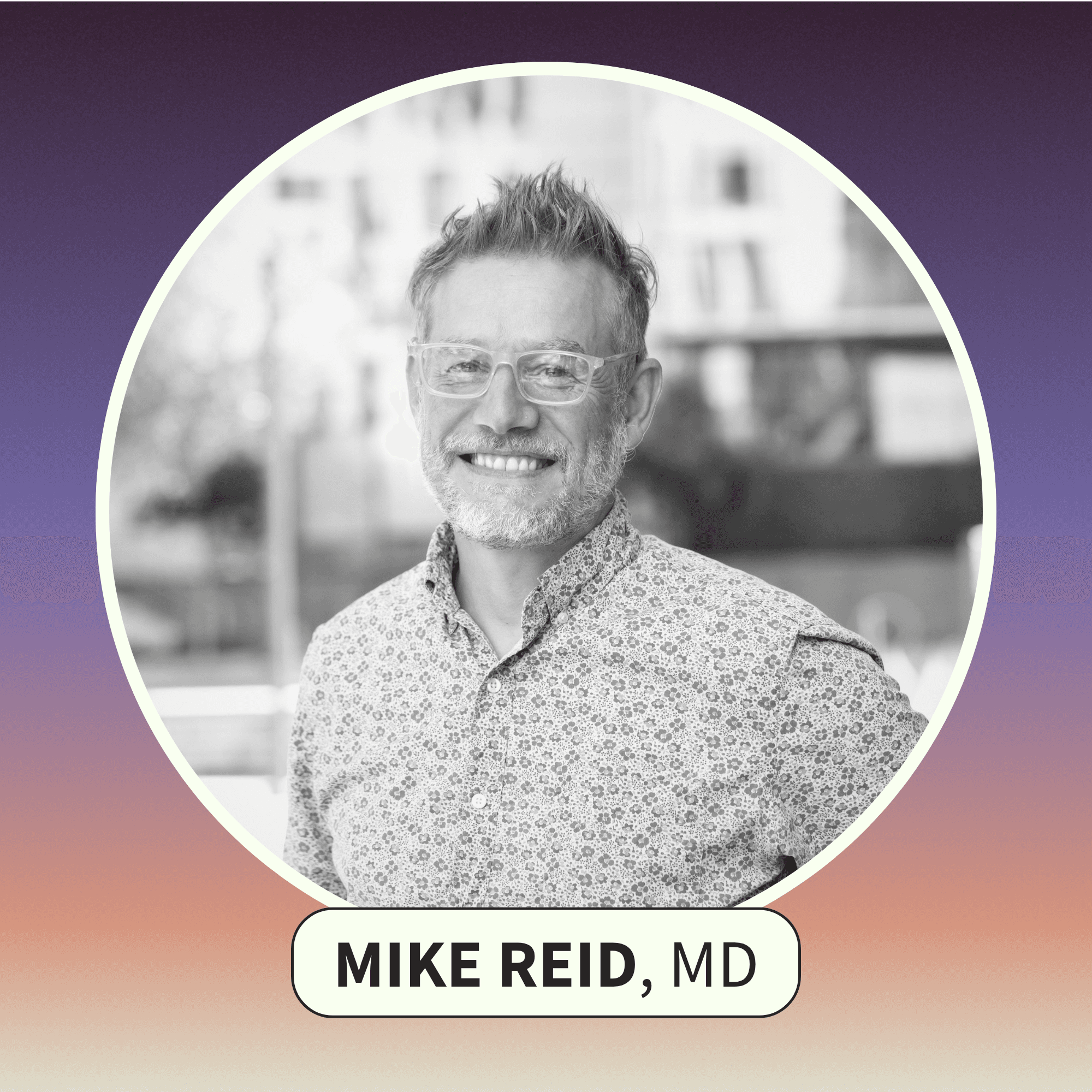
In this episode, infectious disease physician and global health leader Dr. mike Reid reflects on a moment early in his career working in Botswana, when a young patient died in front of him despite his efforts to help. The experience brought back a memory from childhood, when he first heard his father quietly describe himself as a failure. In a field where the needs often far exceed the available resources, Mike explores how physicians learn to live with doubt, responsibility, and the persistent feeling of not doing enough. Together we talk about the emotional landscape of global health, the role of failure in medicine, and what it means to keep trying anyway. |
0:00/1:34
The Nocturnists
Season
9
Episode
2
|
Failure and Grace with mike Reid, MD
In this episode, infectious disease physician and global health leader Dr. mike Reid reflects on a moment early in his career working in Botswana, when a young patient died in front of him despite his efforts to help. The experience brought back a memory from childhood, when he first heard his father quietly describe himself as a failure. In a field where the needs often far exceed the available resources, Mike explores how physicians learn to live with doubt, responsibility, and the persistent feeling of not doing enough. Together we talk about the emotional landscape of global health, the role of failure in medicine, and what it means to keep trying anyway. |
0:00/1:34
About Our Guest
mike Reid is a physician, public health scholar, and policy practitioner working at the intersection of global health, science and emerging technologies. He is an associate professor at UCSF and Chief Science Officer at GHSD in the State Dept. His work—and life—are shaped by questions of care, responsibility, fatherhood, and how people and systems respond in moments of strain and transition.
About The Show
The Nocturnists is an award-winning medical storytelling podcast, hosted by physician Emily Silverman. We feature personal stories from frontline clinicians, conversations with healthcare-related authors, and art-makers. Our mission is to humanize healthcare and foster joy, wonder, and curiosity among clinicians and patients alike.
resources
Credits
About Our Guest
mike Reid is a physician, public health scholar, and policy practitioner working at the intersection of global health, science and emerging technologies. He is an associate professor at UCSF and Chief Science Officer at GHSD in the State Dept. His work—and life—are shaped by questions of care, responsibility, fatherhood, and how people and systems respond in moments of strain and transition.
About The Show
The Nocturnists is an award-winning medical storytelling podcast, hosted by physician Emily Silverman. We feature personal stories from frontline clinicians, conversations with healthcare-related authors, and art-makers. Our mission is to humanize healthcare and foster joy, wonder, and curiosity among clinicians and patients alike.
resources
Credits
Transcript
Note: The Nocturnists is an audio-first experience with emotion and sound design that can be difficult to fully capture in text. Transcripts are provided to support accessibility and reference, but may contain minor inaccuracies. If quoting in print, please consult the audio when possible.
Emily Silverman: This is The Nocturnists. I'm Emily Silverman. Today's episode features Dr. mike Reid, an infectious disease physician and global health leader whose work has taken him from the UK to Botswana to the front lines of HIV policy. mike's story begins with a small moment from childhood. He's 11 years old, watching his father attempt to paint the dining room when an accident leaves paint splashed across the carpet and furniture. Standing in the middle of the mess, his father quietly mutters a phrase that will stay with mike for decades, "I'm such a failure."
Years later, while working as an HIV physician in Botswana, mike finds himself facing a devastating moment with a young patient. In the aftermath, that same phrase comes back to him. In my conversation with mike, we talk about the emotional weight of global health work, the ways physicians internalize failure, and how medicine often asks us to keep showing up, even when the outcomes are far from perfect. First, here's a clip from mike's live story, which he told on stage at a Nocturnists satellites event produced by the UCSF Institute for Global Health Sciences. Here's mike.
mike Reid: I think I was 11 years old. We live in High Wycombe, which is a small suburban town on the outskirts of London, and we live in a 1970s housing estate like the kind at the start of the Harry Potter movie, red brick houses and neatly cut lawns. A very English middle class sensibility to the neighborhood. My mom is a nurse. She went back to work after all of us kids were in school, and she is working a swing shift, so she'll be home tonight, probably around ten o'clock, typically smelling of hospital antiseptic and instant coffee.
That evening, it's just me and my dad at home. I'm watching TV, and my dad says he's going to paint the dining room. Now, my dad is many things. He's a reader, a luminous thinker. He's a church pastor, so he can quote Martin Luther King and Martin Lloyd Jones in the same breath, but he is not handy. He doesn't do DIY. When he says he's going to paint the dining room, I should have known that something bad was about to happen. I'm watching TV, and suddenly I hear from the dining room the scrape of a chair, a sudden thud, and then almost instantly, the hollow splosh of emulsion paint hitting the carpet.
I jump up and rush to the threshold of the dining room to survey this scene of chaos. There were no dust sheets, no covers on the carpet. I don't still know exactly what happened, but my guess is he fell off the chair, and the can of paint flew out of his hand, because there's paint in a perfect semicircular arc, from one end of the dining room through into the kitchen. The carpet, the dining room table, in the far distance, the kitchen cabinets and the linoleum, everything is covered in emulsion paint. I look up at my dad, and he takes a deep breath and then exhales. Under his breath, he says, "Ah, I'm such a failure."
[music]
Emily Silverman: I am sitting here with Dr. mike Reid. mike, thank you so much for coming on the show.
mike Reid: Oh, you're most welcome. Thanks for having me.
Emily Silverman: How was it telling your story on stage? Tell us about the experience.
mike Reid: It was a good experience. In many respects, it's a story that I have lived with for a long time. There probably was some catharsis, getting it out in a public space, and there was probably a little bit of anxiety, because some of it's fairly vulnerable. I talk about my dad, and that's more of an inner side that I don't share publicly so much. I think I was surprised by how much people connected with it in the room, which was appreciated.
Emily Silverman: Maybe we can rewind a bit and tell us about coming into medicine. What brought you into the profession, and then specifically what got you interested in infectious disease and global health?
mike Reid: Sure. I was 17, and I took a trip to India. Actually, I remember landing in Mumbai. The flight landed at one o'clock in the morning, and driving across the city in the early hours of the morning in one of those old Ambassador taxis, and driving through miles and miles of slums and just being overwhelmed by the profound poverty. It's also a place that is incredibly vibrant. It's people on the streets, even in the middle of the night, sweeping or sleeping or doing stuff.
That experience as a senior in high school was really transformative. It left me feeling like I want to do something with my career that is focused on justice and equity, and I ended up applying for medical school in the UK. You go to medical school straight out of high school. That took me through into residency, and then the rest, I suppose, is history. I ended up moving to the US. My ex wife is American, and I quickly realized I didn't like practicing in the US, and I was really restless to work in low income settings. After residency, ended up pursuing a career that was mostly focused on global health, and that's where I've been ever since.
Emily Silverman: Infectious disease was your specialty of choice. Was that an obvious pick, considering that you were interested in global health, or did something else, a specific disease, sometimes it is, drew you to ID?
mike Reid: Funnily enough, it wasn't an obvious choice for me. I finished residency and was pretty clear I didn't want to do infectious diseases. I cared about global health and health systems, but I didn't want to get boxed into one discipline. After residency, I took five years working in global health programs based initially in New York and then in Botswana, and increasingly, just was only focused on HIV. It became clear that in order to have the professional legitimacy I wanted, I really did need to do additional training. Five years after completing residency, and three-and-a-half years after moving to Africa, came back to the US and did ID training, and have been on that track ever since.
Emily Silverman: After your ID training, you landed-- I guess more recently, you landed this job as Chief Science Officer for PEPFAR. Maybe you can tell us a little bit about what is PEPFAR, what is the Chief Science Officer role, and how did you come into that role? It's such a awesome position.
mike Reid: PEPFAR is in a moment of branding transition. For the last 20 years, PEPFAR stood-- It's an acronym for the President's Emergency Plan for AIDS Relief. It was set up by George W. Bush in 2002 as the US government's global response to HIV. That's where I work, although now we are called the Bureau of Global Health Security and Diplomacy. We serve disease programs broader than just HIV.
My role there as Chief Science Officer is really to try and identify what are the emerging tools and best science that we could be supporting to take to scale in low and middle income countries. Most of that involves HIV programs, because most of PEPFAR is funding is HIV focused. A lot of what I think about is, how do we get these brilliant new tools, whether they are diagnostic or therapeutic tools, and get them to people who need them in resource-constrained settings where PEPFAR works?
How I ended up in this role, which was your third question, is a story that reflects stuff that I've done and people I know. During COVID, I ended up running the contact tracing program in San Francisco. You may remember the stories. It was an amazing experience. Very quickly, we mobilized this whole workforce of librarians to contact trace across the city. I think we were the first place in the US to stand up a robust contact tracing infrastructure.
That led to taking on a similar role within the California Department of Public Health. Then I ended up taking on more leadership roles in a policy space. I think the other thing I'd say is that I've spent the last 10 years being mentored by an amazing, visionary, brilliant mentor, Eric Goosby, who's a professor emeritus at UCSF. He used to work in PEPFAR and I think played an instrumental role in advocating for me in that role.
Emily Silverman: I remember taking a course on global health in college. Actually, it was called The Burden of Disease in Developing Countries. I think it was called back then. Then in medical school, I did a little bit of global health work. I took a trip to India, actually, to work with a team of engineers who were trying to invent the device that cooled babies. In these neonatal units, a way to cool the brain to prevent brain damage.
That was kind of an interesting, fun trip where I learned about engineering and also global health. I remember through those experiences, hearing a lot about malaria, that was a disease that was big, and bed nets, and just how much morbidity and mortality you could prevent with bed nets. Then, of course, reading and learning a ton about HIV and TB and how they often go together and things like that.
I'm wondering, since I've fallen out of that world for the last 10 years or so, what is the state of global health right now? Is it the same diseases? Have there been changes in the epidemiology of what's impacting people? Have there been changes in the approach? Or, I don't know, as someone with their finger on the pulse of public health right now, I would just be really interested to hear, what is public health broadly looking at in 2026?
mike Reid: there's a lot of ways to answer that question, Emily, there's a policy answer, there's an epidemiological answer, there's a political answer. Perhaps I'll start with a political answer, which I think is most relevant. To use use the words of Mark Carney, we're in a moment of rupture. I think it's fair to say that there is a tremendous amount of uncertainty about the future of global health, academic global health, but also global health writ large. US government has historically been the major funder of programs, and it is evolving in its stance to continuing in that role. As a consequence, there's a tremendous amount of uncertainty and instability across many elements of the global health ecosystem.
That's not all bad. To answer your question in another way, I think from an epidemiological point of view, many of those infectious diseases that have been priorities for the global community for the last 20 years, whilst we haven't eradicated them or eliminated them, we've made incredible progress. We're at a point now, an inflection point, where it's not inconceivable that partner governments in each of these countries can and should be playing a bigger role.
I think there are really important questions that the field is wrestling with about, what does governance look like? How can we create a global health ecosystem that is not dependent on the US? What's the role for financing-- Many countries, really poor countries, are still going to be dependent on financing from high income countries, and how and when can that happen, and what's the role for the US in that?
Then there are also lots of really exciting opportunities to think about, how can technology, AI, in particular, solve some of the problems that we're facing now? I don't think AI is a silver bullet. It's never going to replace drugs or healthcare workers, but could it afford us efficiencies that may be necessary as there is less funding? All of that to say, we're in this really pivotal inflection point. I think it's both a moment where a lot of people are feeling very, very anxious, but I think there are really exciting opportunities for for governments and local stakeholders to take leadership roles, to move away from a moment of dependency to independency.
I think we're in an inflection point where there is grounds for pessimism or sobriety, given the fact that the US is stepping away from an era of leadership, but there is also grounds for optimism. I think this is an opportunity for other stakeholders to play a bigger role, for us to rethink how we do global health epistemologically and financially and from a governance point of view, and that's not a bad thing.
Emily Silverman: As Chief Science Officer, I'm wondering if there's a particular project or concept that you've been working with that you're excited about and passionate about that you can share with us to make this concrete. I'd love to hear a bit about what you're actually working on?
mike Reid: One thing that we're very focused on, and is consuming a lot of my time right now is a new preventative tool called lenacapavir. Lenacapavir is a first-in-class capsid inhibitor. It's a drug that we are using to prevent HIV. Specifically, it's an injection that you can take once every six months, a SubQ injection. What's really exciting about it is that the phase III clinical data basically showed amazing efficacy. In adolescent girls and young women in the main randomized control trial that was targeting them, it had 100% efficacy at preventing HIV transmission. In the sister trial in MSM and gender non-binary individuals, I think it had a 97% efficacy.
When we compare that against all of the other prevention tools that have been scaled over the last 20 years, nothing comes close. Lots of excitement of lenacapavir. The challenge will be, how do we scale this tool effectively in resource-limited settings, and can we do it in a way that is affordable? The Trump administration has committed substantial resources to making lenacapavir available over the next couple of years. They partnered with the originator drug company, Gilead, to procure a substantial volume. The hope is that that can help generate a market that will allow countries to buy in when the generic formulation is available in 2027.
My work has been to translate some of that science into programs, and think through how we do this, and then collaborate across the myriad of stakeholders who are involved. There's a huge numbers of stakeholders who are invested in this, from multilaterals like the Global Fund and the WHO to the pharmaceutical company, both Gilead, but also the generic companies, community activists, and then scientists and academics who are thinking through the implementation science and the research agenda.
I'm not really quarterback, but I'm out in front, maybe more like the cheerleader, trying to help move move this program forward. I'm a member of a small but mighty team at PEPFAR that is focused on this right now. That's just one example. The other kinds of things that I'm thinking about are the application of artificial intelligence, the role of long acting treatment agents for HIV, and then some more systems level innovation that we have to think about as we're moving towards country ownership, and there's less money on the table.
[music]
Emily Silverman: Maybe we can talk about your story. It's a story about doubt and about failure. You open with this anecdote about your dad and his adventures trying to paint your house, and his use of the word failure, and how that stayed with you, and how he pointed that word at himself and how that stayed with you, not just the word, but the way that it was wielded. I was wondering if you could just expand on that a bit. Tell us about your dad and that anecdote and why it stayed with you.
mike Reid: I think I mentioned this in the stories of he's a very talented individual. He's a really luminous thinker. I think his professional career reflects his constellation of talents. He's well loved in his line of work, and does brilliant work.
Emily Silverman: Remind me his line of work.
mike Reid: He's a church minister in the UK-- Or was. He's 83 now, so he's getting on a bit. That's where his professional career has been located. I think in that space, in the pulpit and in front of his congregation, I think I've often felt like there is a sense of internal self reflection on his inadequacies, to be better, to have more impact, to be more effective. Certainly, I carry that into my own professional life, and I think that the genesis of that is my dad's professional career.
That story just encapsulates it in some respects. I don't think I ever heard him articulate another point. When I think about my own failures, not just professional failures, my failures as a father and as a sports person, I connect with that inner voice, like, "Oh, you're such a failure," which I think has its origins there, at least in some sense.
Emily Silverman: I think a lot of us have that inner voice. It doesn't say you made a mistake. It doesn't say you'll do better next time, just work on this skill or that skill, or make an apology, or here are all your other strengths. "The voice tends to say not just you failed, but that you are a failure. It becomes a self defining belief. It's one that I think is pretty prevalent in medicine.
We did a whole series on the theme of shame in medicine, and the internally and externally imposed systems of shame that we're operating in. The profession tends to attract shame-prone individuals. You could say that's good or bad, but it's a pattern that we've noticed. I'm wondering how you think about this self attack habit, and especially in high performing individuals. I don't know. How has your relationship to that inner voice shifted over time?
mike Reid: I'd hope that I could tell you that I have more grace for it.
Emily Silverman: You're completely enlightened. [laughs]
mike Reid: Yes. I'm on this journey to, yes, greater enlightenment and self discovery and self love. There are moments where I have that objectivity, but I think a lot of the time I am really struggling with my own internal sense that I'm not good enough, and that is a blessing and a curse. It's a blessing in so far as I think what has driven me, in many respects, is this sense of like, I want to do better because I don't feel like I'm good enough. I need to write another paper or apply for another job. It's a curse because I think it's a lie.
Actually, when I am the best version of myself, it's when I'm able to sit in the fullness of my goodness and be able to acknowledge that I'm enough. I am enough as I am, and I'm enough as a dad, as a colleague, as a clinical provider. I obviously always got to improve, but I also don't need to flagellate myself on my inadequacies. I think about this a lot, both in my professional and my personal life.
I think 2025 was just truly a shit year. On my Christmas card to friends and family, I defined it as my annus horribilis, which I think is what the Queen Elizabeth called 1992 was her annus horribilis. We watched the whole of global health go into meltdown, and so many people have felt the consequences of policy decisions, both here and globally, that have been really profound and catastrophic. I have felt a lot like, "Shit, what can I be doing? What more can I be doing?" Some of that is good. I think when it's defined by a moral ambition to do something better or to to be something better, it's good. When it becomes all consuming and about me and why I feel inadequate, that doesn't feel healthy.
Emily Silverman: There's two pop culture references that are coming to mind as I'm hearing you talk. One of them is from the musical Hamilton, which I love. It's, I think, pretty early in the musical, where they introduce Alexander Hamilton. He's an immigrant, he's an orphan, and he meets Burr at the very, very beginning. I think Burr's parents died too. Hamilton says to Burr, "Oh, you're an orphan. That makes so much sense. I'm an orphan too, and I just really wish that there were a war so that we could prove to people that were so much more than they bargained for," or something like that. I'm obviously not going to rob Hamilton.
They plant that seed really early, that this is a man who could not stop. He did so much, and he built so much, and his legacy is tremendous. Some of that engine for him came from developmental trauma, from being orphaned, from being seen as less than as an immigrant, and that some of his relentless ambition may have been driven by insecurity. Then the other pop culture reference that I'm thinking about is completely different.
This comedian, Taylor Tomlinson, I don't know if you've ever heard of her. She's a young woman. Her mom died when she was young, and I remember in one of her stand up comedy shows, she was like, "Do you think I would be this successful at age 24 if I had a living mom? [laughs] She was like, "You think I would have a Netflix special at 22?" She was like, "No." She was, "No." She was like, "If I had a living mom, I would be an English teacher somewhere, and I would love myself," [laughs] something like that. I'm just wondering what you think about this, like, can we have greatness without trauma and insecurity?
mike Reid: I think so. Here I reflect on the wisdom of another champion of pop culture, Brené Brown. She talks about there's no courage without risk of failure. Failure is not falling down, it's choosing not to get back up again. I think there is something really important about failing and being vulnerable to failure that can lead to beautiful, creative outcomes. I think it's about where we let our heart be, how we engage with failure that defines us, right?
Emily Silverman: Yes. Have you heard of this trend? I remember a few years ago back when MedTwitter was a thing, people would post their failure resumes. Did you ever see that, instead of their--
mike Reid: [laughs] Oh, no. I like that idea.
Emily Silverman: It was like every fellowship they had applied for and didn't get, every grant, every award, every promotion. You would put together a failure resume, and then you would share it to normalize failure. I'm wondering if you ever saw that.
mike Reid: No. I like that sentiment, though. It's funny, there's one paper that I wrote when I was in Botswana. I think we got rejected by nine different journals and got accepted by the tenth. It's a really bad science. It was a flawed study. I am still friends with the people who I wrote that with. I think that journey of failure and persistence was very defining to those relationships in a positive way, even if the paper was neither here nor there.
Emily Silverman: The second part of your story talks about a medical emergency that you attended to and how your father's voice came back to you in that moment. Maybe you can bring us into that part of the story.
mike Reid: I was living in Botswana. We'd been there, I think, a couple of years by then, and it was a really amazing privilege as a physician to be in Botswana at that time. I, every week, would visit different rural clinics in the southern part of the country. I had a standard routine where I would go and give lectures at morning report or grand rounds, and then I would see all the patients on the inpatient service at these small hospitals, and then spend the rest of the afternoon in their HIV failure clinic seeing people with complicated HIV.
On that particular day, I got up pretty early in the morning and drove out of Gaborone, the capital city. Just to set the scene, it's so beautiful in that area of Southern Africa, up in the High Sierras, and the sun rising is just magical. I arrived at this clinic, and I went through normal routine. I gave a lecture, and then they ushered me into the inpatient ward. I ended up being asked to see this young woman who was recently diagnosed with HIV and had vaginal discharge.
You've heard the story, so I won't go into in too much detail, except to say that I thought the best thing I could do was examine her, because nobody had examined her. I was obviously concerned about cervical cancer as a likely diagnosis in this woman who'd been newly diagnosed with HIV and had a very low CD4 count. In the process of examining her, she started to bleed. Things just happened so quickly, and she bled to death in front of me. In the very moment that was happening, it was just, "Shit, fuck, fuck, shit, shit. What do I do?" There's no blood, there's no IV fluids. The nearest ambulance is like 40 minutes away.
She'd just been sat there, not comfortable, but she'd been stable. Then I examined her, and suddenly she's exsanguinating in front of me. I left that experience just feeling devastated. I thought that I was doing the right thing by examining her. In retrospect, probably that kind of episode could have happened at any point in her disease course, but I felt responsibility for it. Drove home that day just feeling terribly defeated, like, "I'm such a fucking failure."
A lot of my experience in Botswana felt like that. There were so many times where the need was massive, and I had a sense for what we needed, whether it was more drugs, more people, or some diagnostic tests that we didn't have and it wasn't available. That feeling of failure was common. Then to add into the mix, and I don't think I tell this in the story, but I went with a young family.
I went with a daughter who was eight weeks old, and my wife at the time, and it was the pits. I had this notion that going to Africa would be beautifully romantic, and we'd have all all these fun adventures. It was so hard. We were like 10,000 miles away from family. We had a tiny baby. We were so alone, and then I'd go into work doing what on paper seemed like a great job, and feeling inadequate all the time. That's the bigger context of that story.
Emily Silverman: Wow, what a story. It's funny, we're talking about failure, and you think about professional failures, and it's maybe not getting a certain client or whatever, but in medicine, failures can be really devastating and irreversible when somebody's harmed or when somebody dies. Like you said, it may or may not have happened eventually, but to be so proximal to it, do you have any advice for anybody listening who maybe has gone through something similar, or is going through something similar, where there was an adverse event or an error or just a devastating outcome that they were present for or connected with? Just any words for them and how they might process that?
mike Reid: I think two things come to mind. The first is just the importance of honesty with ourselves and with those around us. What could I have done better? What were the mistakes I made that I need to own up for, rather than just brushing them under the carpet? Then the second thing is just the importance of self care. Again, I'm an expert on this. I've alluded to. I push myself too hard. My work boundaries are shitty. [chuckles] I'm not as compassionate with myself as I would like to be. If I had wisdom, it would be to love myself better. That can look like a lot of things, but I think it is about that internal voice of affirmation. It's about the community that you surround yourself with that can support you to feel loved and supported.
Emily Silverman: Any future storytelling projects for you?
mike Reid: [laughs] I would like to. I write some of these things on Substack. I'm inclined to think I would like to try and capture. I've told a few stories. I did The Moth in New York once before. I told the story of the first time I ever delivered a baby. I like telling stories, so I think I'd like to do again.
Emily Silverman: Fabulous. As we bring it to an end, is there anything else you want to share with us about global health or about failure or about resilience, or any or all of the above, or something different?
mike Reid: I've been reading this book, and I alluded to in terms of the title, Walter Bregman, I think his name is. It's called Moral ambition. I really would encourage folks to read it. It's so relevant for this moment, at least in the US, where there is a real lack of moral ambition in the highest places. It starts with the story of how this one village in rural Holland during the Nazi era saved more Jews from the concentration camps than any other place in Holland, per capita.
The only thing that defined them as different was that they chose to-- when they were asked to, they chose to take these people in. I guess I just reflect on that, that there is a moment right now that demands unique levels of moral ambition, and we're all called to it, and that's particularly true for global health. That's what I'm thinking about a lot. It's like, what does moral ambition look like in the space where I work professionally?
Emily Silverman: Fabulous. I think that's a great note to end on. Does your Substack have a name? How can people find you?
mike Reid: Reimaginingglobalhealth.com. No. Reimagineglobalhealth.substack.com.
Emily Silverman: Okay, fabulous. We'll check that out. mike Reid, thank you so much for sharing your story with us and coming on the show.
mike Reid: Thank you, Emily.
[music]
Emily Silverman: This episode of The Nocturnists was produced by me and producer and head of story development Molly Rose-Williams. Our executive producer is Ali Block and Ashley Pettit is our program director. Original theme music was composed by Yosef Munro, with additional music from Blue Dot Sessions. The Nocturnists is made possible by listeners like you. If you enjoy what you hear and you want to support our work, consider subscribing to The Nocturnists+.
You'll get access to The Nocturnists After Hours, our monthly bonus series featuring original conversations from our team, along with merch discounts and a full archive of episodes all in one place. Subscriptions start at just $10 a month. Learn more at thenocturnists.org/plus or through the link in the description. Thank you for listening and being part of this community. Until next time, I'm your host Emily Silverman.
Transcript
Note: The Nocturnists is an audio-first experience with emotion and sound design that can be difficult to fully capture in text. Transcripts are provided to support accessibility and reference, but may contain minor inaccuracies. If quoting in print, please consult the audio when possible.
Emily Silverman: This is The Nocturnists. I'm Emily Silverman. Today's episode features Dr. mike Reid, an infectious disease physician and global health leader whose work has taken him from the UK to Botswana to the front lines of HIV policy. mike's story begins with a small moment from childhood. He's 11 years old, watching his father attempt to paint the dining room when an accident leaves paint splashed across the carpet and furniture. Standing in the middle of the mess, his father quietly mutters a phrase that will stay with mike for decades, "I'm such a failure."
Years later, while working as an HIV physician in Botswana, mike finds himself facing a devastating moment with a young patient. In the aftermath, that same phrase comes back to him. In my conversation with mike, we talk about the emotional weight of global health work, the ways physicians internalize failure, and how medicine often asks us to keep showing up, even when the outcomes are far from perfect. First, here's a clip from mike's live story, which he told on stage at a Nocturnists satellites event produced by the UCSF Institute for Global Health Sciences. Here's mike.
mike Reid: I think I was 11 years old. We live in High Wycombe, which is a small suburban town on the outskirts of London, and we live in a 1970s housing estate like the kind at the start of the Harry Potter movie, red brick houses and neatly cut lawns. A very English middle class sensibility to the neighborhood. My mom is a nurse. She went back to work after all of us kids were in school, and she is working a swing shift, so she'll be home tonight, probably around ten o'clock, typically smelling of hospital antiseptic and instant coffee.
That evening, it's just me and my dad at home. I'm watching TV, and my dad says he's going to paint the dining room. Now, my dad is many things. He's a reader, a luminous thinker. He's a church pastor, so he can quote Martin Luther King and Martin Lloyd Jones in the same breath, but he is not handy. He doesn't do DIY. When he says he's going to paint the dining room, I should have known that something bad was about to happen. I'm watching TV, and suddenly I hear from the dining room the scrape of a chair, a sudden thud, and then almost instantly, the hollow splosh of emulsion paint hitting the carpet.
I jump up and rush to the threshold of the dining room to survey this scene of chaos. There were no dust sheets, no covers on the carpet. I don't still know exactly what happened, but my guess is he fell off the chair, and the can of paint flew out of his hand, because there's paint in a perfect semicircular arc, from one end of the dining room through into the kitchen. The carpet, the dining room table, in the far distance, the kitchen cabinets and the linoleum, everything is covered in emulsion paint. I look up at my dad, and he takes a deep breath and then exhales. Under his breath, he says, "Ah, I'm such a failure."
[music]
Emily Silverman: I am sitting here with Dr. mike Reid. mike, thank you so much for coming on the show.
mike Reid: Oh, you're most welcome. Thanks for having me.
Emily Silverman: How was it telling your story on stage? Tell us about the experience.
mike Reid: It was a good experience. In many respects, it's a story that I have lived with for a long time. There probably was some catharsis, getting it out in a public space, and there was probably a little bit of anxiety, because some of it's fairly vulnerable. I talk about my dad, and that's more of an inner side that I don't share publicly so much. I think I was surprised by how much people connected with it in the room, which was appreciated.
Emily Silverman: Maybe we can rewind a bit and tell us about coming into medicine. What brought you into the profession, and then specifically what got you interested in infectious disease and global health?
mike Reid: Sure. I was 17, and I took a trip to India. Actually, I remember landing in Mumbai. The flight landed at one o'clock in the morning, and driving across the city in the early hours of the morning in one of those old Ambassador taxis, and driving through miles and miles of slums and just being overwhelmed by the profound poverty. It's also a place that is incredibly vibrant. It's people on the streets, even in the middle of the night, sweeping or sleeping or doing stuff.
That experience as a senior in high school was really transformative. It left me feeling like I want to do something with my career that is focused on justice and equity, and I ended up applying for medical school in the UK. You go to medical school straight out of high school. That took me through into residency, and then the rest, I suppose, is history. I ended up moving to the US. My ex wife is American, and I quickly realized I didn't like practicing in the US, and I was really restless to work in low income settings. After residency, ended up pursuing a career that was mostly focused on global health, and that's where I've been ever since.
Emily Silverman: Infectious disease was your specialty of choice. Was that an obvious pick, considering that you were interested in global health, or did something else, a specific disease, sometimes it is, drew you to ID?
mike Reid: Funnily enough, it wasn't an obvious choice for me. I finished residency and was pretty clear I didn't want to do infectious diseases. I cared about global health and health systems, but I didn't want to get boxed into one discipline. After residency, I took five years working in global health programs based initially in New York and then in Botswana, and increasingly, just was only focused on HIV. It became clear that in order to have the professional legitimacy I wanted, I really did need to do additional training. Five years after completing residency, and three-and-a-half years after moving to Africa, came back to the US and did ID training, and have been on that track ever since.
Emily Silverman: After your ID training, you landed-- I guess more recently, you landed this job as Chief Science Officer for PEPFAR. Maybe you can tell us a little bit about what is PEPFAR, what is the Chief Science Officer role, and how did you come into that role? It's such a awesome position.
mike Reid: PEPFAR is in a moment of branding transition. For the last 20 years, PEPFAR stood-- It's an acronym for the President's Emergency Plan for AIDS Relief. It was set up by George W. Bush in 2002 as the US government's global response to HIV. That's where I work, although now we are called the Bureau of Global Health Security and Diplomacy. We serve disease programs broader than just HIV.
My role there as Chief Science Officer is really to try and identify what are the emerging tools and best science that we could be supporting to take to scale in low and middle income countries. Most of that involves HIV programs, because most of PEPFAR is funding is HIV focused. A lot of what I think about is, how do we get these brilliant new tools, whether they are diagnostic or therapeutic tools, and get them to people who need them in resource-constrained settings where PEPFAR works?
How I ended up in this role, which was your third question, is a story that reflects stuff that I've done and people I know. During COVID, I ended up running the contact tracing program in San Francisco. You may remember the stories. It was an amazing experience. Very quickly, we mobilized this whole workforce of librarians to contact trace across the city. I think we were the first place in the US to stand up a robust contact tracing infrastructure.
That led to taking on a similar role within the California Department of Public Health. Then I ended up taking on more leadership roles in a policy space. I think the other thing I'd say is that I've spent the last 10 years being mentored by an amazing, visionary, brilliant mentor, Eric Goosby, who's a professor emeritus at UCSF. He used to work in PEPFAR and I think played an instrumental role in advocating for me in that role.
Emily Silverman: I remember taking a course on global health in college. Actually, it was called The Burden of Disease in Developing Countries. I think it was called back then. Then in medical school, I did a little bit of global health work. I took a trip to India, actually, to work with a team of engineers who were trying to invent the device that cooled babies. In these neonatal units, a way to cool the brain to prevent brain damage.
That was kind of an interesting, fun trip where I learned about engineering and also global health. I remember through those experiences, hearing a lot about malaria, that was a disease that was big, and bed nets, and just how much morbidity and mortality you could prevent with bed nets. Then, of course, reading and learning a ton about HIV and TB and how they often go together and things like that.
I'm wondering, since I've fallen out of that world for the last 10 years or so, what is the state of global health right now? Is it the same diseases? Have there been changes in the epidemiology of what's impacting people? Have there been changes in the approach? Or, I don't know, as someone with their finger on the pulse of public health right now, I would just be really interested to hear, what is public health broadly looking at in 2026?
mike Reid: there's a lot of ways to answer that question, Emily, there's a policy answer, there's an epidemiological answer, there's a political answer. Perhaps I'll start with a political answer, which I think is most relevant. To use use the words of Mark Carney, we're in a moment of rupture. I think it's fair to say that there is a tremendous amount of uncertainty about the future of global health, academic global health, but also global health writ large. US government has historically been the major funder of programs, and it is evolving in its stance to continuing in that role. As a consequence, there's a tremendous amount of uncertainty and instability across many elements of the global health ecosystem.
That's not all bad. To answer your question in another way, I think from an epidemiological point of view, many of those infectious diseases that have been priorities for the global community for the last 20 years, whilst we haven't eradicated them or eliminated them, we've made incredible progress. We're at a point now, an inflection point, where it's not inconceivable that partner governments in each of these countries can and should be playing a bigger role.
I think there are really important questions that the field is wrestling with about, what does governance look like? How can we create a global health ecosystem that is not dependent on the US? What's the role for financing-- Many countries, really poor countries, are still going to be dependent on financing from high income countries, and how and when can that happen, and what's the role for the US in that?
Then there are also lots of really exciting opportunities to think about, how can technology, AI, in particular, solve some of the problems that we're facing now? I don't think AI is a silver bullet. It's never going to replace drugs or healthcare workers, but could it afford us efficiencies that may be necessary as there is less funding? All of that to say, we're in this really pivotal inflection point. I think it's both a moment where a lot of people are feeling very, very anxious, but I think there are really exciting opportunities for for governments and local stakeholders to take leadership roles, to move away from a moment of dependency to independency.
I think we're in an inflection point where there is grounds for pessimism or sobriety, given the fact that the US is stepping away from an era of leadership, but there is also grounds for optimism. I think this is an opportunity for other stakeholders to play a bigger role, for us to rethink how we do global health epistemologically and financially and from a governance point of view, and that's not a bad thing.
Emily Silverman: As Chief Science Officer, I'm wondering if there's a particular project or concept that you've been working with that you're excited about and passionate about that you can share with us to make this concrete. I'd love to hear a bit about what you're actually working on?
mike Reid: One thing that we're very focused on, and is consuming a lot of my time right now is a new preventative tool called lenacapavir. Lenacapavir is a first-in-class capsid inhibitor. It's a drug that we are using to prevent HIV. Specifically, it's an injection that you can take once every six months, a SubQ injection. What's really exciting about it is that the phase III clinical data basically showed amazing efficacy. In adolescent girls and young women in the main randomized control trial that was targeting them, it had 100% efficacy at preventing HIV transmission. In the sister trial in MSM and gender non-binary individuals, I think it had a 97% efficacy.
When we compare that against all of the other prevention tools that have been scaled over the last 20 years, nothing comes close. Lots of excitement of lenacapavir. The challenge will be, how do we scale this tool effectively in resource-limited settings, and can we do it in a way that is affordable? The Trump administration has committed substantial resources to making lenacapavir available over the next couple of years. They partnered with the originator drug company, Gilead, to procure a substantial volume. The hope is that that can help generate a market that will allow countries to buy in when the generic formulation is available in 2027.
My work has been to translate some of that science into programs, and think through how we do this, and then collaborate across the myriad of stakeholders who are involved. There's a huge numbers of stakeholders who are invested in this, from multilaterals like the Global Fund and the WHO to the pharmaceutical company, both Gilead, but also the generic companies, community activists, and then scientists and academics who are thinking through the implementation science and the research agenda.
I'm not really quarterback, but I'm out in front, maybe more like the cheerleader, trying to help move move this program forward. I'm a member of a small but mighty team at PEPFAR that is focused on this right now. That's just one example. The other kinds of things that I'm thinking about are the application of artificial intelligence, the role of long acting treatment agents for HIV, and then some more systems level innovation that we have to think about as we're moving towards country ownership, and there's less money on the table.
[music]
Emily Silverman: Maybe we can talk about your story. It's a story about doubt and about failure. You open with this anecdote about your dad and his adventures trying to paint your house, and his use of the word failure, and how that stayed with you, and how he pointed that word at himself and how that stayed with you, not just the word, but the way that it was wielded. I was wondering if you could just expand on that a bit. Tell us about your dad and that anecdote and why it stayed with you.
mike Reid: I think I mentioned this in the stories of he's a very talented individual. He's a really luminous thinker. I think his professional career reflects his constellation of talents. He's well loved in his line of work, and does brilliant work.
Emily Silverman: Remind me his line of work.
mike Reid: He's a church minister in the UK-- Or was. He's 83 now, so he's getting on a bit. That's where his professional career has been located. I think in that space, in the pulpit and in front of his congregation, I think I've often felt like there is a sense of internal self reflection on his inadequacies, to be better, to have more impact, to be more effective. Certainly, I carry that into my own professional life, and I think that the genesis of that is my dad's professional career.
That story just encapsulates it in some respects. I don't think I ever heard him articulate another point. When I think about my own failures, not just professional failures, my failures as a father and as a sports person, I connect with that inner voice, like, "Oh, you're such a failure," which I think has its origins there, at least in some sense.
Emily Silverman: I think a lot of us have that inner voice. It doesn't say you made a mistake. It doesn't say you'll do better next time, just work on this skill or that skill, or make an apology, or here are all your other strengths. "The voice tends to say not just you failed, but that you are a failure. It becomes a self defining belief. It's one that I think is pretty prevalent in medicine.
We did a whole series on the theme of shame in medicine, and the internally and externally imposed systems of shame that we're operating in. The profession tends to attract shame-prone individuals. You could say that's good or bad, but it's a pattern that we've noticed. I'm wondering how you think about this self attack habit, and especially in high performing individuals. I don't know. How has your relationship to that inner voice shifted over time?
mike Reid: I'd hope that I could tell you that I have more grace for it.
Emily Silverman: You're completely enlightened. [laughs]
mike Reid: Yes. I'm on this journey to, yes, greater enlightenment and self discovery and self love. There are moments where I have that objectivity, but I think a lot of the time I am really struggling with my own internal sense that I'm not good enough, and that is a blessing and a curse. It's a blessing in so far as I think what has driven me, in many respects, is this sense of like, I want to do better because I don't feel like I'm good enough. I need to write another paper or apply for another job. It's a curse because I think it's a lie.
Actually, when I am the best version of myself, it's when I'm able to sit in the fullness of my goodness and be able to acknowledge that I'm enough. I am enough as I am, and I'm enough as a dad, as a colleague, as a clinical provider. I obviously always got to improve, but I also don't need to flagellate myself on my inadequacies. I think about this a lot, both in my professional and my personal life.
I think 2025 was just truly a shit year. On my Christmas card to friends and family, I defined it as my annus horribilis, which I think is what the Queen Elizabeth called 1992 was her annus horribilis. We watched the whole of global health go into meltdown, and so many people have felt the consequences of policy decisions, both here and globally, that have been really profound and catastrophic. I have felt a lot like, "Shit, what can I be doing? What more can I be doing?" Some of that is good. I think when it's defined by a moral ambition to do something better or to to be something better, it's good. When it becomes all consuming and about me and why I feel inadequate, that doesn't feel healthy.
Emily Silverman: There's two pop culture references that are coming to mind as I'm hearing you talk. One of them is from the musical Hamilton, which I love. It's, I think, pretty early in the musical, where they introduce Alexander Hamilton. He's an immigrant, he's an orphan, and he meets Burr at the very, very beginning. I think Burr's parents died too. Hamilton says to Burr, "Oh, you're an orphan. That makes so much sense. I'm an orphan too, and I just really wish that there were a war so that we could prove to people that were so much more than they bargained for," or something like that. I'm obviously not going to rob Hamilton.
They plant that seed really early, that this is a man who could not stop. He did so much, and he built so much, and his legacy is tremendous. Some of that engine for him came from developmental trauma, from being orphaned, from being seen as less than as an immigrant, and that some of his relentless ambition may have been driven by insecurity. Then the other pop culture reference that I'm thinking about is completely different.
This comedian, Taylor Tomlinson, I don't know if you've ever heard of her. She's a young woman. Her mom died when she was young, and I remember in one of her stand up comedy shows, she was like, "Do you think I would be this successful at age 24 if I had a living mom? [laughs] She was like, "You think I would have a Netflix special at 22?" She was like, "No." She was, "No." She was like, "If I had a living mom, I would be an English teacher somewhere, and I would love myself," [laughs] something like that. I'm just wondering what you think about this, like, can we have greatness without trauma and insecurity?
mike Reid: I think so. Here I reflect on the wisdom of another champion of pop culture, Brené Brown. She talks about there's no courage without risk of failure. Failure is not falling down, it's choosing not to get back up again. I think there is something really important about failing and being vulnerable to failure that can lead to beautiful, creative outcomes. I think it's about where we let our heart be, how we engage with failure that defines us, right?
Emily Silverman: Yes. Have you heard of this trend? I remember a few years ago back when MedTwitter was a thing, people would post their failure resumes. Did you ever see that, instead of their--
mike Reid: [laughs] Oh, no. I like that idea.
Emily Silverman: It was like every fellowship they had applied for and didn't get, every grant, every award, every promotion. You would put together a failure resume, and then you would share it to normalize failure. I'm wondering if you ever saw that.
mike Reid: No. I like that sentiment, though. It's funny, there's one paper that I wrote when I was in Botswana. I think we got rejected by nine different journals and got accepted by the tenth. It's a really bad science. It was a flawed study. I am still friends with the people who I wrote that with. I think that journey of failure and persistence was very defining to those relationships in a positive way, even if the paper was neither here nor there.
Emily Silverman: The second part of your story talks about a medical emergency that you attended to and how your father's voice came back to you in that moment. Maybe you can bring us into that part of the story.
mike Reid: I was living in Botswana. We'd been there, I think, a couple of years by then, and it was a really amazing privilege as a physician to be in Botswana at that time. I, every week, would visit different rural clinics in the southern part of the country. I had a standard routine where I would go and give lectures at morning report or grand rounds, and then I would see all the patients on the inpatient service at these small hospitals, and then spend the rest of the afternoon in their HIV failure clinic seeing people with complicated HIV.
On that particular day, I got up pretty early in the morning and drove out of Gaborone, the capital city. Just to set the scene, it's so beautiful in that area of Southern Africa, up in the High Sierras, and the sun rising is just magical. I arrived at this clinic, and I went through normal routine. I gave a lecture, and then they ushered me into the inpatient ward. I ended up being asked to see this young woman who was recently diagnosed with HIV and had vaginal discharge.
You've heard the story, so I won't go into in too much detail, except to say that I thought the best thing I could do was examine her, because nobody had examined her. I was obviously concerned about cervical cancer as a likely diagnosis in this woman who'd been newly diagnosed with HIV and had a very low CD4 count. In the process of examining her, she started to bleed. Things just happened so quickly, and she bled to death in front of me. In the very moment that was happening, it was just, "Shit, fuck, fuck, shit, shit. What do I do?" There's no blood, there's no IV fluids. The nearest ambulance is like 40 minutes away.
She'd just been sat there, not comfortable, but she'd been stable. Then I examined her, and suddenly she's exsanguinating in front of me. I left that experience just feeling devastated. I thought that I was doing the right thing by examining her. In retrospect, probably that kind of episode could have happened at any point in her disease course, but I felt responsibility for it. Drove home that day just feeling terribly defeated, like, "I'm such a fucking failure."
A lot of my experience in Botswana felt like that. There were so many times where the need was massive, and I had a sense for what we needed, whether it was more drugs, more people, or some diagnostic tests that we didn't have and it wasn't available. That feeling of failure was common. Then to add into the mix, and I don't think I tell this in the story, but I went with a young family.
I went with a daughter who was eight weeks old, and my wife at the time, and it was the pits. I had this notion that going to Africa would be beautifully romantic, and we'd have all all these fun adventures. It was so hard. We were like 10,000 miles away from family. We had a tiny baby. We were so alone, and then I'd go into work doing what on paper seemed like a great job, and feeling inadequate all the time. That's the bigger context of that story.
Emily Silverman: Wow, what a story. It's funny, we're talking about failure, and you think about professional failures, and it's maybe not getting a certain client or whatever, but in medicine, failures can be really devastating and irreversible when somebody's harmed or when somebody dies. Like you said, it may or may not have happened eventually, but to be so proximal to it, do you have any advice for anybody listening who maybe has gone through something similar, or is going through something similar, where there was an adverse event or an error or just a devastating outcome that they were present for or connected with? Just any words for them and how they might process that?
mike Reid: I think two things come to mind. The first is just the importance of honesty with ourselves and with those around us. What could I have done better? What were the mistakes I made that I need to own up for, rather than just brushing them under the carpet? Then the second thing is just the importance of self care. Again, I'm an expert on this. I've alluded to. I push myself too hard. My work boundaries are shitty. [chuckles] I'm not as compassionate with myself as I would like to be. If I had wisdom, it would be to love myself better. That can look like a lot of things, but I think it is about that internal voice of affirmation. It's about the community that you surround yourself with that can support you to feel loved and supported.
Emily Silverman: Any future storytelling projects for you?
mike Reid: [laughs] I would like to. I write some of these things on Substack. I'm inclined to think I would like to try and capture. I've told a few stories. I did The Moth in New York once before. I told the story of the first time I ever delivered a baby. I like telling stories, so I think I'd like to do again.
Emily Silverman: Fabulous. As we bring it to an end, is there anything else you want to share with us about global health or about failure or about resilience, or any or all of the above, or something different?
mike Reid: I've been reading this book, and I alluded to in terms of the title, Walter Bregman, I think his name is. It's called Moral ambition. I really would encourage folks to read it. It's so relevant for this moment, at least in the US, where there is a real lack of moral ambition in the highest places. It starts with the story of how this one village in rural Holland during the Nazi era saved more Jews from the concentration camps than any other place in Holland, per capita.
The only thing that defined them as different was that they chose to-- when they were asked to, they chose to take these people in. I guess I just reflect on that, that there is a moment right now that demands unique levels of moral ambition, and we're all called to it, and that's particularly true for global health. That's what I'm thinking about a lot. It's like, what does moral ambition look like in the space where I work professionally?
Emily Silverman: Fabulous. I think that's a great note to end on. Does your Substack have a name? How can people find you?
mike Reid: Reimaginingglobalhealth.com. No. Reimagineglobalhealth.substack.com.
Emily Silverman: Okay, fabulous. We'll check that out. mike Reid, thank you so much for sharing your story with us and coming on the show.
mike Reid: Thank you, Emily.
[music]
Emily Silverman: This episode of The Nocturnists was produced by me and producer and head of story development Molly Rose-Williams. Our executive producer is Ali Block and Ashley Pettit is our program director. Original theme music was composed by Yosef Munro, with additional music from Blue Dot Sessions. The Nocturnists is made possible by listeners like you. If you enjoy what you hear and you want to support our work, consider subscribing to The Nocturnists+.
You'll get access to The Nocturnists After Hours, our monthly bonus series featuring original conversations from our team, along with merch discounts and a full archive of episodes all in one place. Subscriptions start at just $10 a month. Learn more at thenocturnists.org/plus or through the link in the description. Thank you for listening and being part of this community. Until next time, I'm your host Emily Silverman.
0:00/1:34

Humanizing healthcare through storytelling.
podcast
Humanizing healthcare through storytelling.
podcast