
The Nocturnists
Season
9
Episode
5
|
Beyond the Shore with Erika MacIntyre, MD
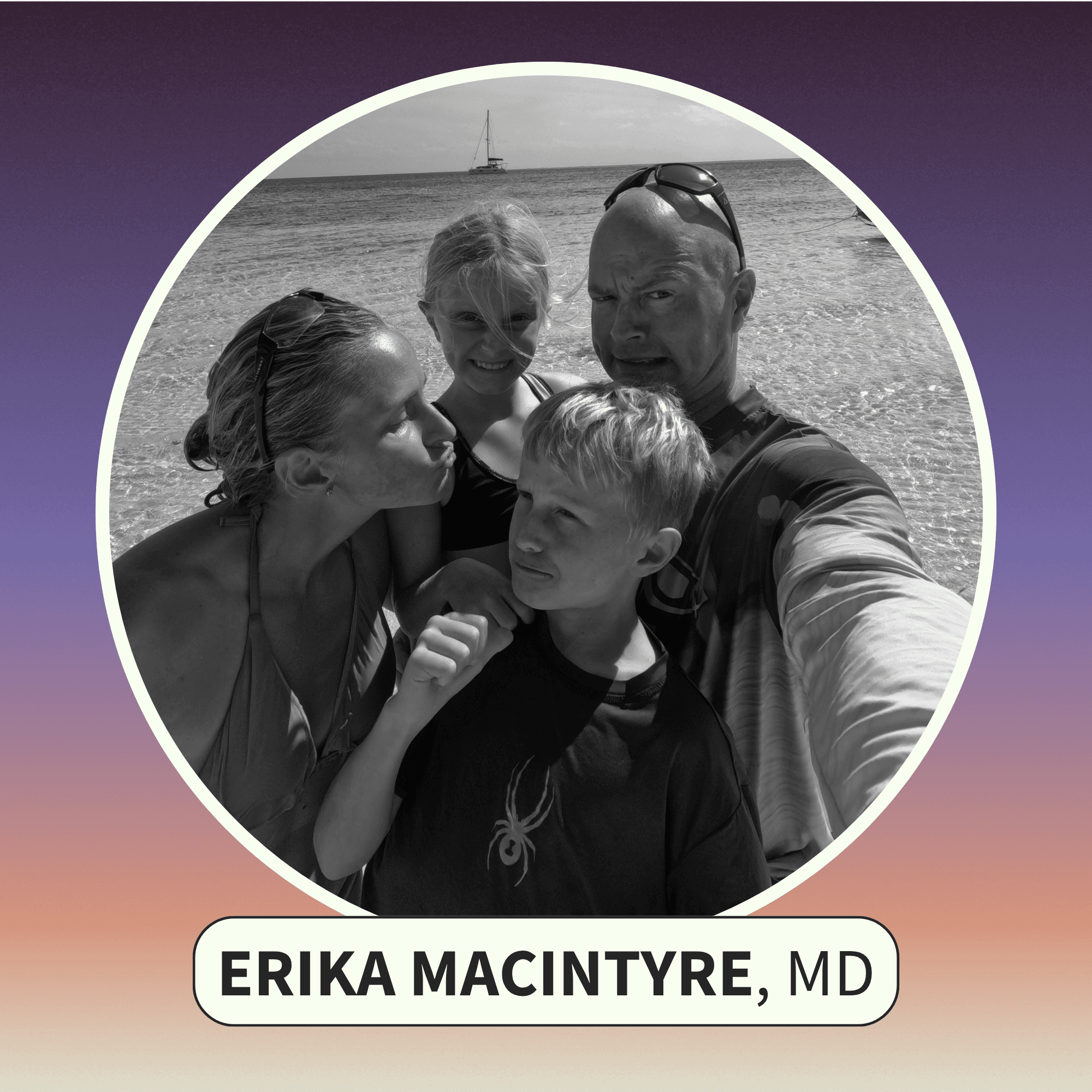
Dr. Erika MacIntyre reflects on her path into critical care and chronic ventilation medicine, as well as the mounting pressures she faced during COVID-19—including professional strain, loss of personal outlets, and family challenges. Seeking change, she and her family embarked on an ambitious sailing journey across the Atlantic, navigating both physical and emotional challenges while living simply and disconnected from modern conveniences.
0:00/1:34
The Nocturnists
Season
9
Episode
5
|
Beyond the Shore with Erika MacIntyre, MD
Dr. Erika MacIntyre reflects on her path into critical care and chronic ventilation medicine, as well as the mounting pressures she faced during COVID-19—including professional strain, loss of personal outlets, and family challenges. Seeking change, she and her family embarked on an ambitious sailing journey across the Atlantic, navigating both physical and emotional challenges while living simply and disconnected from modern conveniences.
0:00/1:34
About Our Guest
Erika MacIntyre MD FRCPC is an Associate Clinical Professor with the Department of Critical Care Medicine and Division of Respirology, Department of Medicine, University of Alberta Hospital. She has been a clinical expert and physician advocate in the subspecialized field of prolonged, chronic and home mechanical ventilation for a decade. In 2023 she took a 1-year sabbatical to cross the Atlantic Ocean with her young family and used this as an opportunity to develop resiliency and personal growth.
About The Show
The Nocturnists is an award-winning medical storytelling podcast, hosted by physician Emily Silverman. We feature personal stories from frontline clinicians, conversations with healthcare-related authors, and art-makers. Our mission is to humanize healthcare and foster joy, wonder, and curiosity among clinicians and patients alike.
resources
Credits
About Our Guest
Erika MacIntyre MD FRCPC is an Associate Clinical Professor with the Department of Critical Care Medicine and Division of Respirology, Department of Medicine, University of Alberta Hospital. She has been a clinical expert and physician advocate in the subspecialized field of prolonged, chronic and home mechanical ventilation for a decade. In 2023 she took a 1-year sabbatical to cross the Atlantic Ocean with her young family and used this as an opportunity to develop resiliency and personal growth.
About The Show
The Nocturnists is an award-winning medical storytelling podcast, hosted by physician Emily Silverman. We feature personal stories from frontline clinicians, conversations with healthcare-related authors, and art-makers. Our mission is to humanize healthcare and foster joy, wonder, and curiosity among clinicians and patients alike.
resources
Credits
Transcript
Note: The Nocturnists is an audio-first experience with emotion and sound design that can be difficult to fully capture in text. Transcripts are provided to support accessibility and reference, but may contain minor inaccuracies. If quoting in print, please consult the audio when possible.
Emily: You're listening to The Nocturnists. I'm Emily Silverman. Today's guest is Dr. Erika MacIntyre, a pulmonary and critical care physician, who tells the story of how pandemic pressures and personal upheaval led her to pause her career and take her family on a year-long sailing adventure across the Atlantic. In our conversation, we talked about how Erika found her niche in critical care and chronic ventilation medicine, what it was like working through COVID while losing the routines and supports that grounded her, and how stepping away to sail across the ocean reshaped her perspective on risk, work, and what really matters.
I hope you enjoy this conversation as much as I did, but first, take a listen to a clip from Erika's live story, which she told on stage at The Nocturnists Satellites event produced by the UCSF Institute for Global Health Sciences. Here's Erika.
[music]
Erika MacIntyre: Now, I'm crawling back to the helm, and I'm hoping that that Zofran that I popped at one in the morning is going to hang in there. 28 knots of wind, 30 knots of wind, we're in it. I'm looking out. It's dark now. I can't see the front of the boat. I'm thinking to myself, "Why couldn't I have been like a normal doctor having a 40-year-old midlife crisis and bought a Porsche and gone on a cruise," but no, I had to be special. I bought a boat and ended up in the Bay of Biscay.
[music]
Emily: I am sitting here with Dr. Erika MacIntyre. Erika, thank you so much for coming on the show.
Erika: Thanks for having me.
Emily: I really enjoyed listening to the recording of your story, and wanted to start by asking you, what it was like to get on stage and tell your story in front of a group of your friends and colleagues.
Erika: It was really unique, and as you know, based on my story, I like to look for different experiences. I very much enjoyed it.
Emily: You are a pulmonary critical care doctor, is that right?
Erika: Yes, that's correct.
Emily: Tell us a little bit about choosing critical care. I realize this is backing up a bit, but I would just love to hear more about how you came into that particular line of work and what your practice was like, thinking kind of like pre-COVID era. What was your rhythm of life as a critical care doctor?
Erika: Critical care actually wasn't my original plan. I did pulmonary medicine, and to be quite honest, I thought to myself, "Who in their right mind would want to do another two-year grueling fellowship? Why wouldn't you just get a job when you're done pulmonary?" It was mentorship. I had one of my more senior colleagues who took me in under his wing and introduced me to critical care, got me moonlighting. He encouraged me to pursue critical care, and as a sideline to that, he also encouraged me to consider chronic ventilation, and ultimately, that's where I've found my niche.
Emily: For people listening who don't know about chronic ventilation, tell us, what is that niche? What kind of patient population is that, and what are some of the main issues that you manage with that patient population?
Erika: I tell people it's ventilation along the continuum from home, acute care, critical care. I actually even sometimes do not regularly, but home visits, where we set people up who usually have neuromuscular conditions on home ventilators, BiPAP machines. I work in the ALS clinic, in the neuromuscular clinic, where I generally initiate BiPAP therapy. Then I work in the ICU, where we deal with, obviously, acute ventilation, but I try to focus on weaning and prolonged mechanical ventilation, so that brings me to a more broad population in the Edmonton Zone, the city where I live.
It's a real variety.
Emily: Later in the interview, we'll talk about some of your sailing adventures, but before we get there, I want to know a bit about your extracurricular life before COVID. You're a mom, you're a doctor, you're working in this chronic ventilation space. Are you an athlete? Do you do sports? Do you sail? What is your recreational life like at that time?
Erika: I did a little bit of triathlon. Was I ever that great at it? No, but it was a form of exercise, an outlet, a way to get outside. Then I had kids, so that obviously changes things. Competing in triathlons wasn't, maybe, the most fun with them. They're just sitting there, and my husband and I, we used to travel, we would do these G tours, these adventure tours, pre-kids, or as I call it, the BC era, before children. Then the kids came along, and we were looking for ways to still travel and do things. The sailing was a really great opportunity, because you have your home on the water. I could bring diapers, I could make meals. We just traveled very much like an RV, right? Only it's on the water.
Emily: A few minutes ago, you said you did a little bit of triathlon, and I was laughing to myself, and I was like, "I don't know if that's a thing." A little bit of triathlon. I don't know. I think you might be being modest or kind of downplaying the kind of rugged skills that you have. I don't think I could do a little bit of triathlon or even a little bit of a little bit of triathlon, but that's awesome. Remind me, where were you living when you developed the sailing hobby? Were you on the water in your ordinary life, in your on-land life?
Erika: I grew up in Saskatchewan, which is about as far away from the ocean as you can be. I met my future husband at the time, and his dad had taken on the hobby of sailing. I hadn't had much exposure to it. My grandfather was a sailor, but I was quite little at the time. He actually started on the Great Lakes of Saskatchewan. I guess I can call them Great Lakes, they're quite big. He kept pushing the limits and the boundaries, and then one year decided to take his sailboat out to the West Coast.
My husband and I, we thought this is great. We were all for it, and every year we would spend one to two weeks on the West Coast of Canada. Every year we go a little further, and then I finished residency, and we were having kids, so my husband says he blames me that we were outgrowing our smallish boat, so we looked at upgrading to, as you know, 41-9, and we were on that when we decided to embark on this adventure.
Emily: You're practicing as a pulmonologist, as a critical care doctor, vent management. It's the year 2020, and this pandemic is arriving. Where were you at when the pandemic hit, not just physically, but emotionally? Were you already craving a change, or was the pandemic exciting for you? Was it scary? What was it like for you when that major world event occurred?
Erika: The pandemic itself, I think I felt a little more excited. I thought to myself, as a respirologist and intensivist, I chose this. I had also taken on a role with our local leadership group, the Edmonton Zone Medical Staff Association. I was looking for new opportunities and challenges, but something that happened in our local area at that time was the government changed, and right before the pandemic hit they decided that doctors were overpaid and underworked and tore up our contract. There was a lot of change happening at one time and not necessarily for the better.
Emily: What did that mean for you on a day-to-day basis? It was like more hours or just a lot of uncertainty, since we didn't really understand the disease yet. How was the first few weeks or months of the pandemic for you?
Erika: Well, we actually were quite quiet in our ICU. Unfortunately, at our hospital, we had an outbreak within the hospital fairly early on, and the decision was made to close our hospital. We also became very quiet. With the Edmonton zone, my leadership role, things were ramping up because people were becoming more discontent, more unhappy with the situation. There was a lot of change once again.
Emily: In the middle of all of that, is that when you got the idea to go on this adventure? Tell us about how that .dea or that inspiration came to you.
Erika: It was a little bit later on in the pandemic, I was taking on other people's issues, part of my leadership role, but then we went into lockdowns, and I started losing my outlets. I had a strong circle of friends, and I would spend time with them on the weekends with my family. I frequently would go to the gym, and I had these things that really added a lot of balance to my life, and those went away. I was even okay with that in the short term, but then it started to drag on, and then that was when I started feeling some discontent.
On top of that, our local ICU, we were losing our nocturnal help, our residents and fellows who would help us out at night and allow us to go home, and we were moving towards an in-house on-call model. The problem with that is I really felt like I was going back in my career, I was becoming a resident again, and then actually, another factor that was going on in the background is one of my family members, very young, was diagnosed
with a Wilms tumor, and so she was undergoing cancer treatment, and she's the exact same age as my daughter. They were both very little at the time, so it was always just a reminder that life is unpredictable, and it can be quite short.
Emily: How did the idea come?
Erika: I was looking for a change, so we started throwing around ideas. Okay, well, maybe I'll leave ICU, I'll leave the in-house nights, and just do pulmonary, or perhaps we want to move and relocate. I even actually looked into moving to the US and what would be required for a license, but then there was this thing called the Atlantic Rally for Cruisers. We started watching a couple of podcasts about people who sail the world, and in one of my magazine subscriptions, I'd read about this Atlantic Rally for Cruisers, and we came to the conclusion that this was something that we could do.
Did we know all the details? No, but nobody does. You see that with these podcasts, that nobody knows completely what they're doing. Out of all the options, that definitely seemed the most fun. Even though people see that as risky going out in the middle of the ocean, which makes sense, in some ways, I saw that as almost the least risky, because if everything worked out well, I would just leave my life here on pause. Everything I worked for, my career, my house, my network, it would just be like a pause button, and then I could come back to it if I wanted to.
Emily: You were both all in?
Erika: Yes. Yes, we were.
Emily: The kids?
Erika: The kids are great, they do whatever. They said, "Okay. Yes. Yes."
Emily: You get on a plane to France, and then what's the plan, what's the route?
Erika: We fly to [unintelligible 00:16:07], we actually get on the boat sight unseen. We saw other lagoons, but not our lagoon, and we spent a few weeks getting it ready, making sure everything works. We actually left once. We had to come back because electronics weren't working properly. We left a second time, and we had to come back because our engine wasn't working, which was a big problem. Then, we left a third time.
Our original plan was actually to hug the coastline of Spain and Portugal, and then push off to the Canary Islands from the southern tip of Portugal, but there was actually this minor issue of orcas that like to bite rudders off boats. I don't know if you heard about this, it's happening over in Europe. We pivoted and cut across to the islands of Madeira. From there, we went down to the Canary Islands, and that's where the Atlantic Rally for Cruisers started.
Emily: You get yourself to the Canary Islands, and then from the Canary Islands, you're going to cross the Atlantic in this pretty small boat, it's not like a giant cruise liner. Does it have a motor at all, or it's just the sails?
Erika: It has two engines, but the issue is your diesel fuel. We figured we had about 72 hours' worth of diesel if we needed to travel under power, so you generally travel under sail. It's a lot more comfortable, and it's free. We did the ARC+, and with that, we traveled six days and six nights from the Canary Islands down to Cape Verde, and then we had a few days there, and then from Cape Verde we made our way to Grenada, which was 16 days and 16 nights at sea.
Emily: 16 days across the Atlantic, you're just in open water. I have so many questions about that, and of course, my mind is already going to the fears and the danger, so let's maybe start with the beautiful parts of it. What is it like to wake up in the morning and be in a small boat floating in the Atlantic, surrounded miles and miles in every direction by open water.
Erika: Well, when there's light that has its own feeling, because you can see the beauty, you can see the ocean. When we were doing the crossing, my shift was 1:00 to 4:00. I did the 1:00 to 4:00 AM shift, and then I go to bed and sleep for a little while, but it was really neat just staring at ocean. I'd sit there and have coffee. There was nothing else to do. We didn't have Wi-Fi or cells, so it's not like I was scrolling on my phone. You just sit out and see ocean. We saw boats the first two days and the last two days, but nothing in between.
Emily: How do you keep busy with no Wi-Fi, no TV, no phones, nowhere to go? Do you play cards? Do you play charades? [chuckles] What do you do?
Erika: My kids, they made the mistake at the beginning of the trip, they'd say, "Mom, we're bored," and I said, "Good, it's good for you to be bored." Sometimes we were bored, and that was okay; we have this crazy life here, where we're constantly stimulated, constantly on our phones. Somebody's calling us, wanting something, and I didn't have that, so we embraced a little bit of boredom to pass the time, though we would do audiobooks, so. Reading turned out to be a little bit challenging on a boat that resulted in some seasickness, and once you get the seasickness, it's
hard to shake it.
We were with audiobooks, we played Scrabble, we would journal, had some Canadian curriculum, so the kids would do homework. Then my father-in-law actually started teaching our kids how to play ukulele, and then I used to play the organ as a child, and he actually encouraged me. He said, "Just get a little kid's keyboard and just start playing," and so I did, and started even playing a little bit by ear. We passed the time, and at the time, did it seem a little boring? Maybe, but that was good for us.
Emily: Can you jump into the water in the Atlantic Ocean when you're out in the middle of the ocean, or is it too dangerous? Are there sharks and things like that?
Erika: Yes, and yes, so we did. Our challenge on the crossing was actually a lack of wind, and it's hot. There's no breeze. Our boat has air conditioning, but that's a whole other thing, because it requires such battery power that you got to run the generator. It's a whole thing. We decided to just let's lower the sails, and we'll attach ourselves to the boat, and we're going to jump in the water. It was 4,000 meters deep. Anyways, it was deep, and we jumped in the water, and the waves are kind of bobbing and bobbing the boat, and we cooled off.
Were there sharks? Apparently, because actually one of the other boats said they were fishing and they caught a tuna, and right before they got the tuna into the boat, a shark came up and ate it. There were sharks, we didn't see them, though. Thankfully,
Emily: What if there's a storm? Do the waves get-- I don't know. I feel like I've seen movies where there's a storm in the middle of the ocean, and the waves are enormous, and I'm just imagining your boat. It's really not that big, like sort of undulating on these menacing waves. Like, what do you do if there's a storm? Or I guess maybe you plan for the weather?
Erika: You got it.
Emily: Do you have, like, radar? You have radar?
Erika: You got it. There's an expression: there's no such thing as bad weather, just bad planning in the sailing world. We went and crossed during a time with, we call the prevailing winds. It's a time of the year where you have in general gentle winds. Now for the crossing, as you get closer to the Caribbean, you can get hit with what are called squalls. They are these little pockets of storm that appear on the radar, and they light up red, so they don't look very friendly. You have to guess if you're going to get hit with one, and all you have to do is just lower your sails.
On our boat, we have a mainsail, which is a square top, so it's a huge sail, and then we have a jib, but then we also have a spinnaker, and a spinnaker is an absolutely massive sail. You'll see them when you see the pictures of boats on magazines, and they're these bright, beautiful, colorful sails, but they are a sail to be respected. Because the force of that sale, I was even making the mistake when I was pulling the sail down. I didn't know what I was doing. I was wrapping the rope around my hand, and then I was told, "Don't do that, it'll deglove you." Those sails are incredibly powerful.
If you're getting hit with this kind of squall or high winds, all you have to do is just lower them, which seems easy in concept, but it's not always. The spinnaker is a lot of work. It's almost a half-hour process to raise it, almost another half hour to bring it down, so you have to anticipate those things. Actually, one time we were a little off on our predictions, and a squall did hit us. We were kind of crapping our pants a little bit, but at least we made the right call, because if you were going to lower it, and then my friend, she said, "I don't think we should lower it, because we're going to get caught in the middle of lowering it, and that's going to be worse." We just left it and kept our fingers crossed, and we hit our fastest speed ever at 8.5 knots, and then the squall passed, and we were fine.
Emily: It didn't toss you about?
Erika: Well, that was the Bay of Biscay.
Emily: Okay,
Erika: The Bay of Biscay sure did. We actually renamed her the Bay of Dismay. The Bay of Biscay is that body of water bordered by Spain and France, and it has a reputation. It's interesting because it always felt like there was two weather patterns that would go through there, so we were always hit with waves from two directions. We called it the washing machine, and that's actually been documented. It creates waves that hit the boat from two directions, so it causes you to lurch from side to side, forward, backwards. It also raises the boat as the waves hit them up and down. If the waves are slow, they're rollers, and they're not really a big deal. The boat just goes up and down, but when they become short and peaked, then they hit the boat, and it's unpleasant.
The seasickness was something that you know, you kind of think, "Oh, whatever, you're just seasick, it's not a big deal," but it ended up being a real issue, and all of the boats talked about it, because it made doing things so difficult. We did have a situation in the Bay of Biscay when we went from no wind to 30 knots of wind at two in the morning. Now, once again, I knew that was coming, but we didn't lower the sales in time, and so we were caught in it, and now the ways are coupled with this force on the sails that is really rocking the boat around, but the people on it, the clothes, and the washing machine, we still have to act. We still have to do things because things break on boats.
I was looking at one rope was rubbing against the mainsail, and I was thinking to myself, "What if this sail rips, then what am I going to do? I'm not going to make the ARC. Man overboard in that situation. It's two in the morning, we're getting hit with the waves, you know. My husband, I said, I told him, "Well, I guess I'll love again," [laughs] because in the middle of the night, darkness, waves, it's an almost impossible task.
[music]
Emily: What is it like to be on the boat in the middle of the night? I assume some nights, if it's clear, you have the moonlight, or you have a gorgeous sky of stars, but on a cloudy night it could be like virtually pitch black. Is that right?
Erika: We didn't have a lot of pitch, pitch black. The stars were always a very reassuring sight, because then you could also see clouds coming, potential storms, so the stars were a reassurance, and some of the nights were beautiful. Like I said, I did the 1:00 to 4:00 AM shift, and I would get up there, and I'd listen to my audiobooks. The first hour, I'd listen to something educational, and then as I'd get sleepy, I'd listen to something less educational. I ended up discovering romantasy, and that helped me stay awake at two in the morning.
Emily: You were joking on stage during your story about listening to the smutty books as you were awake on the open sea. Can you tell us about that? What is romantasy? Is it like lowbrow sexy fiction?
Erika: [chuckles] I believe I think it was Sarah J. Moss that she invented it, or came up with it. I think the demand, as I understand it, was it was all the people who watched Harry Potter grew up, and then they were looking for fantasy meets romance. My one friend had recommended it, and I said, "No, no, no." Then, you know, two in the morning, I'm sitting there by myself, and it was a way to help stay awake.
Emily: Okay, so you do the Bay of Biscay, you get to the Canary Islands, you sail across the entire Atlantic Ocean with wind, and sail alone, largely. You get to the Caribbean. When you were finished, how did that feel?
Erika: It was great. I really found the year, though, felt like different stages. We were on to just the next phase of the adventure. We were concluding our group crossing, and now we were on our Caribbean adventure. It felt like I was just onto the next section, the next mini adventure.
Emily: How many years total was the sailing adventure?
Erika: It was 11 months,
Emily: After that, you went back to work. The kids went back to school.
Erika: We made our way up to Charleston, where we sold the boat, and believe me, we had second thoughts in the Bahamas about listing the boat, because it's pretty gorgeous there. We decided to list it, and we went through the whole process of finding a buyer, and that went very smoothly. Then we went on a bit of a road trip along the East Coast back up to Halifax, and from Halifax we flew back to Edmonton, Alberta.
Emily: Then you were back home,
Erika: Then I was back home,
Emily: Like the whole thing was a dream.
Erika: Yes,
Emily: What did you learn?
Erika: A lot. Like I said, I was becoming a bit disgruntled with my position and my job, and made the choice to come back and not be disgruntled, and created a pro and con list, and really, ultimately, in the end, I came to the conclusion that I just work with these amazing people. A lot of the people I worked with had actually joined me physically along the journey, or they'd followed. Here I had this amazing kind of fan base and group of supporters back home, so I decided I was happy to go back, and I wanted to go back. I didn't want to lose that.
It does put things in perspective. I had lots of people say to me, so it's going to be hard for you to get back to reality, and then I came back, and I realized I was actually in reality, and that this world that we live in, in North America, maybe it's not always reality, it's perception, and how we look at things, and what we decide is important or not important. Those things can be changed, and they can be altered. I don't think a person ever needs to get stuck.
Emily: I read this novel once called Arrowsmith by Sinclair Lewis, and I think it takes place in the 1900s, like 1905 or something like that. It's about a young man in America who becomes a physician, and he likes clinical work, but his real passion is medical research, like he's really driven by a thirst for truth and knowledge that's like his North Star. I'm realizing, as we're talking, how many metaphors come from the sea, like North Star-
Erika: They do.
Emily: Rocking the boat and things like that. Anyway, so in this book it chronicles his life, and again, it's all fiction, but he
has a chapter where he's like a country doctor in a rural area, then he has a chapter where he's working in a bigger city in the public health world, and there's all this bureaucracy and all this red tape that he has to deal with. Then there's another part where he's in New York City at the preeminent research institution in a skyscraper with like millions of dollars and all this money to do his lab experiments. It's an amazing book that I think you might like just separately, but there was this one part of the book where it was just a very small part where he takes a summer
or something to just do manual labor.
I think it was something like he was hanging electricity lines or he was working with a crew of men, and every day they would wake up with the sun, and they would do manual labor all day, hanging these poles or hanging these wires. I can't remember exactly what it was. Then they would have lunch, and the food tasted amazing, because they were so hungry.
Then they would work again, and then they would have dinner, and then they would go to sleep in their sleeping bags, and then they would wake up, and they would do it again. They just did this again and again and again in a rhythm for days and then weeks and then weeks. He describes having, at some point during that summer, a bit of a spiritual awakening, or moments of enlightenment, where he feels transcendent. There's this glory and there's this perception of oneness and wholeness and well-being. Then it goes to the next chapter, and then he goes to his next phase of life, and then he gets caught back up with all the human affairs.
That little moment of transcendence, it's not the main part of the story; it's almost just like a little blip. Then he goes back to the chaos of medical research and everything. I always remember that, because I guess it's not that novel an idea that when you're out in nature or when you're like in your body, that there's something that can be transcendent about that. I'm wondering what you just said about back to reality. What is reality? Is reality a chronic vent career with your iPhone going off every eight minutes, or is reality a million miles of open ocean? I don't know, I'm just wondering kind of the spiritual component of that, and toggling back and forth, or if you came away with any new insights or experiences on that.
Erika: I think it's very much like this guy's his two months. It was just a very different life. Life here is busy, and it's very easy with medicine, I think, to get pulled down this path. We all really strive for medicine, and then you get there, and then it's different for everybody, but is it reality? I'm not sure. This experience, this year away, was a time for me to just completely-- it was a completely different life, totally different. Here, I worry about furniture and clothes, and there, if I had a shirt and my shirt had a rip in it, I still wore it, because getting things was challenging. That was one thing I'd actually underestimated.
Amazon, we take it for granted. You can get anything you want anytime, anywhere, for cheap, and it's delivered to your house. I underestimated how difficult it was. There was one story of my little induction cooktop, and I can order that on Amazon for $40 and shows up in 48 hours. Magic. That's our world. in the Caribbean. My sister fried it, and I could not get another one until my friend brought one in her suitcase from Edmonton. Sometimes even these little things that seem just the norm, Amazon, cell phone cell service, and we get so used to it, and then when you put yourself into a completely different environment, it surprises you. You see things that you maybe didn't even think you were going to see.
Emily: Do you think it's more of a paradise to be sitting in a restaurant in a mall in the middle of Toronto, eating a delicious lunch with everything at your fingertips, and safety and protection, and ease, or is it more of a paradise to be on a boat with nothing?
[laughter]
Erika: Well, the latter. I've actually even started-- sometimes when you say goodbye to someone, you say, "Well, stay safe, take care," and we say these things. Then, I got realizing, why do we want to stay safe? You can, it's an option, and, of course, we want to be safe, but I've almost been thinking a bit more. I'd rather just say, "Have an adventure." You never know what's going to happen. In my job, I work with a lot of ALS, and that hits people at all stages of life with no warning. As physicians, we know it's unpredictable.
Whatever you do, just make sure it's a choice, not just "I got stuck and ended up here," and people said, "Well, I couldn't do that, what you did, Erika". Well, maybe not, or maybe you could, maybe you can cross an ocean, but maybe it's not in that type of boat, or maybe it's a different boat, or maybe it's just a completely different adventure altogether. People can still have adventures.
Emily: Do you feel like your relationship to risk and risk tolerance is different from most of your peers? Like, you were joking, like, "If my husband falls overboard, I'll love again."
[laughter]
Emily: Even with the kids, like pulling them out of school and putting them on a boat in the middle of the ocean, with all that risk, there is a beauty and adventurousness to that, and there's risk. I think you're right when you say a lot of people, they wouldn't have the skills or the courage or the risk tolerance to be able to do something like that. Just wondering, like, what it feels like to be inside of a perception system, where maybe you're willing to tolerate risk a little bit more in a way, and there's something about that that gives you access to these experiences that other people wouldn't have access to.
Erika: For sure. Although, actually, of note, when you take your kids on a boat, that does actually help you recruit other people, because they are friends. We had two friends who crossed the ocean with us, and they said, "Well, I guess if they're taking their kids, it must be safe, or safe enough." While I was gone, I ended up doing my leadership and management course and certificate. I took some of those courses, and this one was on resiliency. I did answer the questions, and of course, it would tell you your profile. When it came to risk, I was very high.
Emily: Interesting.
Erika: Now, that being said, physicians, we all take risks. We all take risks to get where we want to go, but the risk I took was of a different nature. I suppose it was doing something that was different.
Emily: Well, as we bring this to an end, maybe we can hear a message from you to our audience about risk, about adventure. What would you say to somebody listening who maybe they're thinking about taking a leap, or they want to do something, but they're nervous, or maybe they're just stuck in a pattern and are craving adventure? What would you say to them?
Erika: If it works, I would like to end by reading a passage from my kid's journal.
Emily: Oh, sure.
Erika: I'll first read a passage from my daughter, Kenza, who was seven years old at the time, "November 5, ARC Leg One, Las Palmas to Mindelo, 1,000 nautical miles, six days. We were in the biggest waves, which were 3 to 5 meters. These were real rollers. The coolest thing we saw this trip was flying fish. One morning, they were all over the boat, including one in my bathroom. Even better, one of the fish landed in my uncle and aunt's bed." Then, of course, she proceeds to laugh.
I'm going to read one from my son, age nine at the time, November 17. "Atlantic Ocean crossing. This is what we had been preparing for, our longest and by far most challenging adventure. To pass the time, we would do some fishing. We caught a wahoo early on, and later on, we were
followed by some dorados. Further away from land, some egrets decided to take a little rest on our solar panels. They are land birds and were quite tired from flying all day.
Emily: Beautiful. Anything else you want to share with us before we end?
Erika: Just, thank you.
Emily: Thank you. Thank you for sharing your story with us, and wishing you many more adventures in the future.
Erika: You too.
[music]
Emily: This episode of The Nocturnists was produced by me and producer and head of story development Molly Rose-Williams. Our executive producer is Ali Block, and Ashley Pettit is our program director. Original theme music was composed by Yosef Munro, with additional music from Blue Dot Sessions. The Nocturnists is made possible by listeners like you.
If you enjoy what you hear and you want to support our work, consider subscribing to The Nocturnists Plus. You'll get access to The Nocturnists After Hours, our monthly bonus series featuring original conversations from our team, along with merch discounts and a full archive of episodes, all in one place. Subscriptions start at just $10 a month. Learn more at The nocturnists.org/plus or through the link in the description. Thank you for
listening and being part of this community. Until next time, I'm your host, Emily Silverman.
Transcript
Note: The Nocturnists is an audio-first experience with emotion and sound design that can be difficult to fully capture in text. Transcripts are provided to support accessibility and reference, but may contain minor inaccuracies. If quoting in print, please consult the audio when possible.
Emily: You're listening to The Nocturnists. I'm Emily Silverman. Today's guest is Dr. Erika MacIntyre, a pulmonary and critical care physician, who tells the story of how pandemic pressures and personal upheaval led her to pause her career and take her family on a year-long sailing adventure across the Atlantic. In our conversation, we talked about how Erika found her niche in critical care and chronic ventilation medicine, what it was like working through COVID while losing the routines and supports that grounded her, and how stepping away to sail across the ocean reshaped her perspective on risk, work, and what really matters.
I hope you enjoy this conversation as much as I did, but first, take a listen to a clip from Erika's live story, which she told on stage at The Nocturnists Satellites event produced by the UCSF Institute for Global Health Sciences. Here's Erika.
[music]
Erika MacIntyre: Now, I'm crawling back to the helm, and I'm hoping that that Zofran that I popped at one in the morning is going to hang in there. 28 knots of wind, 30 knots of wind, we're in it. I'm looking out. It's dark now. I can't see the front of the boat. I'm thinking to myself, "Why couldn't I have been like a normal doctor having a 40-year-old midlife crisis and bought a Porsche and gone on a cruise," but no, I had to be special. I bought a boat and ended up in the Bay of Biscay.
[music]
Emily: I am sitting here with Dr. Erika MacIntyre. Erika, thank you so much for coming on the show.
Erika: Thanks for having me.
Emily: I really enjoyed listening to the recording of your story, and wanted to start by asking you, what it was like to get on stage and tell your story in front of a group of your friends and colleagues.
Erika: It was really unique, and as you know, based on my story, I like to look for different experiences. I very much enjoyed it.
Emily: You are a pulmonary critical care doctor, is that right?
Erika: Yes, that's correct.
Emily: Tell us a little bit about choosing critical care. I realize this is backing up a bit, but I would just love to hear more about how you came into that particular line of work and what your practice was like, thinking kind of like pre-COVID era. What was your rhythm of life as a critical care doctor?
Erika: Critical care actually wasn't my original plan. I did pulmonary medicine, and to be quite honest, I thought to myself, "Who in their right mind would want to do another two-year grueling fellowship? Why wouldn't you just get a job when you're done pulmonary?" It was mentorship. I had one of my more senior colleagues who took me in under his wing and introduced me to critical care, got me moonlighting. He encouraged me to pursue critical care, and as a sideline to that, he also encouraged me to consider chronic ventilation, and ultimately, that's where I've found my niche.
Emily: For people listening who don't know about chronic ventilation, tell us, what is that niche? What kind of patient population is that, and what are some of the main issues that you manage with that patient population?
Erika: I tell people it's ventilation along the continuum from home, acute care, critical care. I actually even sometimes do not regularly, but home visits, where we set people up who usually have neuromuscular conditions on home ventilators, BiPAP machines. I work in the ALS clinic, in the neuromuscular clinic, where I generally initiate BiPAP therapy. Then I work in the ICU, where we deal with, obviously, acute ventilation, but I try to focus on weaning and prolonged mechanical ventilation, so that brings me to a more broad population in the Edmonton Zone, the city where I live.
It's a real variety.
Emily: Later in the interview, we'll talk about some of your sailing adventures, but before we get there, I want to know a bit about your extracurricular life before COVID. You're a mom, you're a doctor, you're working in this chronic ventilation space. Are you an athlete? Do you do sports? Do you sail? What is your recreational life like at that time?
Erika: I did a little bit of triathlon. Was I ever that great at it? No, but it was a form of exercise, an outlet, a way to get outside. Then I had kids, so that obviously changes things. Competing in triathlons wasn't, maybe, the most fun with them. They're just sitting there, and my husband and I, we used to travel, we would do these G tours, these adventure tours, pre-kids, or as I call it, the BC era, before children. Then the kids came along, and we were looking for ways to still travel and do things. The sailing was a really great opportunity, because you have your home on the water. I could bring diapers, I could make meals. We just traveled very much like an RV, right? Only it's on the water.
Emily: A few minutes ago, you said you did a little bit of triathlon, and I was laughing to myself, and I was like, "I don't know if that's a thing." A little bit of triathlon. I don't know. I think you might be being modest or kind of downplaying the kind of rugged skills that you have. I don't think I could do a little bit of triathlon or even a little bit of a little bit of triathlon, but that's awesome. Remind me, where were you living when you developed the sailing hobby? Were you on the water in your ordinary life, in your on-land life?
Erika: I grew up in Saskatchewan, which is about as far away from the ocean as you can be. I met my future husband at the time, and his dad had taken on the hobby of sailing. I hadn't had much exposure to it. My grandfather was a sailor, but I was quite little at the time. He actually started on the Great Lakes of Saskatchewan. I guess I can call them Great Lakes, they're quite big. He kept pushing the limits and the boundaries, and then one year decided to take his sailboat out to the West Coast.
My husband and I, we thought this is great. We were all for it, and every year we would spend one to two weeks on the West Coast of Canada. Every year we go a little further, and then I finished residency, and we were having kids, so my husband says he blames me that we were outgrowing our smallish boat, so we looked at upgrading to, as you know, 41-9, and we were on that when we decided to embark on this adventure.
Emily: You're practicing as a pulmonologist, as a critical care doctor, vent management. It's the year 2020, and this pandemic is arriving. Where were you at when the pandemic hit, not just physically, but emotionally? Were you already craving a change, or was the pandemic exciting for you? Was it scary? What was it like for you when that major world event occurred?
Erika: The pandemic itself, I think I felt a little more excited. I thought to myself, as a respirologist and intensivist, I chose this. I had also taken on a role with our local leadership group, the Edmonton Zone Medical Staff Association. I was looking for new opportunities and challenges, but something that happened in our local area at that time was the government changed, and right before the pandemic hit they decided that doctors were overpaid and underworked and tore up our contract. There was a lot of change happening at one time and not necessarily for the better.
Emily: What did that mean for you on a day-to-day basis? It was like more hours or just a lot of uncertainty, since we didn't really understand the disease yet. How was the first few weeks or months of the pandemic for you?
Erika: Well, we actually were quite quiet in our ICU. Unfortunately, at our hospital, we had an outbreak within the hospital fairly early on, and the decision was made to close our hospital. We also became very quiet. With the Edmonton zone, my leadership role, things were ramping up because people were becoming more discontent, more unhappy with the situation. There was a lot of change once again.
Emily: In the middle of all of that, is that when you got the idea to go on this adventure? Tell us about how that .dea or that inspiration came to you.
Erika: It was a little bit later on in the pandemic, I was taking on other people's issues, part of my leadership role, but then we went into lockdowns, and I started losing my outlets. I had a strong circle of friends, and I would spend time with them on the weekends with my family. I frequently would go to the gym, and I had these things that really added a lot of balance to my life, and those went away. I was even okay with that in the short term, but then it started to drag on, and then that was when I started feeling some discontent.
On top of that, our local ICU, we were losing our nocturnal help, our residents and fellows who would help us out at night and allow us to go home, and we were moving towards an in-house on-call model. The problem with that is I really felt like I was going back in my career, I was becoming a resident again, and then actually, another factor that was going on in the background is one of my family members, very young, was diagnosed
with a Wilms tumor, and so she was undergoing cancer treatment, and she's the exact same age as my daughter. They were both very little at the time, so it was always just a reminder that life is unpredictable, and it can be quite short.
Emily: How did the idea come?
Erika: I was looking for a change, so we started throwing around ideas. Okay, well, maybe I'll leave ICU, I'll leave the in-house nights, and just do pulmonary, or perhaps we want to move and relocate. I even actually looked into moving to the US and what would be required for a license, but then there was this thing called the Atlantic Rally for Cruisers. We started watching a couple of podcasts about people who sail the world, and in one of my magazine subscriptions, I'd read about this Atlantic Rally for Cruisers, and we came to the conclusion that this was something that we could do.
Did we know all the details? No, but nobody does. You see that with these podcasts, that nobody knows completely what they're doing. Out of all the options, that definitely seemed the most fun. Even though people see that as risky going out in the middle of the ocean, which makes sense, in some ways, I saw that as almost the least risky, because if everything worked out well, I would just leave my life here on pause. Everything I worked for, my career, my house, my network, it would just be like a pause button, and then I could come back to it if I wanted to.
Emily: You were both all in?
Erika: Yes. Yes, we were.
Emily: The kids?
Erika: The kids are great, they do whatever. They said, "Okay. Yes. Yes."
Emily: You get on a plane to France, and then what's the plan, what's the route?
Erika: We fly to [unintelligible 00:16:07], we actually get on the boat sight unseen. We saw other lagoons, but not our lagoon, and we spent a few weeks getting it ready, making sure everything works. We actually left once. We had to come back because electronics weren't working properly. We left a second time, and we had to come back because our engine wasn't working, which was a big problem. Then, we left a third time.
Our original plan was actually to hug the coastline of Spain and Portugal, and then push off to the Canary Islands from the southern tip of Portugal, but there was actually this minor issue of orcas that like to bite rudders off boats. I don't know if you heard about this, it's happening over in Europe. We pivoted and cut across to the islands of Madeira. From there, we went down to the Canary Islands, and that's where the Atlantic Rally for Cruisers started.
Emily: You get yourself to the Canary Islands, and then from the Canary Islands, you're going to cross the Atlantic in this pretty small boat, it's not like a giant cruise liner. Does it have a motor at all, or it's just the sails?
Erika: It has two engines, but the issue is your diesel fuel. We figured we had about 72 hours' worth of diesel if we needed to travel under power, so you generally travel under sail. It's a lot more comfortable, and it's free. We did the ARC+, and with that, we traveled six days and six nights from the Canary Islands down to Cape Verde, and then we had a few days there, and then from Cape Verde we made our way to Grenada, which was 16 days and 16 nights at sea.
Emily: 16 days across the Atlantic, you're just in open water. I have so many questions about that, and of course, my mind is already going to the fears and the danger, so let's maybe start with the beautiful parts of it. What is it like to wake up in the morning and be in a small boat floating in the Atlantic, surrounded miles and miles in every direction by open water.
Erika: Well, when there's light that has its own feeling, because you can see the beauty, you can see the ocean. When we were doing the crossing, my shift was 1:00 to 4:00. I did the 1:00 to 4:00 AM shift, and then I go to bed and sleep for a little while, but it was really neat just staring at ocean. I'd sit there and have coffee. There was nothing else to do. We didn't have Wi-Fi or cells, so it's not like I was scrolling on my phone. You just sit out and see ocean. We saw boats the first two days and the last two days, but nothing in between.
Emily: How do you keep busy with no Wi-Fi, no TV, no phones, nowhere to go? Do you play cards? Do you play charades? [chuckles] What do you do?
Erika: My kids, they made the mistake at the beginning of the trip, they'd say, "Mom, we're bored," and I said, "Good, it's good for you to be bored." Sometimes we were bored, and that was okay; we have this crazy life here, where we're constantly stimulated, constantly on our phones. Somebody's calling us, wanting something, and I didn't have that, so we embraced a little bit of boredom to pass the time, though we would do audiobooks, so. Reading turned out to be a little bit challenging on a boat that resulted in some seasickness, and once you get the seasickness, it's
hard to shake it.
We were with audiobooks, we played Scrabble, we would journal, had some Canadian curriculum, so the kids would do homework. Then my father-in-law actually started teaching our kids how to play ukulele, and then I used to play the organ as a child, and he actually encouraged me. He said, "Just get a little kid's keyboard and just start playing," and so I did, and started even playing a little bit by ear. We passed the time, and at the time, did it seem a little boring? Maybe, but that was good for us.
Emily: Can you jump into the water in the Atlantic Ocean when you're out in the middle of the ocean, or is it too dangerous? Are there sharks and things like that?
Erika: Yes, and yes, so we did. Our challenge on the crossing was actually a lack of wind, and it's hot. There's no breeze. Our boat has air conditioning, but that's a whole other thing, because it requires such battery power that you got to run the generator. It's a whole thing. We decided to just let's lower the sails, and we'll attach ourselves to the boat, and we're going to jump in the water. It was 4,000 meters deep. Anyways, it was deep, and we jumped in the water, and the waves are kind of bobbing and bobbing the boat, and we cooled off.
Were there sharks? Apparently, because actually one of the other boats said they were fishing and they caught a tuna, and right before they got the tuna into the boat, a shark came up and ate it. There were sharks, we didn't see them, though. Thankfully,
Emily: What if there's a storm? Do the waves get-- I don't know. I feel like I've seen movies where there's a storm in the middle of the ocean, and the waves are enormous, and I'm just imagining your boat. It's really not that big, like sort of undulating on these menacing waves. Like, what do you do if there's a storm? Or I guess maybe you plan for the weather?
Erika: You got it.
Emily: Do you have, like, radar? You have radar?
Erika: You got it. There's an expression: there's no such thing as bad weather, just bad planning in the sailing world. We went and crossed during a time with, we call the prevailing winds. It's a time of the year where you have in general gentle winds. Now for the crossing, as you get closer to the Caribbean, you can get hit with what are called squalls. They are these little pockets of storm that appear on the radar, and they light up red, so they don't look very friendly. You have to guess if you're going to get hit with one, and all you have to do is just lower your sails.
On our boat, we have a mainsail, which is a square top, so it's a huge sail, and then we have a jib, but then we also have a spinnaker, and a spinnaker is an absolutely massive sail. You'll see them when you see the pictures of boats on magazines, and they're these bright, beautiful, colorful sails, but they are a sail to be respected. Because the force of that sale, I was even making the mistake when I was pulling the sail down. I didn't know what I was doing. I was wrapping the rope around my hand, and then I was told, "Don't do that, it'll deglove you." Those sails are incredibly powerful.
If you're getting hit with this kind of squall or high winds, all you have to do is just lower them, which seems easy in concept, but it's not always. The spinnaker is a lot of work. It's almost a half-hour process to raise it, almost another half hour to bring it down, so you have to anticipate those things. Actually, one time we were a little off on our predictions, and a squall did hit us. We were kind of crapping our pants a little bit, but at least we made the right call, because if you were going to lower it, and then my friend, she said, "I don't think we should lower it, because we're going to get caught in the middle of lowering it, and that's going to be worse." We just left it and kept our fingers crossed, and we hit our fastest speed ever at 8.5 knots, and then the squall passed, and we were fine.
Emily: It didn't toss you about?
Erika: Well, that was the Bay of Biscay.
Emily: Okay,
Erika: The Bay of Biscay sure did. We actually renamed her the Bay of Dismay. The Bay of Biscay is that body of water bordered by Spain and France, and it has a reputation. It's interesting because it always felt like there was two weather patterns that would go through there, so we were always hit with waves from two directions. We called it the washing machine, and that's actually been documented. It creates waves that hit the boat from two directions, so it causes you to lurch from side to side, forward, backwards. It also raises the boat as the waves hit them up and down. If the waves are slow, they're rollers, and they're not really a big deal. The boat just goes up and down, but when they become short and peaked, then they hit the boat, and it's unpleasant.
The seasickness was something that you know, you kind of think, "Oh, whatever, you're just seasick, it's not a big deal," but it ended up being a real issue, and all of the boats talked about it, because it made doing things so difficult. We did have a situation in the Bay of Biscay when we went from no wind to 30 knots of wind at two in the morning. Now, once again, I knew that was coming, but we didn't lower the sales in time, and so we were caught in it, and now the ways are coupled with this force on the sails that is really rocking the boat around, but the people on it, the clothes, and the washing machine, we still have to act. We still have to do things because things break on boats.
I was looking at one rope was rubbing against the mainsail, and I was thinking to myself, "What if this sail rips, then what am I going to do? I'm not going to make the ARC. Man overboard in that situation. It's two in the morning, we're getting hit with the waves, you know. My husband, I said, I told him, "Well, I guess I'll love again," [laughs] because in the middle of the night, darkness, waves, it's an almost impossible task.
[music]
Emily: What is it like to be on the boat in the middle of the night? I assume some nights, if it's clear, you have the moonlight, or you have a gorgeous sky of stars, but on a cloudy night it could be like virtually pitch black. Is that right?
Erika: We didn't have a lot of pitch, pitch black. The stars were always a very reassuring sight, because then you could also see clouds coming, potential storms, so the stars were a reassurance, and some of the nights were beautiful. Like I said, I did the 1:00 to 4:00 AM shift, and I would get up there, and I'd listen to my audiobooks. The first hour, I'd listen to something educational, and then as I'd get sleepy, I'd listen to something less educational. I ended up discovering romantasy, and that helped me stay awake at two in the morning.
Emily: You were joking on stage during your story about listening to the smutty books as you were awake on the open sea. Can you tell us about that? What is romantasy? Is it like lowbrow sexy fiction?
Erika: [chuckles] I believe I think it was Sarah J. Moss that she invented it, or came up with it. I think the demand, as I understand it, was it was all the people who watched Harry Potter grew up, and then they were looking for fantasy meets romance. My one friend had recommended it, and I said, "No, no, no." Then, you know, two in the morning, I'm sitting there by myself, and it was a way to help stay awake.
Emily: Okay, so you do the Bay of Biscay, you get to the Canary Islands, you sail across the entire Atlantic Ocean with wind, and sail alone, largely. You get to the Caribbean. When you were finished, how did that feel?
Erika: It was great. I really found the year, though, felt like different stages. We were on to just the next phase of the adventure. We were concluding our group crossing, and now we were on our Caribbean adventure. It felt like I was just onto the next section, the next mini adventure.
Emily: How many years total was the sailing adventure?
Erika: It was 11 months,
Emily: After that, you went back to work. The kids went back to school.
Erika: We made our way up to Charleston, where we sold the boat, and believe me, we had second thoughts in the Bahamas about listing the boat, because it's pretty gorgeous there. We decided to list it, and we went through the whole process of finding a buyer, and that went very smoothly. Then we went on a bit of a road trip along the East Coast back up to Halifax, and from Halifax we flew back to Edmonton, Alberta.
Emily: Then you were back home,
Erika: Then I was back home,
Emily: Like the whole thing was a dream.
Erika: Yes,
Emily: What did you learn?
Erika: A lot. Like I said, I was becoming a bit disgruntled with my position and my job, and made the choice to come back and not be disgruntled, and created a pro and con list, and really, ultimately, in the end, I came to the conclusion that I just work with these amazing people. A lot of the people I worked with had actually joined me physically along the journey, or they'd followed. Here I had this amazing kind of fan base and group of supporters back home, so I decided I was happy to go back, and I wanted to go back. I didn't want to lose that.
It does put things in perspective. I had lots of people say to me, so it's going to be hard for you to get back to reality, and then I came back, and I realized I was actually in reality, and that this world that we live in, in North America, maybe it's not always reality, it's perception, and how we look at things, and what we decide is important or not important. Those things can be changed, and they can be altered. I don't think a person ever needs to get stuck.
Emily: I read this novel once called Arrowsmith by Sinclair Lewis, and I think it takes place in the 1900s, like 1905 or something like that. It's about a young man in America who becomes a physician, and he likes clinical work, but his real passion is medical research, like he's really driven by a thirst for truth and knowledge that's like his North Star. I'm realizing, as we're talking, how many metaphors come from the sea, like North Star-
Erika: They do.
Emily: Rocking the boat and things like that. Anyway, so in this book it chronicles his life, and again, it's all fiction, but he
has a chapter where he's like a country doctor in a rural area, then he has a chapter where he's working in a bigger city in the public health world, and there's all this bureaucracy and all this red tape that he has to deal with. Then there's another part where he's in New York City at the preeminent research institution in a skyscraper with like millions of dollars and all this money to do his lab experiments. It's an amazing book that I think you might like just separately, but there was this one part of the book where it was just a very small part where he takes a summer
or something to just do manual labor.
I think it was something like he was hanging electricity lines or he was working with a crew of men, and every day they would wake up with the sun, and they would do manual labor all day, hanging these poles or hanging these wires. I can't remember exactly what it was. Then they would have lunch, and the food tasted amazing, because they were so hungry.
Then they would work again, and then they would have dinner, and then they would go to sleep in their sleeping bags, and then they would wake up, and they would do it again. They just did this again and again and again in a rhythm for days and then weeks and then weeks. He describes having, at some point during that summer, a bit of a spiritual awakening, or moments of enlightenment, where he feels transcendent. There's this glory and there's this perception of oneness and wholeness and well-being. Then it goes to the next chapter, and then he goes to his next phase of life, and then he gets caught back up with all the human affairs.
That little moment of transcendence, it's not the main part of the story; it's almost just like a little blip. Then he goes back to the chaos of medical research and everything. I always remember that, because I guess it's not that novel an idea that when you're out in nature or when you're like in your body, that there's something that can be transcendent about that. I'm wondering what you just said about back to reality. What is reality? Is reality a chronic vent career with your iPhone going off every eight minutes, or is reality a million miles of open ocean? I don't know, I'm just wondering kind of the spiritual component of that, and toggling back and forth, or if you came away with any new insights or experiences on that.
Erika: I think it's very much like this guy's his two months. It was just a very different life. Life here is busy, and it's very easy with medicine, I think, to get pulled down this path. We all really strive for medicine, and then you get there, and then it's different for everybody, but is it reality? I'm not sure. This experience, this year away, was a time for me to just completely-- it was a completely different life, totally different. Here, I worry about furniture and clothes, and there, if I had a shirt and my shirt had a rip in it, I still wore it, because getting things was challenging. That was one thing I'd actually underestimated.
Amazon, we take it for granted. You can get anything you want anytime, anywhere, for cheap, and it's delivered to your house. I underestimated how difficult it was. There was one story of my little induction cooktop, and I can order that on Amazon for $40 and shows up in 48 hours. Magic. That's our world. in the Caribbean. My sister fried it, and I could not get another one until my friend brought one in her suitcase from Edmonton. Sometimes even these little things that seem just the norm, Amazon, cell phone cell service, and we get so used to it, and then when you put yourself into a completely different environment, it surprises you. You see things that you maybe didn't even think you were going to see.
Emily: Do you think it's more of a paradise to be sitting in a restaurant in a mall in the middle of Toronto, eating a delicious lunch with everything at your fingertips, and safety and protection, and ease, or is it more of a paradise to be on a boat with nothing?
[laughter]
Erika: Well, the latter. I've actually even started-- sometimes when you say goodbye to someone, you say, "Well, stay safe, take care," and we say these things. Then, I got realizing, why do we want to stay safe? You can, it's an option, and, of course, we want to be safe, but I've almost been thinking a bit more. I'd rather just say, "Have an adventure." You never know what's going to happen. In my job, I work with a lot of ALS, and that hits people at all stages of life with no warning. As physicians, we know it's unpredictable.
Whatever you do, just make sure it's a choice, not just "I got stuck and ended up here," and people said, "Well, I couldn't do that, what you did, Erika". Well, maybe not, or maybe you could, maybe you can cross an ocean, but maybe it's not in that type of boat, or maybe it's a different boat, or maybe it's just a completely different adventure altogether. People can still have adventures.
Emily: Do you feel like your relationship to risk and risk tolerance is different from most of your peers? Like, you were joking, like, "If my husband falls overboard, I'll love again."
[laughter]
Emily: Even with the kids, like pulling them out of school and putting them on a boat in the middle of the ocean, with all that risk, there is a beauty and adventurousness to that, and there's risk. I think you're right when you say a lot of people, they wouldn't have the skills or the courage or the risk tolerance to be able to do something like that. Just wondering, like, what it feels like to be inside of a perception system, where maybe you're willing to tolerate risk a little bit more in a way, and there's something about that that gives you access to these experiences that other people wouldn't have access to.
Erika: For sure. Although, actually, of note, when you take your kids on a boat, that does actually help you recruit other people, because they are friends. We had two friends who crossed the ocean with us, and they said, "Well, I guess if they're taking their kids, it must be safe, or safe enough." While I was gone, I ended up doing my leadership and management course and certificate. I took some of those courses, and this one was on resiliency. I did answer the questions, and of course, it would tell you your profile. When it came to risk, I was very high.
Emily: Interesting.
Erika: Now, that being said, physicians, we all take risks. We all take risks to get where we want to go, but the risk I took was of a different nature. I suppose it was doing something that was different.
Emily: Well, as we bring this to an end, maybe we can hear a message from you to our audience about risk, about adventure. What would you say to somebody listening who maybe they're thinking about taking a leap, or they want to do something, but they're nervous, or maybe they're just stuck in a pattern and are craving adventure? What would you say to them?
Erika: If it works, I would like to end by reading a passage from my kid's journal.
Emily: Oh, sure.
Erika: I'll first read a passage from my daughter, Kenza, who was seven years old at the time, "November 5, ARC Leg One, Las Palmas to Mindelo, 1,000 nautical miles, six days. We were in the biggest waves, which were 3 to 5 meters. These were real rollers. The coolest thing we saw this trip was flying fish. One morning, they were all over the boat, including one in my bathroom. Even better, one of the fish landed in my uncle and aunt's bed." Then, of course, she proceeds to laugh.
I'm going to read one from my son, age nine at the time, November 17. "Atlantic Ocean crossing. This is what we had been preparing for, our longest and by far most challenging adventure. To pass the time, we would do some fishing. We caught a wahoo early on, and later on, we were
followed by some dorados. Further away from land, some egrets decided to take a little rest on our solar panels. They are land birds and were quite tired from flying all day.
Emily: Beautiful. Anything else you want to share with us before we end?
Erika: Just, thank you.
Emily: Thank you. Thank you for sharing your story with us, and wishing you many more adventures in the future.
Erika: You too.
[music]
Emily: This episode of The Nocturnists was produced by me and producer and head of story development Molly Rose-Williams. Our executive producer is Ali Block, and Ashley Pettit is our program director. Original theme music was composed by Yosef Munro, with additional music from Blue Dot Sessions. The Nocturnists is made possible by listeners like you.
If you enjoy what you hear and you want to support our work, consider subscribing to The Nocturnists Plus. You'll get access to The Nocturnists After Hours, our monthly bonus series featuring original conversations from our team, along with merch discounts and a full archive of episodes, all in one place. Subscriptions start at just $10 a month. Learn more at The nocturnists.org/plus or through the link in the description. Thank you for
listening and being part of this community. Until next time, I'm your host, Emily Silverman.
0:00/1:34

Humanizing healthcare through storytelling.
podcast
Humanizing healthcare through storytelling.
podcast