
The Nocturnists
Season
8
Episode
6
|
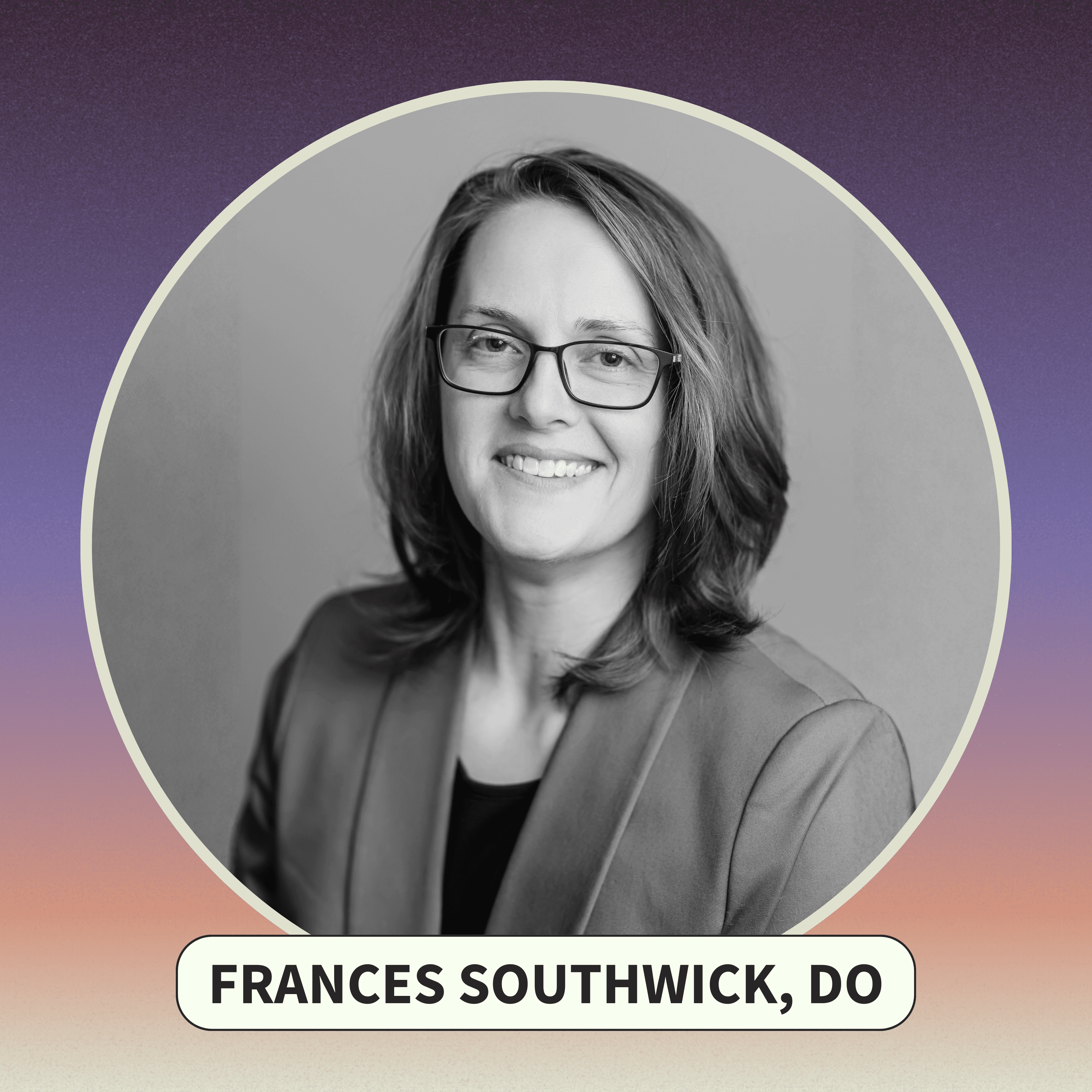
A Soft Place to Land with Frances Southwick, DO
Physician and writer Francis Southwick tells a deeply personal story about love and illness. Growing up queer in rural Colorado, Francis experiences mysterious episodes of sudden paralysis triggered by intense emotion, beginning in adolescence and persisting for decades without a diagnosis. After years of shame, misattribution, and near-abandonment of dreams, Francis falls in love with Judith, builds a life with her, and finally receives a diagnosis of type 1 narcolepsy with cataplexy—explaining why moments of beauty, joy, and love literally caused collapse.
0:00/1:34
The Nocturnists
Season
8
Episode
6
|
A Soft Place to Land with Frances Southwick, DO
Physician and writer Francis Southwick tells a deeply personal story about love and illness. Growing up queer in rural Colorado, Francis experiences mysterious episodes of sudden paralysis triggered by intense emotion, beginning in adolescence and persisting for decades without a diagnosis. After years of shame, misattribution, and near-abandonment of dreams, Francis falls in love with Judith, builds a life with her, and finally receives a diagnosis of type 1 narcolepsy with cataplexy—explaining why moments of beauty, joy, and love literally caused collapse.
0:00/1:34
About Our Guest
Frances Southwick is a board-certified osteopathic family physician, literary nonfiction writer and storyteller practicing at a federally qualified health center in California's central valley. Their education includes a BA in philosophy from Colorado State University, a DO from the West Virginia School of Osteopathic Medicine, and completion of University of Pittsburgh Medical Center's Shadyside Family Medicine Residency Program, and countless hours of one-on-one clinical education by patients. They have served as Yolo County's DHCS (Department of Health Care Services) Medications for Addiction Treatment Expert Facilitator. They also innovate front-lines clinical tools such as the "Self Interview," a strengths-based tool with roots in motivational interviewing, and healing-oriented trauma-informed practices.
About The Show
The Nocturnists is an award-winning medical storytelling podcast, hosted by physician Emily Silverman. We feature personal stories from frontline clinicians, conversations with healthcare-related authors, and art-makers. Our mission is to humanize healthcare and foster joy, wonder, and curiosity among clinicians and patients alike.
resources
Credits
About Our Guest
Frances Southwick is a board-certified osteopathic family physician, literary nonfiction writer and storyteller practicing at a federally qualified health center in California's central valley. Their education includes a BA in philosophy from Colorado State University, a DO from the West Virginia School of Osteopathic Medicine, and completion of University of Pittsburgh Medical Center's Shadyside Family Medicine Residency Program, and countless hours of one-on-one clinical education by patients. They have served as Yolo County's DHCS (Department of Health Care Services) Medications for Addiction Treatment Expert Facilitator. They also innovate front-lines clinical tools such as the "Self Interview," a strengths-based tool with roots in motivational interviewing, and healing-oriented trauma-informed practices.
About The Show
The Nocturnists is an award-winning medical storytelling podcast, hosted by physician Emily Silverman. We feature personal stories from frontline clinicians, conversations with healthcare-related authors, and art-makers. Our mission is to humanize healthcare and foster joy, wonder, and curiosity among clinicians and patients alike.
resources
Credits
The Nocturnists is made possible by the California Medical Association, and donations from people like you!
This episode is sponsored by The Physicians Foundation as well as Unleashed: Redesigning Health Care, a podcast that features clinician-innovators who have changed care on the front lines. Their stories, their voices, their ingenuity.
Transcript
Note: The Nocturnists is an audio-first experience with emotion and sound design that can be difficult to fully capture in text. Transcripts are provided to support accessibility and reference, but may contain minor inaccuracies. If quoting in print, please consult the audio when possible.
Emily Silverman: This is The Nocturnists. I'm Emily Silverman. Today I'm joined by Frances Southwick, physician, writer and storyteller. Frances shares a personal story about growing up queer in rural Colorado while experiencing sudden, unexplained collapses, triggered by intense emotions, episodes that began in adolescence and went undiagnosed for decades. Frances originally performed the story live at an event produced by Dr. Rebecca George of the Sierra Valley Health Center in Nevada City, California, in 2025.
In my conversation with Frances, we talk about living for years without a diagnosis and the shame and self doubt that can fill that void, finding love and partnership while navigating an invisible, misunderstood illness, and how a late diagnosis reshaped identity, relationships and medical practice. It's a tender, funny, and profound story and conversation, and I hope you love it as much as I did. Before we dive in, let's take a listen to Frances's story.
Frances Southwick: This is the story of three couches. It was 1998 and I was 15 years old. I was growing up in a rural community in Colorado. It was so rural that our town's restaurant was called The Tumbleweed, and there was this girl, her name was Annie. She played first base. I was the catcher. She was going to be a teacher. I was going to be a doctor. She looked like Cameron Diaz, and I looked like a young Joseph Gordon-Levitt.
[laughter]
Frances Southwick: I woke up one morning and realized I am in love with Annie, and I need to tell her. I wake up, put on my power outfit, which is JNCO jeans and a Cheerios t-shirt and my blue fedora.
[laughter]
Frances Southwick: Fourth period biology, she sits right next to me, so the class is a blur. The bell rings and she asks me to lunch.
[bell rings]
Frances Southwick: My heart starts pounding, and I'm pretty sure she can see my heart through my shirt. I grab my notebooks, I hold them to my chest, and I think it's time to tell her. "Annie." "Yes, France, what is it?" Suddenly, I feel weak, but not just a little weak, like colossally weak. My notebooks tumbled to the floor, and then I crumble to the floor, which is just thinly carpeted concrete. Annie's over me. "Are you okay, Frances? Oh my God." I try to answer her, but I can't speak. I can't move my fingers, my legs. I can't even move my eyes. It's like full locked-in syndrome. Somebody calls 911, the ambulance arrives. Everybody's still asking me if I'm okay, and I'm still completely mute and unable to move or answer.
Fearing a spinal cord injury, they snap on a hard C collar, strap me to the stretcher, whatever, hard board. I'm not an EMT, sorry.
[laughter]
Frances Southwick: They load me into the bus, and Annie is holding my hand, and we're making our way through the county roads to Denver, and I still can't move or speak. It takes 15 minutes, and eventually I start breathing a sigh of relief, because I can move my eyes finally again, and I can start moving my fingers, I can start mumbling a little bit. By the time we get to Denver, I'm walking, I'm talking, I'm doing well, the ER is like, "Eeh." My dad drives to Denver, he picks me and Annie up, drives us to our tiny town. Later that evening, he shares with me what his theory is of why I fell down, because the ER didn't know.
He said, "I think Annie's trying to make you gay.
[laughter]
Frances Southwick: That's why you fainted." From that moment on, I had regular bouts of varying degrees of weakness, sometimes just as called ptosis, a little bit of kind of sinking eyes, sometimes weakness, sometimes my hands, sometimes my whole body would collapse, like earlier in the story. I went to a lot of doctors, and I talked to a lot of people, and I tried everything that they said, and nothing worked. That included salt tablets and cinnamon gum.
[laughter]
Frances Southwick: Eye Movement practices, anti-seizure medications, and I decided I'd test out my dad's theory-
[laughter]
Frances Southwick: -and proposed to a man, and he said, "Yes," but that didn't work either. I was still having these episodes, so I broke off the engagement because I am super gay.
[laughter]
Frances Southwick: June 2004, I was a senior in college, and 11 states had just banned same sex marriage, so I was feeling like I need to do something. I call up our local Lambda Community Center, and I say, "I want to help out." They're like, "Great. We are putting on Fort Collins's first Pride." I'm like, "Cool." I show up for the event, and they realize I have no skill-
[laughter]
Frances Southwick: -and they assign me to be a trash collector.
[laughter]
Frances Southwick: Fortunate for me, a lot of the trash was around the stage, and the main stage musician was a knockout powerhouse who sounded like a cross between Dolly Parton and Tracy Chapman, asymmetric haircut, big black guitar, and her name was Judith. By the end of her set, I'm completely entranced. I come up and I scribble my name and my phone number on her email list, and she signs my record, "You're beautiful." A week later, she calls me and we do the thing where you fall off the face of the planet, and none of your friends know where you are, you're calling each other constantly or at each other's places, nothing else matters.
I wake up one morning and I realize I'm in love with this person, and I need to tell her.
[bell rings]
[laughter]
Frances Southwick: We're on her green vintage sofa, wood walled apartment, house plants everywhere, this very graceful black cat walking across. I set down my rooibos tea. I say, "Judith." "Yes, Frances." "I love you." At that point, I realized I had not mentioned my quirk about falling down sometimes, and I take a header into the couch cushions. Judith checks to see if I'm breathing, stands up, walks away, gets to the front door. The door opens and closes. Now I am left to my thoughts.
[laughter]
Frances Southwick: I start having some big thoughts, like, "What am I doing? Waiting to hear from med schools. What kind of doctor falls down in an exam room? What kind of person can't even say I love you without collapsing? Maybe my dad was right. Maybe I need to stop trying to be gay." I hear the door click open. Judith comes down, sits right next to me, waits for me until I can walk and talk again, and she says, "I am so sorry. I just panicked. Didn't know what to do. Went to the next door neighbor, and he suggested that I come and fucking check on you."
[laughter]
Frances Southwick: A week later, she says she loves me too. I get into med school. We move across the country. We get married in the small town in West Virginia, the first queer couple to get married in this baby, tiny, little town, and the whole town lines the streets with sparklers. We are building a life together, complete residency. All this time, I'm still falling down. 911 calls have been just common place in my life. By this point, I've had a few head injuries, and we're just trying to accept it, but I know that both of us are hoping for an answer.
20 years after that first episode on the Twentieth Doctor, Judith and I are sitting in his office, and he's a quiet neurologist. He asks me the most important medical question of my life. He says, "Do you experience sudden bouts of weakness when you are also experiencing intense emotion?" Judith and I are like, "Is this a joke?" She screams, "The test, they end early because the results are so conclusive. The diagnosis is narcolepsy, but not just narcolepsy yet." I'm a sleepy person.
[laughter]
Frances Southwick: I have type 1 narcolepsy, so that means my brain's not always sure if I'm awake or asleep, and that paralysis that you get when you're in REM, that can happen at any time. Cataplexy is what it's called, and for most people with cataplexy, the main triggers are strong emotions, like dude said. For me personally, the strongest triggers are the beautiful things in life-
[music]
Frances Southwick: -children laughing, earnest love, and maybe telling a bunch of strangers the most tender moments of my life. That's why I'm on couch number 2.
[laughter]
[bell rings]
Frances Southwick: This Christmas, Judith and I, like we've done every year since we started accepting my diagnosis, we will get our laundry basket, pack up the gifts, walk around the block to my sister's house, where we will be greeted by excited children. Will come inside, sip coffee, eat frittatas, and I will make my way to the corner of the sectional couch, number 3, where Judith and my sister will pack me tight with quilts and pillows, so that when the youngest comes up with her present and she says, "Aunt Frankie, I made this for you," I will have a soft place to land you.
[laughter]
[applause]
[music]
Emily Silverman: I am sitting here with Frances Southwick. Frances, thank you so much for coming on the show.
Frances Southwick: Thank you for having me. I'm really excited to be here.
Emily Silverman: Frances, what was it like telling your story on stage in Nevada City?
Frances Southwick: It was a lot of things. It was a big relief, in some ways, because I had been preparing for months, and I had tried to back out of this. It was an intimidating process, but it turned out much better than I expected, and much more of a cathartic process than I expected as well. A
Emily Silverman: I imagine one concern was that if it was catharsis, that you would start getting symptomatic on stage with your cataplexy. I'm wondering how you thought about that and planned around that. I know that we had the couch on stage for you, so that was there. Tell us about what is it like to be performing live when your condition-- that's when your symptoms come up. What was that like?
Frances Southwick: Yes. I can back up a little bit. The reason that I nearly didn't do the project was because I have fallen before giving talks, and I've fallen at work and all those sorts of things. My story coach, Brandy Colmer, and I was crying to her like, "Brandy, I can't do this. I don't know what I think I'm doing. I'm a writer and a doctor, not oral storyteller." She said, "Well, what is the main thing that you're afraid of?" "I was like, "Well--" I think most people when they are scared of public speaking, it's the actual speaking, and for me, it's the falling.
I had head injuries in the past from this sort of thing, and I was watching The Moth. I was listening to everything that I could think of, and everyone stands for their stories. I was like, "Brandy, I just don't think I can stand up there and do this." She was like, "What if you were sitting?"
[laughter]
Frances Southwick: Which was so smart. I was like, "Brandy, you're a GD genius." That's actually how the story evolved. The story is called "This is the Story of the three couches," and it started from that conversation.
Emily Silverman: I want to walk back to the beginning of your story. You talk about growing up in rural Colorado. You say it was so rural that the town's restaurant was called The Tumbleweed. Tell us what it was like growing up there.
Frances Southwick: 2000 people-- when I say Colorado, I mean picture Kansas, really, because it's the brown plains, and on a good day, you can see the mountains in the back. It was interesting. My dad was the town's bank president, and my mom was the elementary school secretary, and so we were real plugged in. I was hiding a lot, and so that was a very exhausting way to live for me, because I wasn't out. I'm queer, I wasn't out. Coming back to the narcolepsy, I didn't know I had narcolepsy. I was having falling episodes and weakness episodes that were not explainable at the time, and were chalked up to stress or dramatics, things like that.
It was a quiet place, and I was tied up in knots in a way, living there.
Emily Silverman: What was the name of the town?
Frances Southwick: Strasburg.
Emily Silverman: What did kids do for fun there? I'm just curious.
Frances Southwick: Sports. It's all about sports. That was the natural next line of my talk, that I was the catcher and Annie was first base, because that was what we did, softball, basketball, track, soccer, just on a loop. Sports and academics, those were the main things.
Emily Silverman: Do you remember your first episode of cataplexy?
Frances Southwick: I do. I do. The the first big episode was at a Christian camp, and we had just gotten done telling very personal stories at the camp fire, and I didn't even tell a story. I was just listening to these very traumatic episodes that all of us teens were finally willing to admit at the campfire, and I felt a huge sense of weakness. I collapsed, and I was taken to the camp nurse who decided to drive me by ambulance to the local hospital. By which time, by the ER, I was fine, running around, and so no testing was done. Again, it was chucked up too. I don't know. Stress, excitement, who knows? That was the first time.
Emily Silverman: Then you had an episode when you were telling Annie that you liked her, that you described in your story. I know that you told us about that in the story, but was wondering if you could talk a little bit more about that particular episode.
Frances Southwick: Yes. I took a little artistic license with saying I was just about to tell her I loved her. Every day was like that. I was almost going to tell her that I liked her. We're walking to lunch. I was holding my books, so I was hungry and I was excited. I probably hadn't had breakfast that day either, and I could really feel my heart pounding, and I got overcome when I was looking at her with this, at the time, very difficult to describe feeling. It started at the back of my neck, and it travels down my spine and then to my fingertips and my toes, and I had a full collapse and hit my head a little bit.
It was scary and overwhelming, and a lot of shame was rushing over me, actually, because, as I said, my first time was at a Christian camp, so I was growing up pretty Christian, and I had a lot of shame about these episodes, and had been actively praying for them to stop, or for me to find a way to get them to stop. For this to happen in front of this person I liked in the middle of school was the opposite of what I had hoped.
Emily Silverman: Then on top of that, after that episode, I think you said your dad said to you, "I think Annie is trying to make you gay." There's this link now that other people are trying to make between your orientation and this kind of chronic invisible syndrome. What was it like to hear that connection be made by your dad?
Frances Southwick: I, at the time, had no connect-- I thought it was completely ridiculous, and it was really scary as well because Annie was a lifeline to me. I loved spending time with her, and I felt like I could be myself. To have that questioned or threatened as maybe it's dangerous on multiple levels, was very scary.
Emily Silverman: You aid that growing up, you were in hiding a lot of the time. It was a very rural environment, a very Christian environment, so that's something invisible about you, and then also this condition. You're growing up, you're coming of age. I don't know, tell us about the arc into adulthood. How did all that play out over time? Because you didn't have a diagnosis yet. Sounds like you left Colorado. Maybe pull us along the next decade or two, and tell us how things evolved from from there, from those very early childhood episodes.
Frances Southwick: Okay. I was an exchange student in New Zealand out of high school, and had a couple episodes there. That was actually the accidental first time of my first diagnosis. Was living with a nurse, and I was falling asleep constantly. She said, jokingly, "What if you have narcolepsy?" I thought that she was joking, and she was only really half joking. It was the first suggestion, and really the only idea, until I was 33, that this was the actual diagnosis. That was when I was 16. I was in New Zealand.
I went to college. I was a philosophy student trying to figure out what's real and what's not constantly. [chuckles] I came out in college, and during some of the coming out times, I had collapse. Had another collapse when I decided to buy a ring and ask a man to marry me, then I collapsed at the mall. That was a good one. [chuckles] I got into med school in West Virginia, and I continued to have episodes. Every time I had one, I was like, "I really got to figure this out. This is a big problem." Like, "What's going to happen if I'm by myself and this happens? How many times can I really hit my head and expect to continue to pursue my dream of being a physician?"
Then I would recover and then forget about it, and then it would happen a few days or weeks later. I was just living in that cycle of hoping that it would stop, but having no control over it and not understanding the triggers.
Emily Silverman: You said your dream of being a physician, where did that come from?
Frances Southwick: That was a lifelong dream. I was one of the kids that knew, since age four, I'm going to be a doctor. I had a lot of comfort at the doctor's office actually. Really liked my family doctors. Just gentle approach. Dr. Heyman, just big white coat, checking my neck for swollen lymph nodes. I was like, "This is great." Good vibes at the doctor's office. Then I loved school. I had a lot of interest in the human body and anatomy.
Emily Silverman: Did you have any kind of hypothesis about what was going on before you got a diagnosis? Obviously, you connected it to moments of high emotionality, that's the pattern. Did you have a working theory, or did you just not really think about it that way?
Frances Southwick: The original theory was I had done something horrible, and this was my punishment, sort of a mystical idea. I started connecting the dots to this often happens when I'm talking to someone I really respect or really admire, which is also why I'm not looking at your face during this interview, PS, because there's a real risk of that happening when I'm talking to somebody that I admire. I thought that I was trying to get attention. I bought into this idea that I'm doing this for dramatic effect, to put myself into a passive position to be cared for, something like that. I just could not imagine what else it could be, because people would call this passing out, and I was too embarrassed to say I'm not unconscious.
Okay, sure, I'm passing out. Eventually, I started calling them falling down. I would call Judith and say, "I fell at school," or "I fell at work," or just like, "Okay."
It's very complex for me. I was only diagnosed eight years ago, and being diagnosed as an adult, I am still actively processing backward what was happening in a lot of different times in my life.
Emily Silverman: A few years ago, I read this book called Metagnosis. Instead of diagnosis, it's metagnosis. The author is-- she's not a physician, she's an academic. Her name is Danielle Spencer, and she's based at Columbia University. She has a really cool background. She works in the medical humanities, but she used to work with David Byrne from the Talking Heads in a creative capacity, she worked with him. She wrote this really powerful book. It's definitely more of an academic text about this concept of metagnosis.
The idea is that metagnosis is an experience that you have when you get a diagnosis and nothing changes for you really materially, but there's a narrative rupture in the sense of self, where suddenly you're looking back at your whole life and you're like, "Oh." [laughs] Sometimes that can be medical, like ADHD wasn't something that people really thought or talked a lot about in the last 25 years, and so people who get diagnosed with that later in life as adults, it just clicks and explains so many things about their learning style or their attentional regulation issues growing up, or being on the autism spectrum is another one.
Sometimes it has to do with doing 23andMe and finding out that your father isn't your father. She even had some sci-fi examples, like from Blade Runner, I think it was, where there's a character throughout the movie, and then you learn that they're actually not human, they're a cyborg. This idea that you get a piece of information, it doesn't necessarily change your day-to-day life or your prognosis or how you live, but it causes a complete reshuffling and reorienting of how you conceive of yourself. I had a little bit of this because I'm adopted, and I learned new information about where I came from as an adult, and it really, really shifted the way that I thought about myself.
I'm wondering if this concept of metagnosis resonates with you. Like you said, it's been eight years, but it sounds like you're still, I guess, working with that narrative that ruptured from getting that diagnosis.
Frances Southwick: Oh yes, definitely, that all fits. I like that. Now I want to read that. I wrote a little outline. A four-part outline, very few words right before this interview, and I just wrote, "College queer, then trauma processing in the past eight years have been about narcolepsy," so learning about being gay and then also about being a non-binary person who's been non-binary consistently my whole life, and then doing some trauma processing, and then learning about narcolepsy. Each of those stages have helped me completely re-examine my life retrospectively. I love doing it, but it's also tragic sometimes because I see how many junctures I could have had less suffering and less shame, at least, had I known some of these things earlier.
Emily Silverman: Do you think about it in a storytelling way at all, like do you ever think of yourself as a character with like new information revealed about the character? I don't know. That's how my brain works, and I'm wondering [chuckles] if you ever see things through that lens too.
Frances Southwick: Yes. I have put out two books. The first one was all about medical training, Prognosis: Poor. It was very focused on, wow, I didn't know how hard medical training would be. It was even so hard, I was collapsing at work. That was what that was about. Then the next one was Prognosis: Fair, all about trauma and my view of myself as someone who had undergone trauma, and how that shaped and sculpted my life. Absolutely, my character keeps unveiling new-- I don't know, pulling back pieces of the onion, whatever you want to say.
Emily Silverman: Prognosis: Poor, Prognosis: Fair. I wonder if there's a Prognosis: Good to complete the trilogy. To use a Christian metaphor.
[laughter]
Frances Southwick: Yes. I am thinking so. A lot of things are pointing toward that. My first two books were written accidentally. I didn't realize I had written so much until after the fact. Looking back, I was like, "Wow, past six years I've been writing about one topic." Didn't realize it was all on one theme. That's the case. Lately, I've been looking back at a lot of material that I have about found family because I'm estranged, and acceptance of myself and my family's acceptance of me, and what kind of life I have now, a much more comfortable life.
[music]
Emily Silverman: Tell us about the moment you got diagnosed. I think you said you were 33. At 16, there was a nurse who actually sounds like diagnosed you half jokingly, but correctly. Then it wasn't for another 15-plus years that you formally were diagnosed. Tell us about that moment. When it happened, did you remember back to the nurse in New Zealand? What was it like to get that final label, I guess?
Frances Southwick: Yes. There's stories about people, "Oh, I didn't know I was gay. People around me knew I was gay." This was similar to where I went to a neurologist who was my nth neurologist, lots of neurologists I had seen, and he was just like, "Oh, do you experience episodes of profound weakness when you experience strong emotions?" I was like, "That is the simplest, most concise way to explain what I've been going through. Yes." He was like, "It could be narcolepsy, let's do some tests."
When I saw that sleep doctor later, I was sitting there just yawning crazy, just holding myself up. He's like, "It's so clear that you have narcolepsy. We'll do the test, but that's the diagnosis." I was embarrassed that I hadn't thought of it myself as well. How it worked out was I did the test, which is an overnight test, and then the next day a nap test, where you get the opportunity to take four or five naps, which is a good day for me, [laughs] although they keep getting interrupted. The test involved these four or five nap attempts, and after four attempts, I had very fast REM onset on all four naps, and so they nixed the fifth one.
I knew, already, based on them not attempting the fifth nap, that it was conclusive. They called me and told me the diagnosis, and I had just gotten a job in California, I had just started a new place, and they had just asked me, "Are you living with a disability?" I said, "No." [chuckles] That has also been a huge reframing for me, because I am and have been living with a disabling condition for a long time, so that has been a lot to process.
Emily Silverman: Is the sleep test the main way that they diagnose it, or do they do a spinal tap too? I was reading a little bit about this on UpToDate the other day.
Frances Southwick: Nice. I did not have a spinal tap because I have such classic cataplexy symptoms and excessive daytime sleepiness and sleep paralysis and hallucinations. I have all the things, plus the REM thing, the sore REMs. They're called sleep onset REM initiation. I got to skip the spinal tap, which is nice for me. I got to be honest. I got to be honest. I searched you up and listened to your story about your sleep paralysis as well.
Emily Silverman: I was just going to bring that. What did you think of it?
Frances Southwick: I enjoyed it. I enjoyed it. I can tell you that I remember so many of my dreams from when I was a kid as well, which is surprising to a lot of people around me. I'm like, "You don't remember your dreams?" I'm like, "I've got my Wicked Witch of the West. I've got my lion behind the cages that turns into my dad. Then I've got my beaver. The evil beaver that comes swimming and chews off my leg. That was my nickname when I was a kid, "Beaver Bait." I remember all these dreams. I've had sleep paralysis countless times. That's me, but it was really cool to hear you talk about the details of your dreams and the experience of sleep paralysis as well.
Emily Silverman: For anyone listening who doesn't know about this story, there was a Nocturnists show. It was the only Nocturnists show where I told a story, [chuckles] and this was in San Francesco a couple years ago during an event co-sponsored with the UCSF Memory and Aging center. The theme was Sleep and Dreams. I spoke about my dreams and my sleep paralysis and my hallucinations, auditory sometimes, visual sometimes. One of the most memorable hallucinations I had was a man with a hat standing next to my bed by the window. Then I went online and looked up and saw that actually a lot of people see that with sleep paralysis.
Have you ever seen the man with the hat, Frances?
Frances Southwick: Have not seen the man. I was like, "Oh, no."
Emily Silverman: That's good. He's scary. I'm glad he hasn't visited upon you.
Frances Southwick: I haven't seen the man.
Emily Silverman: [chuckles] I want to switch gears for a minute and talk about your wedding. You fall in love with this hot guitarist [chuckles] named Judith, who you see playing music at a festival, and then you get married in West Virginia. You said you were the first queer couple to get married in West Virginia, and that the whole town came and lined the streets with sparklers, and that was just such a powerful image in your story. Was wondering if you could tell us a bit more about your wedding and being the first queer couple to get married in West Virginia.
Frances Southwick: I felt a little pre-cataplexy jolt there. You're asking about that. It was still not legal in West Virginia when we got married, and there were certain family members of mine who, when they heard I was getting married, pre-emptively, had called me and told me, "I'm not coming because I don't want to be around those people." It was a very emotional-- just getting married is emotional. Obviously, it's huge, and the fact that this small West Virginia town held us and supported us so much was shocking. I was so surprised I had multiple episodes of weakness that day, which we chalked it up to whatever it was at that time. I didn't have the diagnosis at the time.
It was torture standing on the stage, I can say that too, of just trying to do eye movements, distract myself, move my various muscles. Just personally, internally, it was a little bit of torment trying to get through that. It was a really beautiful experience on the community side, and then also just standing there with Judith was overwhelming.
Emily Silverman: You said that you were doing eye movements and moving your body. I'm just really curious about what practical and emotional tools doctors and experts have to offer to people who are living with narcolepsy, cataplexy. I know there's obviously medications that can help with wakefulness and things like that, but was just wondering if you could bring us into that toolbox, if you don't mind. What is in the toolbox?
Frances Southwick: Some of it is about prevention, some is about treatment, and a lot is about recon. [chuckles] I've learned almost all of my things the hard way. I'll give you some little tips. Here's very practical examples. We travel with a transport chair, and that was right behind the curtain, actually at your show. I sit in the transport chair. It's a wheelchair that somebody else pushes. Wheelchairs the patient can manipulate themselves, but when I'm having cataplexy, kind of defeats the purpose. We have the transport chair, and it breaks down and sits in the car.
I have a Medic Alert necklace. I've counseled the people at my work how to handle it if I have cataplexy, because it's not in BLS or ACLS training, like, "What do you do when somebody has cataplexy?" I just wrote the rule book myself on how to handle it, but how to try and, in the moment, prevent an episode, is much more doable now that I have medication. I'm taking Bupropion and then also WAKIX. That was completely life changing, the WAKIX.
Emily Silverman: Really?
Frances Southwick: Completely. After few days of having it in my system, I was like, "Becky--" Becky's my sister. I was like, "Becky, this is like having braces on my legs all the time." I was just crying. I could cry thinking about it. Previously, I would yawn over 100 times a day. Now it's once a day. Anyway, it cut the cataplexy actually, so much as well. I use voices, I use movie quotes. I do shorthand speech. There's a lot of things that are reminiscent of people with a stutter. Instead of "I love you," which hurts to say, in my family, we just say "Nubs." I have tons of different voices that I use as well to try and circumvent the emotional part of speech.
Talking right now, this is my real voice. I don't use it that often. Writing, singing. There's a lot of ways to circumvent whatever pathway and we're talking about with the--
Emily Silverman: When you say voices, do you mean like you talk higher, or you talk lower, or what does that mean?
Frances Southwick: I have various voices. Very sort of character voices.
Emily Silverman: I don't know you that well, but you seem to me like a very funny person, like a very dry humor person. I don't know, maybe it's a way to be playful and try on different improvisational [chuckles] characters, while also circumventing some of the-- Why do you think it's easier to be in character than it is to speak in your real voice?
Frances Southwick: Oh, because my real voice is attached to my real emotions.
Emily Silverman: That's so interesting.
Frances Southwick: Writing is so easy. I could have written all of this so easily. For example, when I go to therapy-- I don't go anymore, but I went for years, and it was exhausting. Exhausting. At minute 35 every time, I would start slowing and gluing up and getting slow. Cataplexy doesn't have to come like a ton of bricks. Sometimes it's also sort of a slow fade. When I was using my real voice and I was being as vulnerable and open as possible, and that just absolutely takes it out of me.
Emily Silverman: This is a question that you probably don't have an answer for, but it's just something I'm wondering. My understanding is that narcolepsy, cataplexy is related to a problem in the brain. I think I read they think it's an autoimmune destruction of certain cells in the brain that deal with sleep/wake regulation. I'm getting a thumbs up, so that's good, so that you'll be awake and walking and talking, and your brain will get confused and think that you're asleep, and then it'll turn on the body paralysis, which is what it normally turns on when you're sleeping to prevent you from kicking and acting out your dreams.
I just think it's so interesting that the pathology shows up during moments of emotion. It doesn't show up when you're straining and going to the bathroom, it doesn't show up when you're seeing bright lights. There are so many different situations that could trigger this decoupling of consciousness and body muscle tone, and yet it's emotion. It's not even always sad emotion. In fact, often it's happy emotion or laughter. Again, I don't know if there is an answer to this question, but I'm just wondering what you think. Why do you think it happens with emotion?
Frances Southwick: I don't think that part has been completely figured out. It hasn't. That's the point. I am constantly thinking about it, wondering about it. Last night, I finally bit the bullet and listened to this very famous episode of This American Life with Matt Frerking. It's called, "I've Fallen in Love and I Can't Get Up." Some producers heard it and then made a movie called Ode to Joy, and it's the only mainstream movie that features type 1 narcolepsy. There's a lot of division in the narcolepsy community about how accurate it is, or whatever.
Personally, I think it's amazing. I think it's so great to have something that is not just about how funny it is to be falling down and weak with emotion, although it opens with a funny scene with that. I finally listened to it. Matt Frerking is a neuroscientist who developed type 1 narcolepsy as an adult, and he gave this interview four years after he was diagnosed, and it definitely-- it brought the house down for me. It's only 11 minute interview, and his wife is interviewed as well, and they're like, "We used to hold hands. Now we don't. I'm sticking with him for now, but it's not like it used to be."
I was just so grateful that I had met Judith after my symptoms had started, so that we could go through the process together, and it was not like a relearning who a person is from the ground up. She was there with me through all of these episodes. She's there when I'm like, "I can't say I love you. I can't say goodbye to you" like I'm going. [laughs] They used to be a source of contention. Like, "Why do you not like saying goodbye, especially when you're going into work? Why can't you give me a hug?" I would just get furious. Before diagnosis, I was like, "I don't know why. I'm just angry."
It was like a defense. I know that if I kiss you or hug you goodbye, I could fall down in the parking lot and not be able to work today. That episode's really powerful. You got to check it out.
Emily Silverman: I will definitely check that out. That's so interesting, what you said about the fact that it's linked to emotion has major implications for relationships. I could see a whole new field emerging that combines neurology and occupational therapy and marriage counseling [chuckles] around like how do you be in relationship with somebody who has this condition? How do you manage-- I don't even know where to begin with that. I'm wondering if you could share a bit more about that. How do you navigate this as a couple?
Frances Southwick: I'd love to talk about it. I'd love to. Judith drives most of the time. There's-- give me a second. Let me think. I'm getting a little weak talking.
Emily Silverman: Take your time. I'm here.
Frances Southwick: We plan ahead. We know that I can flake out on a plan at any minute. We'll plan a beach trip, and I get so excited about the beach trip that we don't go because I can't get in the car. We live a mile from my office, so she can come get me. Sorry.
Emily Silverman: Whatever you need to do.
Frances Southwick: Oh, I know what I was going to tell you. There are narcolepsy support groups for people with narcolepsy, but there's also narcolepsy support groups for people who love people with narcolepsy, so parents and spouses. I believe it's with The Narcolepsy Network or Wake Up Narcolepsy. Judith loves going to those meetings and sharing tips and talking about options of medications, moving right along.
Emily Silverman: [chuckles] This was the topic that you were most excited to talk about.
Frances Southwick: [chuckles] Yes, exactly, exactly. I have to be careful about the excitement. It's true.
Emily Silverman: Let's switch to a different topic, because I know that we're almost rounding to a close here. I just wanted to ask about how this whole journey has impacted the way that you practice medicine, particularly the before/after with the diagnosis and the metagnosis, you could say. Do you see your patients differently? Do you connect to them differently? How has it changed how you practice?
Frances Southwick: I have helped make the diagnosis for two different patients, which is exciting. It's like the pulmonary embolism of collapses and fatigues. If you don't think about it, you will miss it. That's just specific to that diagnosis. I have a lot of empathy for people with locked-in syndrome. Diving Bell and the Butterfly, I don't know if you read that and saw the movie? I get tastes of that. People who have had strokes or people living with autism love me the minute I walk in the room, because they can tell them in their neurological family or people with traumatic brain injuries. It's a club that if you haven't experienced some sort of severe neurological phenomenon, it's hard to really physically empathize. So it's a gift in that way.
Emily Silverman: Hmm, yeah, physically emphasize, that's really well put. Well, this has been a wonderful conversation. It's so good to see you, and it's so good to unpack the story together and to hear about everything that you've gone through, and just the resilience and the humor, the humor especially, is wonderful. So thank you for for joining us in The Nocturnists Satellites and for coming on the podcast.
Frances Southwick: Thank you so much. Thank you. It's been very fun, too fun.
Emily Silverman: Super fun. All right.
[outro music]
Emily Silverman: This episode of The Nocturnists was produced by me and Producer and Head of Story Development Molly Rose-Williams. Our executive producer is Ali Block, and Ashley Pettit is our program director. Original theme music was composed by Yosef Munro, and additional music comes from Blue Dot Sessions. The Nocturnists is made possible by the California Medical Association, a physician-led organization that works to ensure the doctor-patient relationship remains at the center of medicine.
To learn more about the CMA, visit cmadocs.org. This episode of The Nocturnists: Conversations is sponsored by The Physicians Foundation, which supports physician well-being, practice sustainability, and leadership in delivering high-quality, cost-efficient care. The Nocturnists is also made possible by donations from listeners like you. In fact, we recently moved over to Substack, which makes it easier than ever to support our work directly. By joining us with a donation of $2, $5, or $10 a month, you'll become an essential part of our creative community. I'm your host, Emily Silverman.
Transcript
Note: The Nocturnists is an audio-first experience with emotion and sound design that can be difficult to fully capture in text. Transcripts are provided to support accessibility and reference, but may contain minor inaccuracies. If quoting in print, please consult the audio when possible.
Emily Silverman: This is The Nocturnists. I'm Emily Silverman. Today I'm joined by Frances Southwick, physician, writer and storyteller. Frances shares a personal story about growing up queer in rural Colorado while experiencing sudden, unexplained collapses, triggered by intense emotions, episodes that began in adolescence and went undiagnosed for decades. Frances originally performed the story live at an event produced by Dr. Rebecca George of the Sierra Valley Health Center in Nevada City, California, in 2025.
In my conversation with Frances, we talk about living for years without a diagnosis and the shame and self doubt that can fill that void, finding love and partnership while navigating an invisible, misunderstood illness, and how a late diagnosis reshaped identity, relationships and medical practice. It's a tender, funny, and profound story and conversation, and I hope you love it as much as I did. Before we dive in, let's take a listen to Frances's story.
Frances Southwick: This is the story of three couches. It was 1998 and I was 15 years old. I was growing up in a rural community in Colorado. It was so rural that our town's restaurant was called The Tumbleweed, and there was this girl, her name was Annie. She played first base. I was the catcher. She was going to be a teacher. I was going to be a doctor. She looked like Cameron Diaz, and I looked like a young Joseph Gordon-Levitt.
[laughter]
Frances Southwick: I woke up one morning and realized I am in love with Annie, and I need to tell her. I wake up, put on my power outfit, which is JNCO jeans and a Cheerios t-shirt and my blue fedora.
[laughter]
Frances Southwick: Fourth period biology, she sits right next to me, so the class is a blur. The bell rings and she asks me to lunch.
[bell rings]
Frances Southwick: My heart starts pounding, and I'm pretty sure she can see my heart through my shirt. I grab my notebooks, I hold them to my chest, and I think it's time to tell her. "Annie." "Yes, France, what is it?" Suddenly, I feel weak, but not just a little weak, like colossally weak. My notebooks tumbled to the floor, and then I crumble to the floor, which is just thinly carpeted concrete. Annie's over me. "Are you okay, Frances? Oh my God." I try to answer her, but I can't speak. I can't move my fingers, my legs. I can't even move my eyes. It's like full locked-in syndrome. Somebody calls 911, the ambulance arrives. Everybody's still asking me if I'm okay, and I'm still completely mute and unable to move or answer.
Fearing a spinal cord injury, they snap on a hard C collar, strap me to the stretcher, whatever, hard board. I'm not an EMT, sorry.
[laughter]
Frances Southwick: They load me into the bus, and Annie is holding my hand, and we're making our way through the county roads to Denver, and I still can't move or speak. It takes 15 minutes, and eventually I start breathing a sigh of relief, because I can move my eyes finally again, and I can start moving my fingers, I can start mumbling a little bit. By the time we get to Denver, I'm walking, I'm talking, I'm doing well, the ER is like, "Eeh." My dad drives to Denver, he picks me and Annie up, drives us to our tiny town. Later that evening, he shares with me what his theory is of why I fell down, because the ER didn't know.
He said, "I think Annie's trying to make you gay.
[laughter]
Frances Southwick: That's why you fainted." From that moment on, I had regular bouts of varying degrees of weakness, sometimes just as called ptosis, a little bit of kind of sinking eyes, sometimes weakness, sometimes my hands, sometimes my whole body would collapse, like earlier in the story. I went to a lot of doctors, and I talked to a lot of people, and I tried everything that they said, and nothing worked. That included salt tablets and cinnamon gum.
[laughter]
Frances Southwick: Eye Movement practices, anti-seizure medications, and I decided I'd test out my dad's theory-
[laughter]
Frances Southwick: -and proposed to a man, and he said, "Yes," but that didn't work either. I was still having these episodes, so I broke off the engagement because I am super gay.
[laughter]
Frances Southwick: June 2004, I was a senior in college, and 11 states had just banned same sex marriage, so I was feeling like I need to do something. I call up our local Lambda Community Center, and I say, "I want to help out." They're like, "Great. We are putting on Fort Collins's first Pride." I'm like, "Cool." I show up for the event, and they realize I have no skill-
[laughter]
Frances Southwick: -and they assign me to be a trash collector.
[laughter]
Frances Southwick: Fortunate for me, a lot of the trash was around the stage, and the main stage musician was a knockout powerhouse who sounded like a cross between Dolly Parton and Tracy Chapman, asymmetric haircut, big black guitar, and her name was Judith. By the end of her set, I'm completely entranced. I come up and I scribble my name and my phone number on her email list, and she signs my record, "You're beautiful." A week later, she calls me and we do the thing where you fall off the face of the planet, and none of your friends know where you are, you're calling each other constantly or at each other's places, nothing else matters.
I wake up one morning and I realize I'm in love with this person, and I need to tell her.
[bell rings]
[laughter]
Frances Southwick: We're on her green vintage sofa, wood walled apartment, house plants everywhere, this very graceful black cat walking across. I set down my rooibos tea. I say, "Judith." "Yes, Frances." "I love you." At that point, I realized I had not mentioned my quirk about falling down sometimes, and I take a header into the couch cushions. Judith checks to see if I'm breathing, stands up, walks away, gets to the front door. The door opens and closes. Now I am left to my thoughts.
[laughter]
Frances Southwick: I start having some big thoughts, like, "What am I doing? Waiting to hear from med schools. What kind of doctor falls down in an exam room? What kind of person can't even say I love you without collapsing? Maybe my dad was right. Maybe I need to stop trying to be gay." I hear the door click open. Judith comes down, sits right next to me, waits for me until I can walk and talk again, and she says, "I am so sorry. I just panicked. Didn't know what to do. Went to the next door neighbor, and he suggested that I come and fucking check on you."
[laughter]
Frances Southwick: A week later, she says she loves me too. I get into med school. We move across the country. We get married in the small town in West Virginia, the first queer couple to get married in this baby, tiny, little town, and the whole town lines the streets with sparklers. We are building a life together, complete residency. All this time, I'm still falling down. 911 calls have been just common place in my life. By this point, I've had a few head injuries, and we're just trying to accept it, but I know that both of us are hoping for an answer.
20 years after that first episode on the Twentieth Doctor, Judith and I are sitting in his office, and he's a quiet neurologist. He asks me the most important medical question of my life. He says, "Do you experience sudden bouts of weakness when you are also experiencing intense emotion?" Judith and I are like, "Is this a joke?" She screams, "The test, they end early because the results are so conclusive. The diagnosis is narcolepsy, but not just narcolepsy yet." I'm a sleepy person.
[laughter]
Frances Southwick: I have type 1 narcolepsy, so that means my brain's not always sure if I'm awake or asleep, and that paralysis that you get when you're in REM, that can happen at any time. Cataplexy is what it's called, and for most people with cataplexy, the main triggers are strong emotions, like dude said. For me personally, the strongest triggers are the beautiful things in life-
[music]
Frances Southwick: -children laughing, earnest love, and maybe telling a bunch of strangers the most tender moments of my life. That's why I'm on couch number 2.
[laughter]
[bell rings]
Frances Southwick: This Christmas, Judith and I, like we've done every year since we started accepting my diagnosis, we will get our laundry basket, pack up the gifts, walk around the block to my sister's house, where we will be greeted by excited children. Will come inside, sip coffee, eat frittatas, and I will make my way to the corner of the sectional couch, number 3, where Judith and my sister will pack me tight with quilts and pillows, so that when the youngest comes up with her present and she says, "Aunt Frankie, I made this for you," I will have a soft place to land you.
[laughter]
[applause]
[music]
Emily Silverman: I am sitting here with Frances Southwick. Frances, thank you so much for coming on the show.
Frances Southwick: Thank you for having me. I'm really excited to be here.
Emily Silverman: Frances, what was it like telling your story on stage in Nevada City?
Frances Southwick: It was a lot of things. It was a big relief, in some ways, because I had been preparing for months, and I had tried to back out of this. It was an intimidating process, but it turned out much better than I expected, and much more of a cathartic process than I expected as well. A
Emily Silverman: I imagine one concern was that if it was catharsis, that you would start getting symptomatic on stage with your cataplexy. I'm wondering how you thought about that and planned around that. I know that we had the couch on stage for you, so that was there. Tell us about what is it like to be performing live when your condition-- that's when your symptoms come up. What was that like?
Frances Southwick: Yes. I can back up a little bit. The reason that I nearly didn't do the project was because I have fallen before giving talks, and I've fallen at work and all those sorts of things. My story coach, Brandy Colmer, and I was crying to her like, "Brandy, I can't do this. I don't know what I think I'm doing. I'm a writer and a doctor, not oral storyteller." She said, "Well, what is the main thing that you're afraid of?" "I was like, "Well--" I think most people when they are scared of public speaking, it's the actual speaking, and for me, it's the falling.
I had head injuries in the past from this sort of thing, and I was watching The Moth. I was listening to everything that I could think of, and everyone stands for their stories. I was like, "Brandy, I just don't think I can stand up there and do this." She was like, "What if you were sitting?"
[laughter]
Frances Southwick: Which was so smart. I was like, "Brandy, you're a GD genius." That's actually how the story evolved. The story is called "This is the Story of the three couches," and it started from that conversation.
Emily Silverman: I want to walk back to the beginning of your story. You talk about growing up in rural Colorado. You say it was so rural that the town's restaurant was called The Tumbleweed. Tell us what it was like growing up there.
Frances Southwick: 2000 people-- when I say Colorado, I mean picture Kansas, really, because it's the brown plains, and on a good day, you can see the mountains in the back. It was interesting. My dad was the town's bank president, and my mom was the elementary school secretary, and so we were real plugged in. I was hiding a lot, and so that was a very exhausting way to live for me, because I wasn't out. I'm queer, I wasn't out. Coming back to the narcolepsy, I didn't know I had narcolepsy. I was having falling episodes and weakness episodes that were not explainable at the time, and were chalked up to stress or dramatics, things like that.
It was a quiet place, and I was tied up in knots in a way, living there.
Emily Silverman: What was the name of the town?
Frances Southwick: Strasburg.
Emily Silverman: What did kids do for fun there? I'm just curious.
Frances Southwick: Sports. It's all about sports. That was the natural next line of my talk, that I was the catcher and Annie was first base, because that was what we did, softball, basketball, track, soccer, just on a loop. Sports and academics, those were the main things.
Emily Silverman: Do you remember your first episode of cataplexy?
Frances Southwick: I do. I do. The the first big episode was at a Christian camp, and we had just gotten done telling very personal stories at the camp fire, and I didn't even tell a story. I was just listening to these very traumatic episodes that all of us teens were finally willing to admit at the campfire, and I felt a huge sense of weakness. I collapsed, and I was taken to the camp nurse who decided to drive me by ambulance to the local hospital. By which time, by the ER, I was fine, running around, and so no testing was done. Again, it was chucked up too. I don't know. Stress, excitement, who knows? That was the first time.
Emily Silverman: Then you had an episode when you were telling Annie that you liked her, that you described in your story. I know that you told us about that in the story, but was wondering if you could talk a little bit more about that particular episode.
Frances Southwick: Yes. I took a little artistic license with saying I was just about to tell her I loved her. Every day was like that. I was almost going to tell her that I liked her. We're walking to lunch. I was holding my books, so I was hungry and I was excited. I probably hadn't had breakfast that day either, and I could really feel my heart pounding, and I got overcome when I was looking at her with this, at the time, very difficult to describe feeling. It started at the back of my neck, and it travels down my spine and then to my fingertips and my toes, and I had a full collapse and hit my head a little bit.
It was scary and overwhelming, and a lot of shame was rushing over me, actually, because, as I said, my first time was at a Christian camp, so I was growing up pretty Christian, and I had a lot of shame about these episodes, and had been actively praying for them to stop, or for me to find a way to get them to stop. For this to happen in front of this person I liked in the middle of school was the opposite of what I had hoped.
Emily Silverman: Then on top of that, after that episode, I think you said your dad said to you, "I think Annie is trying to make you gay." There's this link now that other people are trying to make between your orientation and this kind of chronic invisible syndrome. What was it like to hear that connection be made by your dad?
Frances Southwick: I, at the time, had no connect-- I thought it was completely ridiculous, and it was really scary as well because Annie was a lifeline to me. I loved spending time with her, and I felt like I could be myself. To have that questioned or threatened as maybe it's dangerous on multiple levels, was very scary.
Emily Silverman: You aid that growing up, you were in hiding a lot of the time. It was a very rural environment, a very Christian environment, so that's something invisible about you, and then also this condition. You're growing up, you're coming of age. I don't know, tell us about the arc into adulthood. How did all that play out over time? Because you didn't have a diagnosis yet. Sounds like you left Colorado. Maybe pull us along the next decade or two, and tell us how things evolved from from there, from those very early childhood episodes.
Frances Southwick: Okay. I was an exchange student in New Zealand out of high school, and had a couple episodes there. That was actually the accidental first time of my first diagnosis. Was living with a nurse, and I was falling asleep constantly. She said, jokingly, "What if you have narcolepsy?" I thought that she was joking, and she was only really half joking. It was the first suggestion, and really the only idea, until I was 33, that this was the actual diagnosis. That was when I was 16. I was in New Zealand.
I went to college. I was a philosophy student trying to figure out what's real and what's not constantly. [chuckles] I came out in college, and during some of the coming out times, I had collapse. Had another collapse when I decided to buy a ring and ask a man to marry me, then I collapsed at the mall. That was a good one. [chuckles] I got into med school in West Virginia, and I continued to have episodes. Every time I had one, I was like, "I really got to figure this out. This is a big problem." Like, "What's going to happen if I'm by myself and this happens? How many times can I really hit my head and expect to continue to pursue my dream of being a physician?"
Then I would recover and then forget about it, and then it would happen a few days or weeks later. I was just living in that cycle of hoping that it would stop, but having no control over it and not understanding the triggers.
Emily Silverman: You said your dream of being a physician, where did that come from?
Frances Southwick: That was a lifelong dream. I was one of the kids that knew, since age four, I'm going to be a doctor. I had a lot of comfort at the doctor's office actually. Really liked my family doctors. Just gentle approach. Dr. Heyman, just big white coat, checking my neck for swollen lymph nodes. I was like, "This is great." Good vibes at the doctor's office. Then I loved school. I had a lot of interest in the human body and anatomy.
Emily Silverman: Did you have any kind of hypothesis about what was going on before you got a diagnosis? Obviously, you connected it to moments of high emotionality, that's the pattern. Did you have a working theory, or did you just not really think about it that way?
Frances Southwick: The original theory was I had done something horrible, and this was my punishment, sort of a mystical idea. I started connecting the dots to this often happens when I'm talking to someone I really respect or really admire, which is also why I'm not looking at your face during this interview, PS, because there's a real risk of that happening when I'm talking to somebody that I admire. I thought that I was trying to get attention. I bought into this idea that I'm doing this for dramatic effect, to put myself into a passive position to be cared for, something like that. I just could not imagine what else it could be, because people would call this passing out, and I was too embarrassed to say I'm not unconscious.
Okay, sure, I'm passing out. Eventually, I started calling them falling down. I would call Judith and say, "I fell at school," or "I fell at work," or just like, "Okay."
It's very complex for me. I was only diagnosed eight years ago, and being diagnosed as an adult, I am still actively processing backward what was happening in a lot of different times in my life.
Emily Silverman: A few years ago, I read this book called Metagnosis. Instead of diagnosis, it's metagnosis. The author is-- she's not a physician, she's an academic. Her name is Danielle Spencer, and she's based at Columbia University. She has a really cool background. She works in the medical humanities, but she used to work with David Byrne from the Talking Heads in a creative capacity, she worked with him. She wrote this really powerful book. It's definitely more of an academic text about this concept of metagnosis.
The idea is that metagnosis is an experience that you have when you get a diagnosis and nothing changes for you really materially, but there's a narrative rupture in the sense of self, where suddenly you're looking back at your whole life and you're like, "Oh." [laughs] Sometimes that can be medical, like ADHD wasn't something that people really thought or talked a lot about in the last 25 years, and so people who get diagnosed with that later in life as adults, it just clicks and explains so many things about their learning style or their attentional regulation issues growing up, or being on the autism spectrum is another one.
Sometimes it has to do with doing 23andMe and finding out that your father isn't your father. She even had some sci-fi examples, like from Blade Runner, I think it was, where there's a character throughout the movie, and then you learn that they're actually not human, they're a cyborg. This idea that you get a piece of information, it doesn't necessarily change your day-to-day life or your prognosis or how you live, but it causes a complete reshuffling and reorienting of how you conceive of yourself. I had a little bit of this because I'm adopted, and I learned new information about where I came from as an adult, and it really, really shifted the way that I thought about myself.
I'm wondering if this concept of metagnosis resonates with you. Like you said, it's been eight years, but it sounds like you're still, I guess, working with that narrative that ruptured from getting that diagnosis.
Frances Southwick: Oh yes, definitely, that all fits. I like that. Now I want to read that. I wrote a little outline. A four-part outline, very few words right before this interview, and I just wrote, "College queer, then trauma processing in the past eight years have been about narcolepsy," so learning about being gay and then also about being a non-binary person who's been non-binary consistently my whole life, and then doing some trauma processing, and then learning about narcolepsy. Each of those stages have helped me completely re-examine my life retrospectively. I love doing it, but it's also tragic sometimes because I see how many junctures I could have had less suffering and less shame, at least, had I known some of these things earlier.
Emily Silverman: Do you think about it in a storytelling way at all, like do you ever think of yourself as a character with like new information revealed about the character? I don't know. That's how my brain works, and I'm wondering [chuckles] if you ever see things through that lens too.
Frances Southwick: Yes. I have put out two books. The first one was all about medical training, Prognosis: Poor. It was very focused on, wow, I didn't know how hard medical training would be. It was even so hard, I was collapsing at work. That was what that was about. Then the next one was Prognosis: Fair, all about trauma and my view of myself as someone who had undergone trauma, and how that shaped and sculpted my life. Absolutely, my character keeps unveiling new-- I don't know, pulling back pieces of the onion, whatever you want to say.
Emily Silverman: Prognosis: Poor, Prognosis: Fair. I wonder if there's a Prognosis: Good to complete the trilogy. To use a Christian metaphor.
[laughter]
Frances Southwick: Yes. I am thinking so. A lot of things are pointing toward that. My first two books were written accidentally. I didn't realize I had written so much until after the fact. Looking back, I was like, "Wow, past six years I've been writing about one topic." Didn't realize it was all on one theme. That's the case. Lately, I've been looking back at a lot of material that I have about found family because I'm estranged, and acceptance of myself and my family's acceptance of me, and what kind of life I have now, a much more comfortable life.
[music]
Emily Silverman: Tell us about the moment you got diagnosed. I think you said you were 33. At 16, there was a nurse who actually sounds like diagnosed you half jokingly, but correctly. Then it wasn't for another 15-plus years that you formally were diagnosed. Tell us about that moment. When it happened, did you remember back to the nurse in New Zealand? What was it like to get that final label, I guess?
Frances Southwick: Yes. There's stories about people, "Oh, I didn't know I was gay. People around me knew I was gay." This was similar to where I went to a neurologist who was my nth neurologist, lots of neurologists I had seen, and he was just like, "Oh, do you experience episodes of profound weakness when you experience strong emotions?" I was like, "That is the simplest, most concise way to explain what I've been going through. Yes." He was like, "It could be narcolepsy, let's do some tests."
When I saw that sleep doctor later, I was sitting there just yawning crazy, just holding myself up. He's like, "It's so clear that you have narcolepsy. We'll do the test, but that's the diagnosis." I was embarrassed that I hadn't thought of it myself as well. How it worked out was I did the test, which is an overnight test, and then the next day a nap test, where you get the opportunity to take four or five naps, which is a good day for me, [laughs] although they keep getting interrupted. The test involved these four or five nap attempts, and after four attempts, I had very fast REM onset on all four naps, and so they nixed the fifth one.
I knew, already, based on them not attempting the fifth nap, that it was conclusive. They called me and told me the diagnosis, and I had just gotten a job in California, I had just started a new place, and they had just asked me, "Are you living with a disability?" I said, "No." [chuckles] That has also been a huge reframing for me, because I am and have been living with a disabling condition for a long time, so that has been a lot to process.
Emily Silverman: Is the sleep test the main way that they diagnose it, or do they do a spinal tap too? I was reading a little bit about this on UpToDate the other day.
Frances Southwick: Nice. I did not have a spinal tap because I have such classic cataplexy symptoms and excessive daytime sleepiness and sleep paralysis and hallucinations. I have all the things, plus the REM thing, the sore REMs. They're called sleep onset REM initiation. I got to skip the spinal tap, which is nice for me. I got to be honest. I got to be honest. I searched you up and listened to your story about your sleep paralysis as well.
Emily Silverman: I was just going to bring that. What did you think of it?
Frances Southwick: I enjoyed it. I enjoyed it. I can tell you that I remember so many of my dreams from when I was a kid as well, which is surprising to a lot of people around me. I'm like, "You don't remember your dreams?" I'm like, "I've got my Wicked Witch of the West. I've got my lion behind the cages that turns into my dad. Then I've got my beaver. The evil beaver that comes swimming and chews off my leg. That was my nickname when I was a kid, "Beaver Bait." I remember all these dreams. I've had sleep paralysis countless times. That's me, but it was really cool to hear you talk about the details of your dreams and the experience of sleep paralysis as well.
Emily Silverman: For anyone listening who doesn't know about this story, there was a Nocturnists show. It was the only Nocturnists show where I told a story, [chuckles] and this was in San Francesco a couple years ago during an event co-sponsored with the UCSF Memory and Aging center. The theme was Sleep and Dreams. I spoke about my dreams and my sleep paralysis and my hallucinations, auditory sometimes, visual sometimes. One of the most memorable hallucinations I had was a man with a hat standing next to my bed by the window. Then I went online and looked up and saw that actually a lot of people see that with sleep paralysis.
Have you ever seen the man with the hat, Frances?
Frances Southwick: Have not seen the man. I was like, "Oh, no."
Emily Silverman: That's good. He's scary. I'm glad he hasn't visited upon you.
Frances Southwick: I haven't seen the man.
Emily Silverman: [chuckles] I want to switch gears for a minute and talk about your wedding. You fall in love with this hot guitarist [chuckles] named Judith, who you see playing music at a festival, and then you get married in West Virginia. You said you were the first queer couple to get married in West Virginia, and that the whole town came and lined the streets with sparklers, and that was just such a powerful image in your story. Was wondering if you could tell us a bit more about your wedding and being the first queer couple to get married in West Virginia.
Frances Southwick: I felt a little pre-cataplexy jolt there. You're asking about that. It was still not legal in West Virginia when we got married, and there were certain family members of mine who, when they heard I was getting married, pre-emptively, had called me and told me, "I'm not coming because I don't want to be around those people." It was a very emotional-- just getting married is emotional. Obviously, it's huge, and the fact that this small West Virginia town held us and supported us so much was shocking. I was so surprised I had multiple episodes of weakness that day, which we chalked it up to whatever it was at that time. I didn't have the diagnosis at the time.
It was torture standing on the stage, I can say that too, of just trying to do eye movements, distract myself, move my various muscles. Just personally, internally, it was a little bit of torment trying to get through that. It was a really beautiful experience on the community side, and then also just standing there with Judith was overwhelming.
Emily Silverman: You said that you were doing eye movements and moving your body. I'm just really curious about what practical and emotional tools doctors and experts have to offer to people who are living with narcolepsy, cataplexy. I know there's obviously medications that can help with wakefulness and things like that, but was just wondering if you could bring us into that toolbox, if you don't mind. What is in the toolbox?
Frances Southwick: Some of it is about prevention, some is about treatment, and a lot is about recon. [chuckles] I've learned almost all of my things the hard way. I'll give you some little tips. Here's very practical examples. We travel with a transport chair, and that was right behind the curtain, actually at your show. I sit in the transport chair. It's a wheelchair that somebody else pushes. Wheelchairs the patient can manipulate themselves, but when I'm having cataplexy, kind of defeats the purpose. We have the transport chair, and it breaks down and sits in the car.
I have a Medic Alert necklace. I've counseled the people at my work how to handle it if I have cataplexy, because it's not in BLS or ACLS training, like, "What do you do when somebody has cataplexy?" I just wrote the rule book myself on how to handle it, but how to try and, in the moment, prevent an episode, is much more doable now that I have medication. I'm taking Bupropion and then also WAKIX. That was completely life changing, the WAKIX.
Emily Silverman: Really?
Frances Southwick: Completely. After few days of having it in my system, I was like, "Becky--" Becky's my sister. I was like, "Becky, this is like having braces on my legs all the time." I was just crying. I could cry thinking about it. Previously, I would yawn over 100 times a day. Now it's once a day. Anyway, it cut the cataplexy actually, so much as well. I use voices, I use movie quotes. I do shorthand speech. There's a lot of things that are reminiscent of people with a stutter. Instead of "I love you," which hurts to say, in my family, we just say "Nubs." I have tons of different voices that I use as well to try and circumvent the emotional part of speech.
Talking right now, this is my real voice. I don't use it that often. Writing, singing. There's a lot of ways to circumvent whatever pathway and we're talking about with the--
Emily Silverman: When you say voices, do you mean like you talk higher, or you talk lower, or what does that mean?
Frances Southwick: I have various voices. Very sort of character voices.
Emily Silverman: I don't know you that well, but you seem to me like a very funny person, like a very dry humor person. I don't know, maybe it's a way to be playful and try on different improvisational [chuckles] characters, while also circumventing some of the-- Why do you think it's easier to be in character than it is to speak in your real voice?
Frances Southwick: Oh, because my real voice is attached to my real emotions.
Emily Silverman: That's so interesting.
Frances Southwick: Writing is so easy. I could have written all of this so easily. For example, when I go to therapy-- I don't go anymore, but I went for years, and it was exhausting. Exhausting. At minute 35 every time, I would start slowing and gluing up and getting slow. Cataplexy doesn't have to come like a ton of bricks. Sometimes it's also sort of a slow fade. When I was using my real voice and I was being as vulnerable and open as possible, and that just absolutely takes it out of me.
Emily Silverman: This is a question that you probably don't have an answer for, but it's just something I'm wondering. My understanding is that narcolepsy, cataplexy is related to a problem in the brain. I think I read they think it's an autoimmune destruction of certain cells in the brain that deal with sleep/wake regulation. I'm getting a thumbs up, so that's good, so that you'll be awake and walking and talking, and your brain will get confused and think that you're asleep, and then it'll turn on the body paralysis, which is what it normally turns on when you're sleeping to prevent you from kicking and acting out your dreams.
I just think it's so interesting that the pathology shows up during moments of emotion. It doesn't show up when you're straining and going to the bathroom, it doesn't show up when you're seeing bright lights. There are so many different situations that could trigger this decoupling of consciousness and body muscle tone, and yet it's emotion. It's not even always sad emotion. In fact, often it's happy emotion or laughter. Again, I don't know if there is an answer to this question, but I'm just wondering what you think. Why do you think it happens with emotion?
Frances Southwick: I don't think that part has been completely figured out. It hasn't. That's the point. I am constantly thinking about it, wondering about it. Last night, I finally bit the bullet and listened to this very famous episode of This American Life with Matt Frerking. It's called, "I've Fallen in Love and I Can't Get Up." Some producers heard it and then made a movie called Ode to Joy, and it's the only mainstream movie that features type 1 narcolepsy. There's a lot of division in the narcolepsy community about how accurate it is, or whatever.
Personally, I think it's amazing. I think it's so great to have something that is not just about how funny it is to be falling down and weak with emotion, although it opens with a funny scene with that. I finally listened to it. Matt Frerking is a neuroscientist who developed type 1 narcolepsy as an adult, and he gave this interview four years after he was diagnosed, and it definitely-- it brought the house down for me. It's only 11 minute interview, and his wife is interviewed as well, and they're like, "We used to hold hands. Now we don't. I'm sticking with him for now, but it's not like it used to be."
I was just so grateful that I had met Judith after my symptoms had started, so that we could go through the process together, and it was not like a relearning who a person is from the ground up. She was there with me through all of these episodes. She's there when I'm like, "I can't say I love you. I can't say goodbye to you" like I'm going. [laughs] They used to be a source of contention. Like, "Why do you not like saying goodbye, especially when you're going into work? Why can't you give me a hug?" I would just get furious. Before diagnosis, I was like, "I don't know why. I'm just angry."
It was like a defense. I know that if I kiss you or hug you goodbye, I could fall down in the parking lot and not be able to work today. That episode's really powerful. You got to check it out.
Emily Silverman: I will definitely check that out. That's so interesting, what you said about the fact that it's linked to emotion has major implications for relationships. I could see a whole new field emerging that combines neurology and occupational therapy and marriage counseling [chuckles] around like how do you be in relationship with somebody who has this condition? How do you manage-- I don't even know where to begin with that. I'm wondering if you could share a bit more about that. How do you navigate this as a couple?
Frances Southwick: I'd love to talk about it. I'd love to. Judith drives most of the time. There's-- give me a second. Let me think. I'm getting a little weak talking.
Emily Silverman: Take your time. I'm here.
Frances Southwick: We plan ahead. We know that I can flake out on a plan at any minute. We'll plan a beach trip, and I get so excited about the beach trip that we don't go because I can't get in the car. We live a mile from my office, so she can come get me. Sorry.
Emily Silverman: Whatever you need to do.
Frances Southwick: Oh, I know what I was going to tell you. There are narcolepsy support groups for people with narcolepsy, but there's also narcolepsy support groups for people who love people with narcolepsy, so parents and spouses. I believe it's with The Narcolepsy Network or Wake Up Narcolepsy. Judith loves going to those meetings and sharing tips and talking about options of medications, moving right along.
Emily Silverman: [chuckles] This was the topic that you were most excited to talk about.
Frances Southwick: [chuckles] Yes, exactly, exactly. I have to be careful about the excitement. It's true.
Emily Silverman: Let's switch to a different topic, because I know that we're almost rounding to a close here. I just wanted to ask about how this whole journey has impacted the way that you practice medicine, particularly the before/after with the diagnosis and the metagnosis, you could say. Do you see your patients differently? Do you connect to them differently? How has it changed how you practice?
Frances Southwick: I have helped make the diagnosis for two different patients, which is exciting. It's like the pulmonary embolism of collapses and fatigues. If you don't think about it, you will miss it. That's just specific to that diagnosis. I have a lot of empathy for people with locked-in syndrome. Diving Bell and the Butterfly, I don't know if you read that and saw the movie? I get tastes of that. People who have had strokes or people living with autism love me the minute I walk in the room, because they can tell them in their neurological family or people with traumatic brain injuries. It's a club that if you haven't experienced some sort of severe neurological phenomenon, it's hard to really physically empathize. So it's a gift in that way.
Emily Silverman: Hmm, yeah, physically emphasize, that's really well put. Well, this has been a wonderful conversation. It's so good to see you, and it's so good to unpack the story together and to hear about everything that you've gone through, and just the resilience and the humor, the humor especially, is wonderful. So thank you for for joining us in The Nocturnists Satellites and for coming on the podcast.
Frances Southwick: Thank you so much. Thank you. It's been very fun, too fun.
Emily Silverman: Super fun. All right.
[outro music]
Emily Silverman: This episode of The Nocturnists was produced by me and Producer and Head of Story Development Molly Rose-Williams. Our executive producer is Ali Block, and Ashley Pettit is our program director. Original theme music was composed by Yosef Munro, and additional music comes from Blue Dot Sessions. The Nocturnists is made possible by the California Medical Association, a physician-led organization that works to ensure the doctor-patient relationship remains at the center of medicine.
To learn more about the CMA, visit cmadocs.org. This episode of The Nocturnists: Conversations is sponsored by The Physicians Foundation, which supports physician well-being, practice sustainability, and leadership in delivering high-quality, cost-efficient care. The Nocturnists is also made possible by donations from listeners like you. In fact, we recently moved over to Substack, which makes it easier than ever to support our work directly. By joining us with a donation of $2, $5, or $10 a month, you'll become an essential part of our creative community. I'm your host, Emily Silverman.
0:00/1:34

Humanizing healthcare through storytelling.
podcast
Humanizing healthcare through storytelling.
podcast